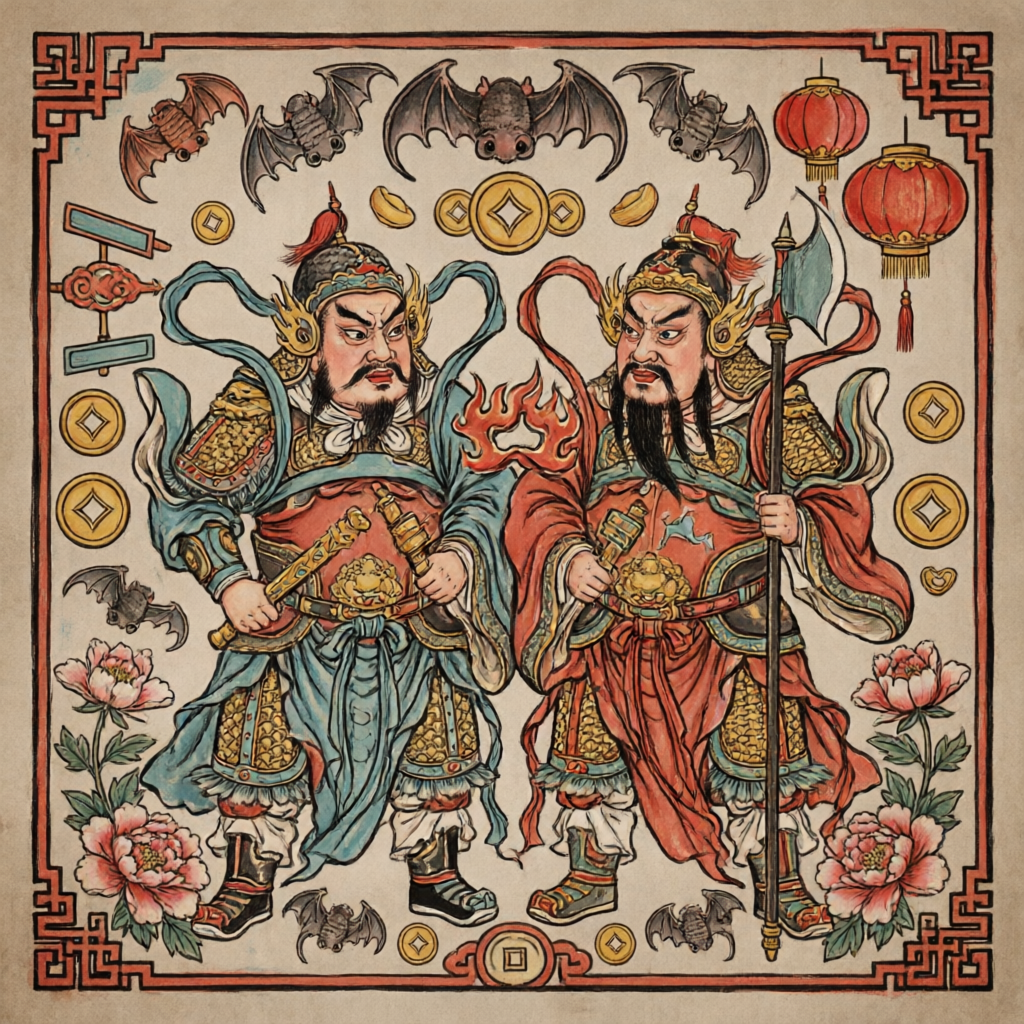
Nianhua: Chinese Woodblock New Year Pictures
Overview
Nianhua (木版年画), literally "New Year pictures," are a traditional form of Chinese folk art that has flourished for over a thousand years. These woodblock prints serve as decorative elements during the New Year and other important festivals, reflecting Chinese cultural values, beliefs, and aesthetic preferences. Recognized as an important element of intangible cultural heritage, Nianhua represents the fusion of artistic expression with popular culture and religious beliefs in traditional Chinese society.
History
The origins of Nianhua can be traced to the Han Dynasty (206 BCE-220 CE), when early forms of door gods ("Shoumen Jiangjun" or "Guardian Generals") began appearing. The development of Buddhist sutra woodblock printing and the maturation of engraving techniques during the Tang Dynasty (618-907 CE), along with the rise of urban culture during the Song Dynasty (960-1279 CE), greatly contributed to the prosperity of Nianhua.
During the Northern Song Dynasty, specialized markets for selling Nianhua, known as "huashier" (画纸儿), emerged. Bianliang (modern-day Kaifeng), as the political, economic, and cultural center of the empire, became a hub for Nianhua production. With the maturity of woodblock printing technology, printed Nianhua gradually replaced hand-painted door god pictures. Both government-run and private workshops thrived, numbering over three hundred during this period. The "Four Beauties" (Simei Tu) from the Song-Jin period represents one of the earliest surviving examples of exquisite woodblock prints.
The term "Nianhua" was formally recorded in the 19th century during the Daoguang era (1821-1850) in Li Guangting's book "Xiangyan Jieyi" (乡言解颐). From then on, "Nianhua" acquired its fixed meaning: woodblock color prints used as annual decorative items for New Year celebrations. By the middle and late Qing Dynasty, folk Nianhua reached its peak of development.
Key Information
| Category | Details |
|---|---|
| Chinese Name | 木版年画 (Mùbǎn Niánhuà) |
| Classification | Art (民间艺术, Folk Art) |
| Region | China |
| Notable Production Areas | Kaifeng, Linfen, Liaocheng, Chongqing Liangping, Tianjin Yangliuqing, Hebei Wuqiang, Shandong Weifang, Suzhou Taohuawu, Henan Zhuxianzhen, Sichuan Mianzhu |
| Intangible Cultural Heritage Status | Listed in 2008 (Item VII-65) |
| Current Status | 18 projects listed as national-level intangible cultural heritage, with 19 protection units and 20 national-level inheritors |
Cultural Significance
Nianhua draws its subjects from all aspects of secular social life. According to statistics by Mr. Wang Shucun, there are over 2,000 different themes of Nianhua, including historical stories, myths and legends, secular life, scenic spots, current events, satirical admonitions, beauties and children, flowers, birds, insects, and fish, as well as auspicious and celebratory themes.
The content of Nianhua encompasses a wide range of subjects: praising wise rulers and virtuous officials, criticizing incompetent rulers and treacherous ministers, promoting cause and effect, teaching filial piety, depicting heroes rescuing others, telling historical stories, illustrating literary works, showing folk customs, depicting opera scenes, and representing various social classes and professions.
Nianhua can be categorized into several types:
-
Xi Hua (喜画): Celebratory pictures for newlyweds, such as "Qilin Songzi" (麒麟送子, Kylin Bringing Offspring), "Longfeng Chengxiang" (龙凤呈祥, Dragon and Phoenix Auspiciousness), and "Zisun Wandai" (子孙万代, Generations of Descendants).
-
Fuzhou Qingshou Hua (祝福庆寿画): Pictures celebrating business openings and auspicious occasions, such as "Lishi Xianguan" (利市仙官, Deity of Prosperity) and "Baishou Tu" (百寿图, Hundred Longevity Diagram).
-
Hangye Zushi Xiang (行业祖师像): Images of founding ancestors of various professions used in ceremonies, such as "Yaowang Sun Simiao" (药王孙思邈, Medical Sage Sun Simiao) and "Wu Daizi" (吴道子, Painter Wu Daozi).
-
Shanmian Hua (扇面画): Woodblock prints for fans, supplementary products during the summer off-season for Nianhua production.
-
Xihu Jing and Zhang Hua (西湖景和丈画): Scenic pictures ("Xihu Jing" or "Layangpian" - peep box pictures) and large horizontal scrolls for teahouses and taverns, often featuring historical and operatic stories.
-
Dengping Hua (灯屏画): Pictures pasted on lanterns, often featuring historical stories and opera scenes, sometimes combined with riddles.
-
Wanju Boxi Lei (玩具博戏类): Decorative elements for games such as chessboards, playing cards, spinning lanterns, and kites.
-
Qita Zahua (其他杂画): Various decorative pictures for seasonal festivals, such as "Jiujiu Xiaohan Tu" (九九消寒图, Nine-Nine Cold Relief Chart) for winter solstice, "Zhong Kui Da Gui Tu" (钟魁打鬼图, Zhong Kui Fighting Ghosts) for Dragon Boat Festival, and "Yueguang Mo" (月光祃, Moon Deity) for Mid-Autumn Festival.
Artistic Styles
Nianhua styles vary significantly by region, reflecting local cultural characteristics and artistic preferences:
-
Yangliuqing Nianhua (Tianjin): Features both imperial and popular tastes, characterized by fine craftsmanship, soft colors, and meticulous hand-painting of faces and hands (known as "kaishoulian").
-
Weifang and Wuqiang Nianhua (Shandong/Hebei): Display a rugged and simple style with strong rural flavor.
-
Liangping Nianhua (Chongqing): Features lively forms, strong color contrasts, and a vibrant sense of life.
-
Taohuawu Nianhua (Suzhou): Known for its delicate and refined craftsmanship.
-
Zhuxianzhen Nianhua (Henan): Exhibits a primitive and simple style, representing the oldest form of Nianhua in China.
-
Mianzhu Nianhua (Sichuan): Displays bold brushwork and rich, vibrant colors.
-
Zhangzhou and Foshan Nianhua (Fujang/Guangdong): Feature strong regional characteristics, often with red and black backgrounds, and diverse religious and divine imagery.
The formation of each artistic style is influenced by environmental and social factors. For example, Yangliuqing Nianhua flourished during the Ming and Qing dynasties, reaching its peak in the late Qing period. Its proximity to Beijing led to the production of refined works for both imperial households and common citizens. The famous "Green Clouds Flowing Stream Door Gods" represents a masterpiece of this style.
Modern Status
Traditional Nianhua faces challenges in contemporary society as changing customs and modernization have created a situation of endangerment. Machine-printed pictures have largely replaced handcrafted woodblock Nianhua, and changes in residential architecture have diminished their traditional application spaces. Today, Nianhua survives mainly in workshops in areas like Tianjin Yangliuqing, Hebei Wuqiang, Shandong Weifang, Henan Zhuxianzhen, Sichuan Mianzhu, Shaanxi Fengxiang, Fujian Zhangzhou, Guangdong Foshan, and Hunan Tantou.
The Chinese government has initiated the "Chinese National Folk Culture Protection Project," which includes traditional woodblock Nianhua as an object of rescue and protection. As of October 2019, 18 Nianhua projects have been listed as national-level intangible cultural heritage items, with 19 protection units and 20 national-level inheritors identified. The central government has invested over 40 million yuan in the protection and inheritance of Nianhua over the past decade.
Xia Wanqun, Vice Chairman of the China Folk Literature and Art Association, notes that the folk foundation of Nianhua from the agricultural period has disappeared, as people no longer paste these pictures in their homes. Nianhua has transitioned from a practical item to a collectible art form. There is a tension between preserving cultural heritage and adapting to contemporary market demands. The challenge lies in innovating while maintaining traditional artistic styles, cultural connotations, and humanistic values.
Heritage Protection
China has made significant efforts to document and preserve Nianhua traditions. Since 2002, the China Folk Literature and Art Association has launched the "China Folk Cultural Heritage Rescue Project," with Nianhua as a leading project. This initiative has resulted in the publication of 22-volume "Chinese Woodblock Nianhua Collection," 14-volume "Chinese Woodblock Nianhua Inheritors' Oral History Series," and four issues of the "Nianhua Research" journal. The project has also completed the National Social Science Fund major project "Construction of Chinese Woodblock Nianhua Database and Research on Oral History Methodology," resulting in a 300,000-character monograph "Research on Inheritors' Oral History Methodology" and the establishment of the Chinese Woodblock Nianhua Database.
Regional Varieties
China's diverse cultural landscape has given rise to distinct regional varieties of Nianhua:
-
Tantou Nianhua (Hunan): Features opera themes, divided into door gods, auspicious meanings, and opera stories. Known for vibrant colors, exaggerated forms, and unique craftsmanship.
-
Wuqiang Nianhua (Hebei): Primarily features opera themes, with over 230 different operas depicted. Known for its dramatic compositions and bold visual style.
-
Jiangzhou Nianhua (Shanxi): Originated in the Northern Song Dynasty, flourishing in Ming and Qing dynasties. Features exquisite craftsmanship and diverse printing techniques.
-
Pingyang Nianhua (Shanxi): Characterized by bold colors, exaggerated forms, and strong decorative qualities. Features local opera themes from Puxi Opera.
-
Taiwan Nianhua: Absorbed techniques from southern Fujian since the Qing Dynasty, featuring diverse styles influenced by both Quanzhou and Zhangzhou traditions.
-
Yangliuqing Nianhua (Tianjin): Known for fine line engraving and brilliant coloring. Features both colored prints and ink-line prints, with various formats including single scenes and continuous narratives.
-
Zhangzhou Nianhua (Fujian): Popular during Ming and Qing dynasties, featuring diverse subjects including disaster prevention, auspicious wishes, historical stories, and decorative patterns.
-
Foshan Nianhua (Guangdong): Flourished during the Qianlong and Jiaqing periods of the Qing Dynasty. Divided into three types by technique and three by subject matter.
-
Liangping Nianhua (Chongqing): One of the "Three Treasures of Liangping" (竹帘、年画、灯戏). Features three main categories: door gods, mythological tales, and opera stories.
References
[1] Wang, Shucun. (2005). Chinese Folk Woodblock New Year Pictures. Beijing: China Arts and Crafts Publishing House.
[2] Feng, Jicai. (2010). The History and Culture of Chinese New Year Pictures. Tianjin: Nankai University Press.
[3] Jiang, Liangyan. (2018). Intangible Cultural Heritage in China: Woodblock Nianhua. Shanghai: Shanghai People's Publishing House.
[4] Ministry of Culture and Tourism of the People's Republic of China. (2019). National Intangible Cultural Heritage Protection Work Report. Beijing: China Cultural Relics Publishing House.
[5] Xia, Wanqun. (2017). "The Contemporary Transformation of Chinese Nianhua." Journal of Folklore Studies, 34(2), 45-62.
[6] China Folk Literature and Art Association. (2015). "Report on the International Forum on Chinese Woodblock Nianhua and New Year Culture." Folk Art Research, 12(4), 78-92.
[7] Li, Songling. (2013). Regional Varieties of Chinese Woodblock Nianhua. Beijing: China Social Sciences Press.
[8] Editorial Committee of Chinese Woodblock Nianhua Collection. (2010-2015). Chinese Woodblock Nianhua Collection. Beijing: Zhonghua Book Company.
[9] Zhang, Zhengshu. (2016). The Art of Chinese Woodblock Printing. Beijing: Cultural Relics Publishing House.
[10] Editorial Committee of Chinese Woodblock Nianhua Collection. (2010). Chinese Woodblock Nianhua Collection: Tantou Volume. Beijing: Zhonghua Book Company.
[11] Editorial Committee of Chinese Woodblock Nianhua Collection. (2009). Chinese Woodblock Nianhua Collection: Wuqiang Volume. Beijing: Zhonghua Book Company.
[12] Editorial Committee of Chinese Woodblock Nianhua Collection. (2010). Chinese Woodblock Nianhua Collection: Jiangzhou Volume. Beijing: Zhonghua Book Company.
[13] Editorial Committee of Chinese Woodblock Nianhua Collection. (2011). Chinese Woodblock Nianhua Collection: Pingyang Volume. Beijing: Zhonghua Book Company.
[14] Editorial Committee of Chinese Woodblock Nianhua Collection. (2012). Chinese Woodblock Nianhua Collection: Taiwan Volume. Beijing: Zhonghua Book Company.
[15] Editorial Committee of Chinese Woodblock Nianhua Collection. (2008). Chinese Woodblock Nianhua Collection: Yangliuqing Volume. Beijing: Zhonghua Book Company.
[16] Editorial Committee of Chinese Woodblock Nianhua Collection. (2013). Chinese Woodblock Nianhua Collection: Zhangzhou Volume. Beijing: Zhonghua Book Company.
[17] Editorial Committee of Chinese Woodblock Nianhua Collection. (2014). Chinese Woodblock Nianhua Collection: Foshan Volume. Beijing: Zhonghua Book Company.
[18] Editorial Committee of Chinese Woodblock Nianhua Collection. (2015). Chinese Woodblock Nianhua Collection: Liangping Volume. Beijing: Zhonghua Book Company.