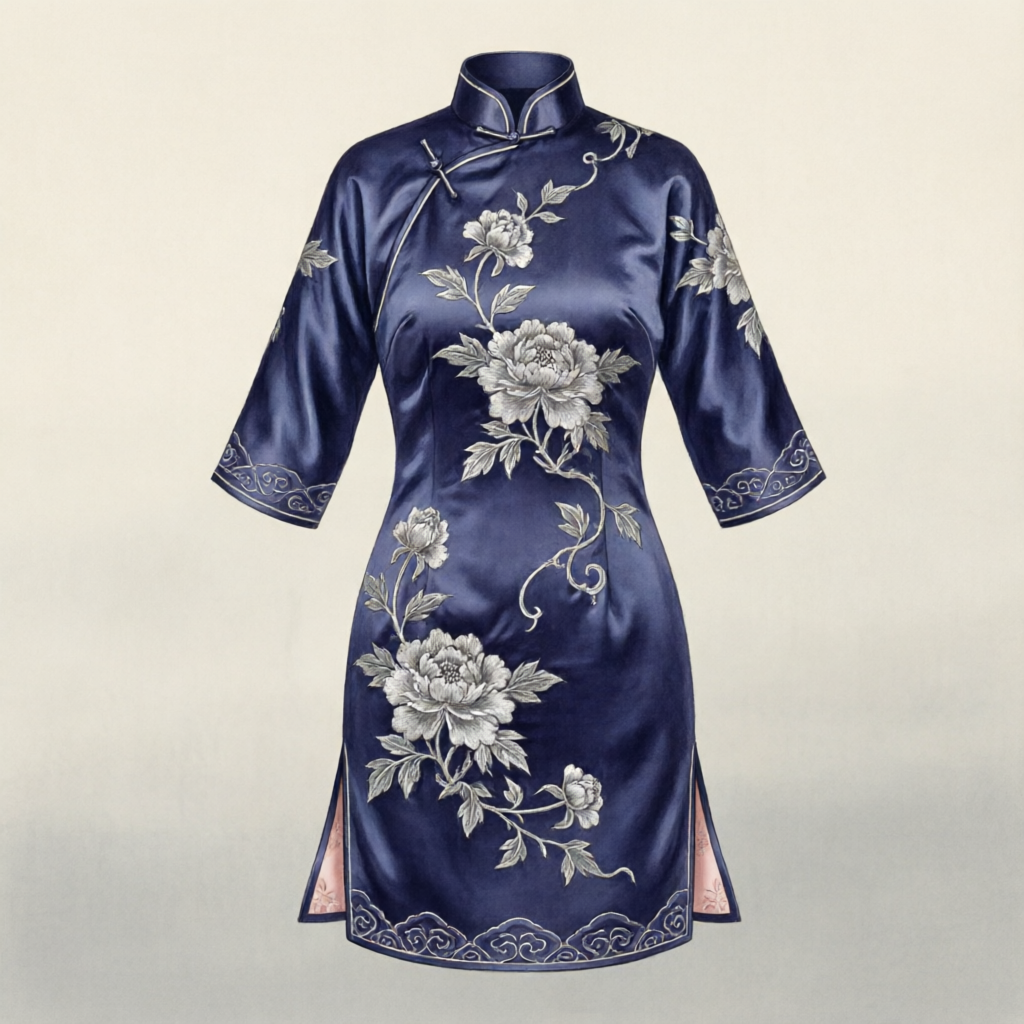
Cheongsam
Overview
The cheongsam, also known as qipao (旗袍), is a form-fitting Chinese dress that has become one of the most recognizable representations of Chinese fashion. This elegant garment features a high collar, side slits, and close-fitting design that accentuates the wearer's figure. While often associated with traditional Chinese culture, the cheongsam as we know it today actually emerged during the 1920s in Shanghai, undergoing significant evolution throughout the 20th century. The garment represents a fascinating blend of Chinese and Western influences, reflecting the social changes occurring in China during the Republican period and beyond.
History
Origins and Development
The cheongsam's origins are a subject of academic debate, with several theories regarding its development. While the name "cheongsam" literally translates to "long gown" and may suggest connections to Manchu banner women's robes (旗装) from the Qing Dynasty, most scholars agree that the modern form of the garment emerged during the 1920s in Shanghai.
According to historical records, the term "cheongsam" first appeared in 1918 in the embroidery manual "Xueyi Shupu" by Shen Shou, where it referred to a specific type of embroidered garment. However, the modern form of the dress began to take shape in the mid-1920s, with newspapers like "Shun Pao" documenting its emergence in 1925.
Qing Dynasty Banner Women's Robes
During the Qing Dynasty, Manchu women wore traditional banner robes (旗装) which differed significantly from the modern cheongsam. These early garments featured straight cuts that concealed the body's curves, with loose-fitting silhouettes, no side slits, and elaborate decorative trimmings at the collar, cuffs, and front openings. The color yellow was reserved for royalty, while commoners used vibrant contrasting colors and intricate embroidery featuring dragons, phoenixes, and other auspicious motifs.
Republican Era Evolution
The 1920s marked a significant transformation in Chinese women's fashion as Western influences began to penetrate Chinese society. Shanghai, as a cosmopolitan hub, became the center of this fashion revolution. The early cheongsam retained some elements of traditional Chinese clothing but incorporated Western tailoring techniques to create a more form-fitting silhouette.
By the 1930s and 1940s, the cheongsam had evolved into its most iconic form, often called the "golden age" of the garment. This version featured a slim, elongated silhouette that aligned with contemporary European fashion trends. Designers began incorporating Western elements such as V-necks, puffed sleeves, and different opening styles while maintaining traditional Chinese features like the mandarin collar and frog buttons.
Post-1949 Developments
After the establishment of the People's Republic of China in 1949, the cheongsam experienced a decline in popularity as Western-style clothing became more prevalent. During the Cultural Revolution (1966-1976), the garment was criticized as a symbol of "feudalism" and "bourgeois decadence," with public figures like Wang Guangmei being criticized for wearing it.
However, the cheongsam experienced a revival in the 1980s with China's opening up. In 1984, it was designated as formal attire for Chinese female diplomats. Since then, it has been featured in international events, including the 1990 Asian Games in Beijing, and has been recognized as an important part of China's cultural heritage.
Modern Status
In contemporary China, the cheongsam has multiple roles. It serves as formal wear for diplomatic occasions, traditional festival celebrations, and special events. In 2011, the traditional craftsmanship of cheongsam making was inscribed on China's national intangible cultural heritage list.
Modern interpretations of the cheongsam have emerged under the "New Chinese Style" (新中式) movement, which blends traditional elements with contemporary design. These versions often feature updated fabrics, simplified embroidery, and adaptations for everyday wear while maintaining the garment's essential characteristics.
Key Information
| Feature | Traditional Qing Robes | Early Republican Cheongsam | Golden Age Cheongsam | Modern Cheongsam |
|---|---|---|---|---|
| Silhouette | Loose, straight | Transitioning to form-fitting | Slim, body-hugging | Varies from traditional to contemporary |
| Side Slits | None | Low, gradually rising | High | Variable |
| Collar | Stand collar (盘领) | Mandarin collar (立领) | Mandarin collar | Mandarin collar or variations |
| Sleeves | Wide, straight | Various styles | Short to sleeveless | Various styles |
| Length | Full length | Variable | Floor-length to above knee | Variable |
| Fabric | Silk, brocade | Silk, cotton | Silk, velvet | Various modern fabrics |
Cultural Significance
The cheongsam holds significant cultural meaning in China and beyond. It represents the evolution of Chinese fashion and reflects changing social attitudes toward women's bodies and roles. During the Republican era, the adoption of the cheongsam by educated women symbolized modernity and liberation from traditional restrictive clothing.
In Hong Kong and some Chinese regions, the cheongsam continues to be worn as school uniforms, particularly for girls. Several schools in Guangzhou have adopted cheongsam-style uniforms, connecting students to cultural heritage.
Interestingly, in recent years, cheongsam has gained new meaning as a symbol of academic success. Parents and teachers wear cheongsams during important examinations as a pun on "旗开得胜" (qí kāi dé shèng), meaning "to win victory as soon as the flags are raised." This demonstrates how traditional garments can acquire contemporary cultural significance.
Modern Status
Today, the cheongsam occupies a unique position in global fashion. It is recognized internationally as a symbol of Chinese cultural identity while continuing to evolve with contemporary aesthetics. Designers both in China and abroad create modern interpretations that maintain traditional elements while adapting to contemporary tastes.
The garment has also become a subject of academic study, with scholars examining its historical development, cultural significance, and role in gender representation. Museums and cultural institutions frequently feature cheongsams in exhibitions on Chinese fashion and design.
In popular culture, the cheongsam continues to appear in films, television shows, and fashion media, often used to evoke a sense of exoticism or historical authenticity. However, contemporary discussions also address issues of cultural appropriation and the importance of understanding the garment's historical context.
References
-
Zhou, X. (1996). History of Ancient Chinese Costume. Shanghai: Shanghai People's Publishing House.
-
Bian, X. (2006). "On the Popular Origin of the Cheongsam." Journal of Fashion Culture, 3(2), 45-67.
-
Wang, Y. (2005). A Study of Women's Robes Throughout Chinese History. Taipei: National Palace Museum Publishing.
-
Yuan, J. (2000). Chinese Cheongsam. Beijing: China Textile & Apparel Press.
-
Gao, Q. (2012). "The Cheongsam: Cultural Identity and Modern Fashion." Asian Studies Review, 36(3), 321-338.