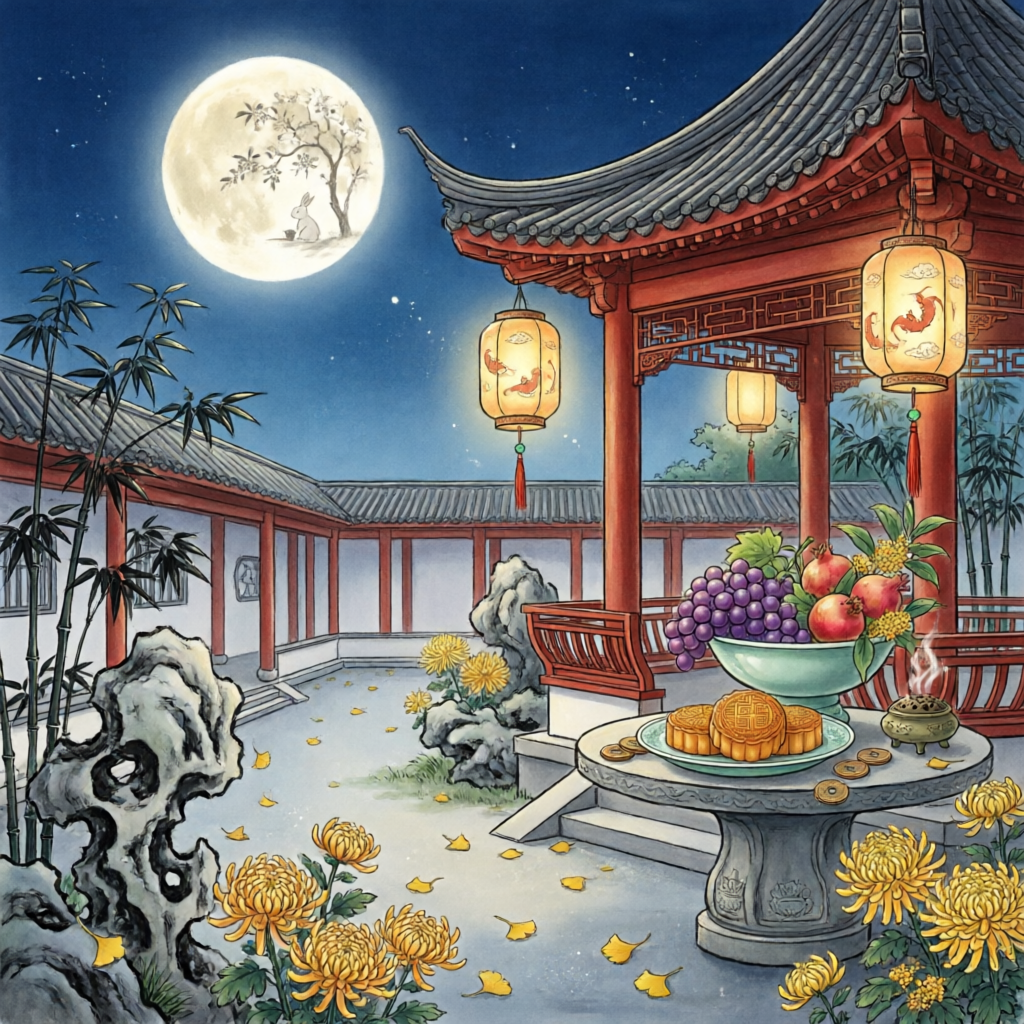
Mid-Autumn Festival
Overview
The Mid-Autumn Festival, also known as the Moon Festival or Mooncake Festival, is one of the most important traditional celebrations in Chinese culture. This festival falls on the 15th day of the eighth month in the Chinese lunar calendar, when the moon is believed to be at its fullest and brightest. The festival has deep cultural significance, symbolizing family reunion, harvest, and prosperity. It is celebrated not only in China but also by many East and Southeast Asian communities worldwide.
History
Early Origins
The Mid-Autumn Festival originated from ancient Chinese moon worship practices. The earliest recorded "Mid-Autumn" (中秋) term appears in the Rites of Zhou (《周礼》), a classic text from the Zhou Dynasty (1046-256 BCE), where it refers to the autumn season rather than a specific festival. The festival's development was influenced by several ancient practices:
-
Moon Worship: Ancient Chinese people worshipped the moon as a symbol of femininity and fertility. The moon deity was often associated with Chang'e, the goddess of the moon.
-
Harvest Celebrations: The eighth lunar month marks the end of the agricultural harvest season, leading to celebrations of abundance.
-
Imperial Rituals: The "Xīyuè" (夕月) ceremony, or "moon sacrifice," was an imperial ritual where the emperor would offer sacrifices to the moon god on the autumnal equinox.
Formation and Development
The festival began to take shape during the Han Dynasty (206 BCE-220 CE), when moon worship became more formalized. Literary works from this period, such as Mei Sheng's "Ode to the Moon" and Fu Yi's "Rhapsody on the Full Moon," reflect growing appreciation for the moon's beauty, though these weren't specifically tied to the eighth lunar month.
During the Tang Dynasty (618-907 CE), the Mid-Autumn Festival became firmly established as a significant cultural event. The imperial court promoted moon-viewing activities, and the festival gained popularity among the literati and common people. The Tang Emperor Xuanzong is said to have held elaborate moon-viewing banquets, and legends about the moon goddess Chang'e and the Jade Rabbit became widely associated with the festival.
Golden Age in Song Dynasty
The Song Dynasty (960-1279 CE) marked a golden age for the Mid-Autumn Festival. In 1071, the festival was officially designated as a national holiday. The celebration became more elaborate and widespread, featuring moon-viewing parties, poetry recitals, and the consumption of special foods. The famous poet Su Shi wrote his masterpiece "Shuidiao Getou" ("Prelude to Water Melody") during the Mid-Autumn Festival, expressing longing for distant family members.
During this period, the concept of "reunion" (团圆) became central to the festival's significance. The round shape of the full moon came to symbolize family completeness and harmony.
Evolution in Ming and Qing Dynasties
During the Ming (1368-1644) and Qing (1644-1912) dynasties, the Mid-Autumn Festival evolved significantly. While moon-viewing remained popular, the emphasis shifted toward family reunions and the consumption of mooncakes. The festival gained additional names reflecting these themes, such as "Reunion Festival" (团圆节) and "Daughter's Festival" (女儿节).
The Ming Dynasty saw the popularization of mooncakes as essential festival food. These round pastries filled with sweet or savory fillings became symbols of family unity and were exchanged as gifts. The Qing Dynasty maintained these traditions while adding regional variations in celebration customs.
Modern Era
In the 20th century, traditional celebrations continued but faced challenges during periods of political upheaval and modernization. However, since the late 1970s, there has been a significant revival of traditional customs. In 2006, the Mid-Autumn Festival was listed as China's first batch of intangible cultural heritage. Since 2008, it has been a statutory public holiday in China.
Key Information
| Aspect | Details |
|---|---|
| Chinese Name | 中秋节 (Zhōngqiū Jié) |
| Alternative Names | Moon Festival, Reunion Festival, Daughter's Festival, Harvest Moon Festival |
| Date | 15th day of the 8th lunar month |
| Cultural Significance | Family reunion, harvest celebration, moon worship |
| Traditional Foods | Mooncakes, pomelos, osmanthus cakes |
| Key Activities | Moon viewing, family gatherings, lantern displays, dragon dances |
| UNESCO Recognition | Intangible Cultural Heritage of China (2006) |
| Regional Names | "Chuseok" in Korea, "Tết Trung Thu" in Vietnam, "Tsukimi" in Japan |
Cultural Significance
Symbolism of Reunion
The Mid-Autumn Festival is deeply associated with family reunion in Chinese culture. The full moon symbolizes completeness and harmony, reflecting the ideal of family members being together. This symbolism is particularly evident in the festival's alternative name, "Reunion Festival" (团圆节). The tradition of married daughters returning to their parents' home for the celebration reinforces this emphasis on family unity.
Moon Worship and Mythology
The festival is rich in lunar mythology, particularly the legend of Chang'e, the Moon Goddess. According to popular legend, Chang'e drank an elixir of immortality and flew to the moon, where she has lived ever since. Another popular tale tells of Wu Gang, an immortal who was condemned to chop down a self-regenerating osmanthus tree on the moon forever. The Jade Rabbit, who pounds medicine in a mortar on the moon, is another prominent figure in Mid-Autumn mythology.
These stories are often depicted in traditional paintings and decorations during the festival, especially on mooncakes and lanterns.
Agricultural Significance
As a harvest festival, the Mid-Autumn Festival celebrates the completion of the autumn harvest. In agricultural societies, this was a time of thanksgiving for the year's bounty. The timing of the festival coincided with the ripening of various crops, particularly pomelos and other fruits that feature prominently in festival foods and offerings.
Modern Status
Contemporary Celebrations
Today, the Mid-Autumn Festival is celebrated with both traditional and modern elements. While family reunions and moon viewing remain central, celebrations have adapted to contemporary lifestyles. In urban areas, public moon-viewing events, lantern displays, and cultural performances are organized. Commercial aspects have also grown, with mooncakes becoming increasingly elaborate and diverse in flavors and designs.
Regional Variations
Different regions of China and other East Asian countries have developed unique celebration customs:
-
China: In southern China, particularly in Guangdong and Hong Kong, lantern displays and dragon dances are prominent. In northern China, eating pomelos and sharing mooncakes with family are central traditions.
-
Hong Kong: The Mid-Autumn Festival features large-scale lantern displays, particularly in Victoria Park, and the "Tai Hang Fire Dragon Dance".
-
Taiwan: The festival includes barbecues, a modern adaptation that has become extremely popular.
-
Korea (Chuseok): A three-day celebration featuring ancestral rites, traditional games, and the consumption of songpyeon (rice cakes).
-
Vietnam (Tết Trung Thu): Features lion dances, lantern processions, and mooncake making for children.
Global Recognition
The Mid-Autumn Festival has gained international recognition as an important cultural celebration of Chinese communities worldwide. Major cities with significant Chinese populations organize public celebrations, including moon-viewing events, cultural performances, and lantern displays. The festival has also been promoted as a cultural tourism attraction in China and other Asian countries.
References
-
Schipper, K. M. (2008). The Chinese Festive Cycle: The Lunar New Year and the Lantern and Ghost Festivals. Singapore: Archipelago Press.
-
Berthier, F. (2008). The Moon in the Water: Understanding Tantric Buddhism. Boston: Shambhala Publications.
-
Yau, C. (2013). Mooncakes and Hungry Ghosts: Festivals of China. Hong Kong: Hong Kong University Press.
-
Zhang, J., & Yung, B. (2008). Chinese Women and Musical Performance: The Kunqu Tradition, 1850-1930. University of Illinois Press.