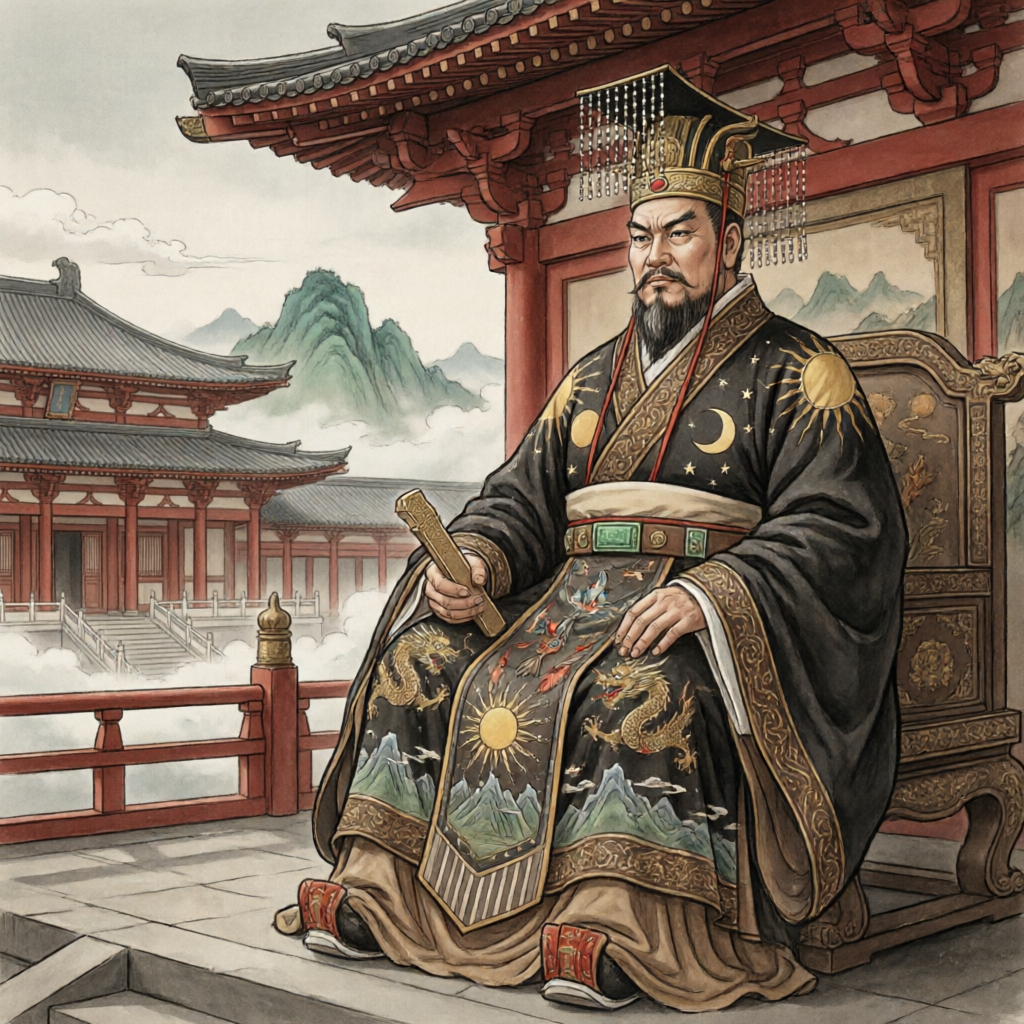
Qin Shi Huang
Overview
Qin Shi Huang (259 BCE – 210 BCE), personal name Ying Zheng, was the founder of the Qin Dynasty and the first emperor to unify China. He ruled from 246 BCE to 210 BCE, having conquered all six rival states to end the Warring States period. Qin Shi Huang is renowned for his unification of China under a centralized bureaucratic system, standardization of currency, weights and measures, and the creation of a vast network of roads and fortifications, including the precursor to the Great Wall of China. His reign marked the beginning of imperial China, which lasted for over two millennia.
History
Early Life in Zhao State
Qin Shi Huang was born in 259 BCE in Handan, the capital of the Zhao state, during the reign of King Zhaoxiang of Qin. His father was Zichu (later King Zhuangxiang of Qin), who was then a hostage in Zhao. Zichu's mother was Lady Zhao, a concubine belonging to the merchant Lü Buwei. At the time, Qin and Zhao were frequently at war, making Zichu's position precarious. Lü Buwei, recognizing Zichu's potential as a valuable political asset, invested in him and helped him return to Qin to eventually become king.
In 257 BCE, when Qin troops besieged Handan, Zichu managed to escape back to Qin with Lü Buwei's assistance. Lady Zhao and the young Ying Zheng remained in Handan but were eventually allowed to join Zichu in Qin after he ascended the throne as King Zhuangxiang in 250 BCE. At the age of 13, Ying Zheng became king of Qin following his father's death in 247 BCE.
Rise to Power
During Ying Zheng's minority, Lü Buwei served as regent and chancellor, wielding significant political influence. Lü Buwei maintained an intimate relationship with Ying Zheng's mother, Lady Zhao, which eventually led to complications. When Ying Zheng reached adulthood, Lü Buwei introduced Lao Ai, a man disguised as a eunuch, to Lady Zhao to serve as her lover.
As Ying Zheng consolidated power, he discovered Lao Ai's relationship with his mother and Lao Ai's subsequent rebellion. In 238 BCE, Lao Ai attempted a coup but was defeated and executed in a brutal manner. Ying Zheng then exiled Lü Buwei to Shu province, where Lü Buwei later committed suicide. These events solidified Ying Zheng's control over the Qin state.
Conquest of the Six Kingdoms
By 230 BCE, Ying Zheng began a systematic campaign to conquer the remaining six states of China. The conquest occurred in the following order:
- 230 BCE: Qin conquered Han, establishing Yingchuan Commandery
- 228 BCE: Qin conquered Zhao, establishing Dai Commandery
- 225 BCE: Qin conquered Wei by flooding Daliang (modern Kaifeng)
- 223 BCE: Qin conquered Chu, establishing Jiangnan and Kuaiji commanderies
- 222 BCE: Qin conquered Yan, establishing Liaodong Commandery
- 221 BCE: Qin conquered Qi, establishing Qi and Langya commanderies
In 221 BCE, after completing the conquest, Ying Zheng proclaimed himself "Shi Huangdi" (First Emperor), establishing the Qin Dynasty and ending the feudal system of the Zhou Dynasty.
Imperial Reforms
As emperor, Qin Shi Huang implemented numerous reforms to consolidate his rule and unify China:
-
Centralized Administration: He abolished the feudal system and replaced it with a centralized bureaucracy based on commanderies and counties.
-
Standardization: He standardized Chinese script, currency (banliang coins), weights and measures, and axle widths for carts.
-
Legalist Policies: He continued the Legalist policies of his predecessors, emphasizing strict laws and punishments.
-
Great Wall: He connected and extended existing fortifications to create the first Great Wall of China.
-
Infrastructure: He constructed a vast network of roads, including the "Straight Road" (Zhidao) connecting the capital to the empire's farthest reaches.
Later Reign and Death
In his later years, Qin Shi Huang became increasingly obsessed with achieving immortality. He made several journeys to the eastern coast seeking the elixir of life, employing numerous alchemists and magicians. In 210 BCE, during one such journey, he fell ill and died at the Shaqiu Palace (modern Guangzong County, Hebei Province).
His death was kept secret during the return journey to the capital, with carts carrying rotten fish to mask the odor of his decomposing body. A conspiracy orchestrated by his chief eunuch Zhao Gao and his youngest son Huhai resulted in the forged deathbed decree that ordered his eldest son Fusu and general Meng Tian to commit suicide. Huhai then ascended the throne as Qin Er Shi.
Key Information
| Aspect | Details |
|---|---|
| Personal Name | Ying Zheng (嬴政) |
| Alternative Names | Zheng of Zhao (赵政), Zheng (正) |
| Birth Name | Zheng (政) |
| Born | January 259 BCE in Handan, Zhao state |
| Died | July 210 BCE at Shaqiu Palace, Hebei |
| Predecessor | King Zhuangxiang of Qin (his father) |
| Successor | Qin Er Shi (Huhai, his second son) |
| Reign | 246 BCE – 210 BCE (as king); 221 BCE – 210 BCE (as emperor) |
| Tomb | Mausoleum of the First Emperor (near modern Xi'an) |
| Ethnicity | Huaxia (Han Chinese) |
| Major Achievements | Unification of China, standardization of writing, currency, and measurements, construction of early Great Wall |
Cultural Significance
Qin Shi Huang's legacy is complex and controversial. On one hand, he is credited with unifying China and establishing many of the institutions that would define Chinese imperial governance for over two millennia. His standardization of writing, currency, and measurements created a unified cultural and economic foundation for China.
On the other hand, his reign was marked by extreme authoritarianism, suppression of intellectual dissent (including the burning of books and burying of scholars), and massive forced labor projects that cost countless lives. The Qin Dynasty collapsed shortly after his death due to its harsh policies and the rebellion it provoked.
In popular culture, Qin Shi Huang is often portrayed as both a unifier and a tyrant. The 2002 film "Hero" and the 2008 film "The Mummy: Tomb of the Dragon Emperor" explore different aspects of his legend. His terracotta army, discovered in 1974 near his tomb, has become one of the world's most significant archaeological finds and a symbol of China's ancient civilization.
Modern Status
Today, Qin Shi Huang remains a figure of immense historical importance in China. His tomb, though largely unexcavated due to preservation concerns, is a UNESCO World Heritage site. The terracotta army continues to be a major tourist attraction and subject of ongoing archaeological research.
Historical assessment of Qin Shi Huang varies. Traditional Chinese historiography often emphasized his tyrannical aspects, while modern scholarship acknowledges both his unification achievements and the brutal methods he employed. In recent decades, there has been some reassessment of his legacy, with increased recognition of the administrative and cultural standardization that occurred during his reign.
The Chinese government has used elements of Qin Shi Huang's legacy in various ways, sometimes emphasizing the unification of China and at other times downplaying the more authoritarian aspects of his rule. His name remains synonymous with both imperial power and the complexities of China's imperial past.
References
-
Knapp, Keith N. Ancient China: A History. Oxford University Press, 2020.
-
Lewis, Mark Edward. The Early Chinese Empires: Qin and Han. Belknap Press, 2007.
-
Pines, Yuri. The Everlasting Empire: Traditional Chinese Political Culture and Its Enduring Legacy. Princeton University Press, 2012.
-
Bodde, Derk. China's First Unifier: A Study of the Chin Dynasty as Seen in the Life of Li Ssu (280-208 B.C.). Wayne State University Press, 1967.
-
Yap, Joseph P. Wars With the Xiongnu: A Translation from Zizhi Tongjian. AuthorHouse, 2009.