Overview
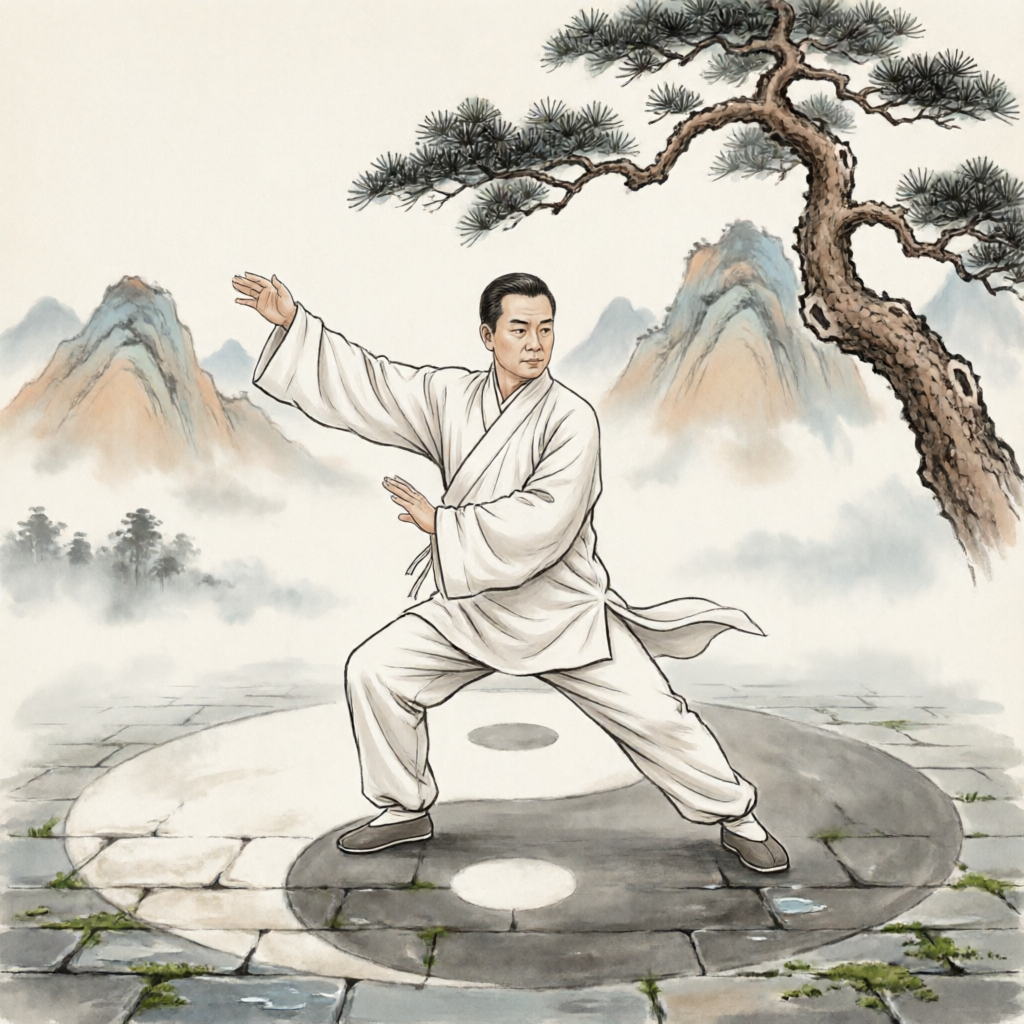
Tai Chi Chuan, often shortened to Tai Chi, is a traditional Chinese martial art practiced for both defense and health benefits. The art combines martial arts techniques with Qigong (breathing exercises), promoting the flow of qi (vital energy) throughout the body. It is characterized by slow, deliberate movements and postures that flow into one another seamlessly, forming a continuous sequence known as a "form." Tai Chi is practiced worldwide for its health benefits, stress reduction, and meditation qualities.
History
Name Origin
The name "Tai Chi Chuan" derives from Chinese philosophy, particularly the concepts of "yin" and "yang" and "Tai Chi" (the Great Ultimate). The term "Tai Chi" originates from the I Ching (Book of Changes): "The I Ching has Tai Chi, which produced the two primary forces" ("易有太极,是生两仪"). "Tai" means "great" or "supreme," while "Chi" refers to the "ultimate" or "pole." During the Song Dynasty, Zhou Dunyi wrote in his "Tai Chi Tu Shuo" ("Explanation of the Tai Chi Diagram"): "From Wuji comes Tai Chi," meaning that Tai Chi is the fundamental source of all things in the universe.
The term "Tai Chi Chuan" first appeared in "Tai Chi Chuan Lun" ("Tai Chi Chuan Theory"), attributed to Wang Zongyue. According to historical records, this text was discovered by Wu Qinghua, a county magistrate in Henan province, around 1852. However, the existence of Wang Zongyue himself remains debated among researchers, with some suggesting the text might have been written by Wu Yuxiang under a pseudonym.
Founding Origins
The exact origins of Tai Chi Chuan remain uncertain, with several theories regarding its creation:
-
Cheng Lingxi (Liang Dynasty): A martial artist from the Liang Dynasty (502-554 CE), whose "Xiao Jiu Tian" ("Little Nine Heavens") style contained movements similar to modern Tai Chi.
-
Xu Xuanping (Tang Dynasty): A practitioner from the Tang Dynasty who taught a 37-posture routine that later expanded to 42 postures, with techniques similar to modern Tai Chi.
-
Li Daozi (Tang Dynasty): A native of Anqing who practiced "Xiantian Quan" ("Pre-Heaven Boxing"), also known as "Chang Quan" ("Long Boxing").
-
Hu Jingzi (Tang Dynasty): Transmitted techniques that were later renamed "Houtian Fa" ("Post-Heaven Method"), emphasizing the "eight techniques" (peng, lu, ji, an, cai, lie, zhou, kao).
-
Zhang Sanfeng: A legendary figure often credited as the founder of Tai Chi. The earliest written reference appears in Huang Zongxi's "Wang Zhengnan's Epitaph" from the late Ming and early Qing dynasties.
-
Chen Wangting (Ming/Qing Dynasty): The most widely accepted theory credits Chen Wangting (1600-1680) of Chen Village in Henan province with creating Tai Chi around 1641. Chen was a military officer who combined various martial arts techniques with principles from traditional Chinese medicine and philosophy to develop a comprehensive martial art system.
Historical Evolution
Despite uncertainties about its origins, the development of Tai Chi since its naming is well-documented. The evolution can be traced through several key periods:
-
Early Period (Late Ming to Early Qing): During Chen Wangting's time, theoretical works like "Quan Jing Ge Ge" ("Song of the Fist Classic") emphasized martial applications. These works already incorporated philosophical concepts like yin-yang and theories from traditional Chinese medicine.
-
Formation of Major Styles (19th Century): By the 19th century, several major styles of Tai Chi emerged:
- Yang Style: Developed by Yang Luchan (1799-1872), who modified Chen style for broader accessibility. His grandson, Yang Chengfu (1883-1936), further developed the large-frame style that became the most widely practiced form.
- Wu Style: Created by Wu Quanyou (1834-1902) and refined by his son Wu Jianquan (1870-1942), featuring compact movements with even speed.
- Wu (Hao) Style: Developed by Wu Yuxiang (1812-1880) and perfected by Li Yishu (1832-1892), emphasizing compact postures and abstract movements based on "opening" and "closing" principles.
- Sun Style: Founded by Sun Lutang (1861-1932), who combined Tai Chi with Xing Yi Quan and Baguazhang, characterized by higher stances and lively footwork.
-
Chen Style: Preserved and spread by Chen Fake (1887-1957), who moved to Beijing in 1928 and helped establish Chen style's popularity.
-
Modern Development (20th Century to Present): Since the 1950s, standardized forms have been developed by the Chinese government to promote Tai Chi's health benefits. These include the 24-form simplified Tai Chi (1956), 32-form Tai Chi sword, 48-form Tai Chi, and various competition routines. In 2006, Tai Chi was recognized as a national intangible cultural heritage in China. In 2020, it was inscribed on UNESCO's Representative List of the Intangible Cultural Heritage of Humanity.
Key Information
| Feature | Description |
|---|---|
| Chinese Name | 太极拳 (Tàijíquán) |
| UNESCO Recognition | 2020 (Intangible Cultural Heritage of Humanity) |
| National Recognition | 2006 (China's first batch of intangible cultural heritage) |
| Major Styles | Chen, Yang, Wu (Hao), Wu, Sun |
| Key Principles | Yin-yang balance, relaxation, mind-body coordination |
| Primary Benefits | Stress reduction, balance improvement, flexibility enhancement |
| Estimated Practitioners | Over 200 million worldwide |
Cultural Significance
Tai Chi holds profound cultural significance in Chinese tradition and beyond. As a martial art that embodies philosophical principles, it represents the integration of physical practice with mental and spiritual cultivation. The practice emphasizes harmony between opposing forces (yin and yang), reflecting core Taoist concepts.
In Chinese culture, Tai Chi is not merely a fighting system but a comprehensive approach to health and well-being. Its slow, meditative movements make it accessible to people of all ages and fitness levels, contributing to its widespread popularity. The art has influenced other practices such as Qigong and various therapeutic exercises.
Modern Status
Today, Tai Chi is practiced globally by millions of people for health, meditation, and self-defense. It has become particularly popular among older adults for its gentle, low-impact nature and proven benefits for balance, flexibility, and cardiovascular health.
Modern Tai Chi has evolved to include standardized forms for competition and health promotion. The Chinese government has actively supported Tai Chi's preservation and development, establishing research institutions and hosting international competitions and exchanges.
In recent years, scientific research has increasingly documented Tai Chi's health benefits, including improved balance, reduced fall risk in older adults, better cardiovascular function, enhanced immune response, and improved psychological well-being. These findings have further boosted Tai Chi's acceptance in Western healthcare systems.
References
-
Wile, D. (1996). Tai Chi's Ancestors: The Making of an Internal Martial Art. Sweetwater Books.
-
Lai, T. (1986). Chen Style Tai Chi Chuan: The Original Forms. North Atlantic Books.
-
Kaptchuk, T. J. (2000). The Web That Has No Weaver: Understanding Chinese Medicine. Contemporary Books.
-
Sun, L. (1999). The Essence of Tai Chi Chuan: The Literary Tradition. North Atlantic Books.
-
Li, X. & Drager, R. D. (2002). Tai Chi Classics. North Atlantic Books.