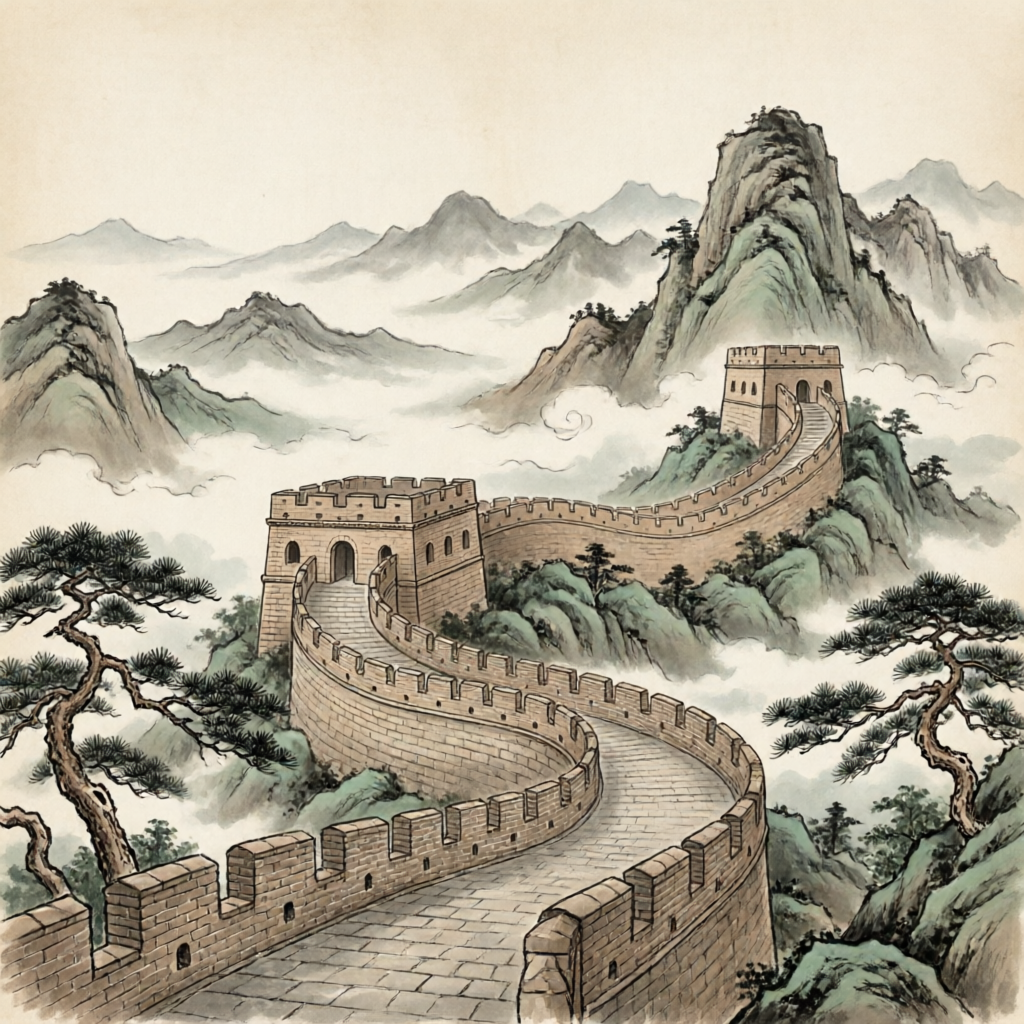
The Great Wall of China
Overview
The Great Wall of China is an ancient fortification system built across the historical northern borders of ancient Chinese states and Imperial China as protection against various nomadic groups. With a history spanning over two millennia, the Wall represents one of the most ambitious architectural feats in human history. It is not a single continuous structure but rather a series of walls, fortifications, and watchtowers built by various dynasties, with the most well-known sections dating from the Ming Dynasty (1368-1644).
History
Early Periods
The construction of defensive walls in China dates back to the Western Zhou Dynasty (1046-771 BCE), when the Zhou built a series of fortifications to protect against northern nomadic attacks. During the Spring and Autumn (771-476 BCE) and Warring States (475-221 BCE) periods, various states constructed defensive walls along their borders.
The earliest recorded wall was the "Chu Fangcheng" (楚方城), built by the state of Chu around the 7th century BCE. Other states including Qi, Han, Wei, Zhao, Yan, and Qin also built defensive walls. These early walls varied in direction and length, typically ranging from several hundred to 1,000-2,000 kilometers. Historians refer to these as "Pre-Qin Great Walls" to distinguish them from later constructions.
Qin Dynasty (221-206 BCE)
After unifying China in 221 BCE, Emperor Qin Shi Huang connected and extended the existing walls to create a unified defense system against northern nomadic groups, particularly the Xiongnu. The Qin Wall extended from Lintao (modern-day Min County in Gansu) in the west to Liaodong in the east, spanning over 10,000 li (approximately 5,000 kilometers). According to historical records, Qin mobilized nearly one million laborers for this project, accounting for one-twentieth of the empire's population at the time.
Han Dynasty (206 BCE-220 CE)
The Han Dynasty constructed the longest section of the Great Wall in Chinese history, extending over 20,000 li (approximately 10,000 kilometers). Emperor Wu of Han (r. 141-87 BCE) expanded the Wall westward to Daxuan (near modern-day Kyrgyzstan) and built an outer wall to further protect against Xiongnu incursions. The Han Wall, also known as the "Sai" or "Saiqiang," extended from the Lob Nor region in Xinjiang to the Yalu River in the northeast, forming a "Y-shaped" defensive system in the Hexi Corridor region.
Sui and Tang Dynasties
The Sui Dynasty (581-618 CE) constructed walls seven times in 28 years, mobilizing nearly 2 million laborers. The Sui Wall extended from the Zi River in the east to Yugang in the west.
Traditionally, it was believed that the Tang Dynasty (618-907 CE) did not build walls, but recent archaeological discoveries have shown that Tang did construct defensive fortifications. However, these were primarily for internal security rather than defense against northern nomads. For example, a wall was built in Shanxi Province to defend against the warlord Liu Wuzhou. In modern-day Heilongjiang Province, remnants of "border walls" from the Bohai Kingdom (698-926 CE) have been discovered, which served similar defensive purposes.
Song, Liao, and Jin Dynasties
The Song Dynasty (960-1279 CE) built walls primarily in northern regions. In Qilan County, Shanxi Province, 38 kilometers of Song-era wall constructed from stone slabs have been discovered. In Ningxia, Song-era wall remnants have been found alongside Qin Dynasty walls, showing the strategic importance of these regions.
The Jin Dynasty (1115-1234 CE) constructed the "Mingchang Boundary" (金长城) beginning in 1192 CE. This wall extended approximately 1,650 kilometers from northeastern Inner Mongolia to Wuchuan County in Inner Mongolia, featuring defensive structures such as moats, watchtowers, and fortified garrisons.
Ming Dynasty (1368-1644 CE)
The Ming Dynasty constructed the most famous and well-preserved sections of the Great Wall. Unlike previous walls, the Ming Wall was primarily built with brick and stone rather than rammed earth. The Ming Wall system included three main components:
- The "Outer Wall" (外边): The main defensive line extending from Jiayuguan in the west to Shanhai Pass in the east.
- The "Inner Wall" (内边): Built on foundations from the Northern Qi Dynasty, running from Pianguan in Shanxi to Juyongguan near Beijing.
- The "Inner Three Passes Wall" (内三关): Parallel to the Inner Wall in some sections.
Ming construction occurred in three phases: early (1368-1447), mid (1448-1566), and late (1567-1620). The mid-phase saw massive construction following the "Tumu Crisis" of 1449, while the late-phase focused on strengthening defenses against the rising Manchu threat in the northeast.
Qing Dynasty (1644-1912 CE)
The Qing Dynasty initially issued an edict against wall construction, but later built extensive defensive systems primarily for internal security rather than external defense. The most notable Qing structure was the "Willow Palisade" (柳条边), a fence constructed with willow branches built between 1638 and 1663 to restrict Han Chinese migration into Manchu territories in northeastern China.
Key Information
| Feature | Details |
|---|---|
| Chinese Name | 长城 (Chángchéng) |
| Location | Northern and central China |
| Construction Period | Multiple periods from Western Zhou (c. 7th century BCE) to Qing Dynasty (1644-1912 CE) |
| Total Length | Over 21,000 kilometers (13,000 miles) of various walls built throughout history |
| Main Construction Materials | Rammed earth, adobe, brick, stone |
| Best-Preserved Sections | Primarily from Ming Dynasty, particularly near Beijing |
| UNESCO Status | World Heritage Site (1987) |
| Notable Features | Watchtowers, fortresses, beacon towers, garrison stations |
Cultural Significance
The Great Wall has become an enduring symbol of Chinese civilization and identity. In Chinese culture, it represents both the nation's ability to undertake massive engineering projects and its historical relationship with northern nomadic groups. The Wall has been featured in numerous works of art, literature, and popular culture, both within China and internationally.
Traditional Chinese literature often portrays the Wall as a symbol of national unity and determination. The famous saying "He who has not been to the Great Wall is not a true man" (不到长城非好汉) reflects its cultural importance. The Wall has also been associated with numerous legends and stories, such as the tale of Meng Jiangnu, whose tears caused a section of the Wall to collapse.
Modern Status
Today, the Great Wall is one of China's most popular tourist destinations and a UNESCO World Heritage Site. The most visited sections include Badaling near Beijing, Mutianyu, and Shanhai Pass. However, many sections of the Wall remain in various states of disrepair due to natural erosion and human activities.
In recent decades, Chinese authorities have implemented conservation efforts to protect the Wall. The Great Wall Protection Regulations were enacted in 2006, and various international collaborations have been established for preservation. Despite these efforts, unauthorized construction, tourism development, and natural factors continue to threaten the Wall's integrity.
References
- Waldron, A. (1990). The Great Wall of China: From History to Myth. Cambridge University Press.
- Lovell, J. (2006). The Great Wall: China against the World, 1000 BC-2000 AD. Atlantic Books.
- Lorge, P. (2008). The Great Wall of China: From History to Myth. Cambridge University Press.
- Yuan, P. (2005). The Great Wall of China: History, Myth, and Archaeology. Yale University Press.