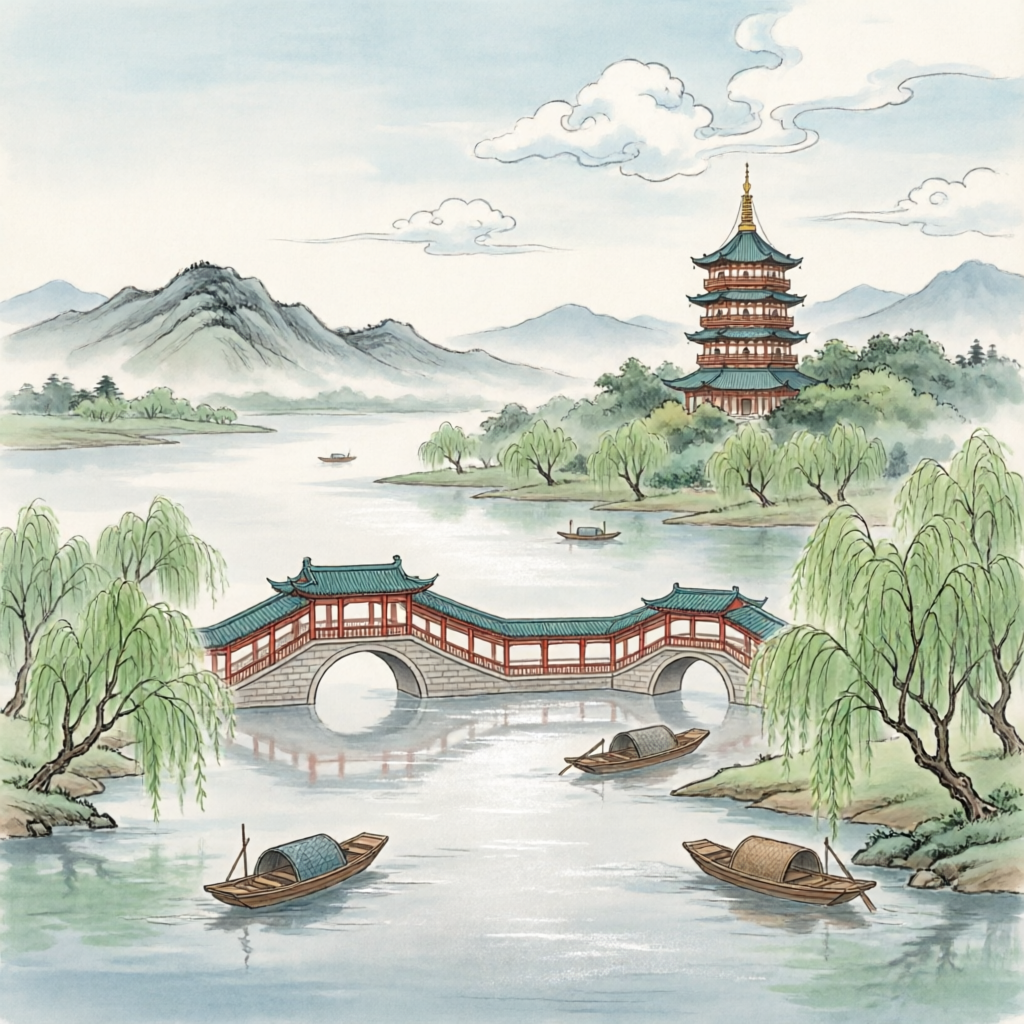
West Lake
Overview
West Lake (西湖, Xī Hú) is a freshwater lake located in the western part of Hangzhou, the capital of Zhejiang province in China. It is renowned for its cultural significance, historical heritage, and natural beauty, making it one of China's most famous tourist destinations. The lake has inspired countless poets, painters, and scholars throughout Chinese history and has been recognized as a UNESCO World Heritage Site since 2011. West Lake covers an area of approximately 6.38 square kilometers with a catchment area of 21.22 square kilometers. The lake is surrounded by hills on three sides (south, west, and north) while facing the city on the east side, creating a harmonious blend of natural and man-made landscapes.
History
The formation of West Lake has been the subject of scientific debate, with three main theories explaining its origin:
Lagoon Formation Theory
In 1921, Chinese scientist Zhu Kezhen conducted detailed field research and proposed that West Lake was originally a lagoon. According to this theory, the lake began as a bay that was gradually separated from the sea by sediment deposition carried by the Qiantang River. This sediment accumulated at two capes (present-day Wushan and Baoshi Mountains) until they connected, isolating the bay from the sea and forming a lagoon. Geological drilling near the lakeshore has revealed marine foraminifera fossils in bluish-gray clay layers found 8-23 meters underground, supporting this theory.
Embankment Formation Theory
This theory suggests that West Lake was originally connected to the sea until it was separated by an artificial embankment. Historical records indicate that during the Eastern Han Dynasty, Hua Xin, a counselor of Qiantang Commandery, recruited residents to build a "seawall defense embankment" to prevent seawater intrusion. This work was so successful that the county seat was moved to the area, which later developed into modern Hangzhou. However, scholars note that if such an embankment existed, it likely functioned as a seawall rather than a dam that created the lake.
Volcanic Eruption Theory
A third theory proposes that West Lake was formed by volcanic eruption and lava flow blocking a bay. The northern and western hills surrounding the lake, including Geling and Baoshi Mountain, consist of rhyolite and tuff—igneous rocks formed from volcanic activity. Geological surveys have identified an ancient volcanic channel on Baoshi Mountain that extends toward the lake, covering an area of about 2,000 square meters. Experts suggest that approximately 130 million years ago, during the Late Jurassic period, a volcanic eruption created a crater that later collapsed into a basin, eventually forming the lakebed of West Lake.
Key Information
| Feature | Details |
|---|---|
| Location | Hangzhou City, Zhejiang Province, China |
| Coordinates | 30°14′45″N, 120°8′30″E |
| Lake Area | 6.38 km² |
| Catchment Area | 21.22 km² |
| Average Depth | 2.27 m |
| Maximum Depth | 5 m |
| Water Volume | 14.29 million m³ |
| Water Sources | Jinsha Stream, Longhong Stream, Chishan Stream, Changqiao Stream, Qiantang River (via water diversion) |
| Outlets | Shengtang Gate, Yongjin Gate |
| Climate | Subtropical monsoon climate |
| Admission | Free (some attractions within the scenic area charge fees) |
| Famous Attractions | Broken Bridge (断桥, Duàn Qiáo) |
Cultural Significance
West Lake has profoundly influenced Chinese culture, literature, and art throughout history. It has been the setting for numerous famous legends, including:
- The Legend of the White Snake (白蛇传, Bái Shé Zhuàn), featuring the "Broken Bridge Meeting" scene and "Lady White Snake suppressed under Leifeng Pagoda"
- The Butterfly Lovers (梁山伯与祝英台, Liáng Shānbó yǔ Zhù Yīngtái)
- The Story of Su Xiaoxiao, a famous courtesan of the Southern Dynasties period
A popular legend explains the lake's formation: the Jade Dragon and Golden Phoenix found a white jade on an immortal island in the Milky Way. After polishing it for years, it became a luminous pearl that made trees evergreen and flowers bloom. When the Mother Goddess discovered the pearl and sent soldiers to seize it, a struggle ensued. During the fight, the pearl fell to Earth, becoming West Lake, while the Jade Dragon and Golden Phoenix transformed into Yuhuang Mountain (Jade Emperor Mountain) and Phoenix Mountain, respectively.
West Lake has inspired countless literary works, particularly poetry. Famous poets who wrote about West Lake include Bai Juyi, Su Shi, Yang Wanli, Ouyang Xiu, Xin Qiji, and Lin Bu. Some of the most celebrated poems about West Lake include:
- Spring Excursion to Qiantang Lake (钱塘湖春行) by Bai Juyi
- Sending Lin Zifang from Jingci Temple at Dawn (晓出净慈寺送林子方) by Yang Wanli
- Drinking on the Lake in Sunny and Rainy Weather (饮湖上初晴后雨) by Su Shi
Modern Status
Today, West Lake is protected as part of the Hangzhou West Lake Scenic Area (杭州西湖风景名胜区), which covers 106 square kilometers and includes numerous cultural and natural attractions. The lake has undergone significant restoration and conservation efforts in recent decades:
- In 1985, a water diversion project from the Qiantang River was initiated to improve water quality
- From 1999 to 2003, a major dredging project was carried out
- In 2001, the West Lake Comprehensive Protection Project was launched, implementing a water diversion and distribution system that allows the lake water to be completely replaced monthly
The lake is home to diverse flora and fauna, with 119 bird species, over 20 mammal species, and 1,369 plant species recorded in the area. Notable plant species include the endangered Zhejiang nanmu (浙江楠) and short-stalked bamboo (短穗竹). The area also contains 620 ancient trees over 100 years old, including 138 trees over 300 years old.
West Lake is divided into several sections by causeways including the Bai Causeway (白堤), Su Causeway (苏堤), Yanggong Causeway (杨公堤), and Zhao Causeway (赵公堤). The lake contains three islands: Three Pools Mirroring the Moon (三潭印月), Mid-lake Pavilion (湖心亭), and Lord Ruan's Mound (阮公墩).
The lake is famous for its "Ten Scenes of West Lake" (西湖十景), "New Ten Scenes of West Lake" (新西湖十景), and "Three Selected Ten Scenes of West Lake" (三评西湖十景), each showcasing different aspects of the lake's beauty throughout the seasons and various weather conditions.
References
-
Needham, J. (1971). Science and Civilisation in China, Volume 4: Physics and Physical Technology, Part 3: Civil Engineering and Nautics. Cambridge University Press.
-
Hangzhou Municipal Government. (2015). West Lake Comprehensive Protection Report. Hangzhou: Hangzhou Publishing House.
-
Zhang, Y. (2018). The Evolution of West Lake: A Geological and Historical Perspective. Journal of Hangzhou Studies, 42(3), 112-128.
-
Li, W., & Chen, X. (2020). Cultural Landscape Conservation and Sustainable Tourism Development at West Lake. Tourism Management Perspectives, 33, 100678.
-
Wang, H. (2019). Poetry and Painting: West Lake in Chinese Literary and Artistic Traditions. Beijing: Chinese Literature and History Press.