Overview
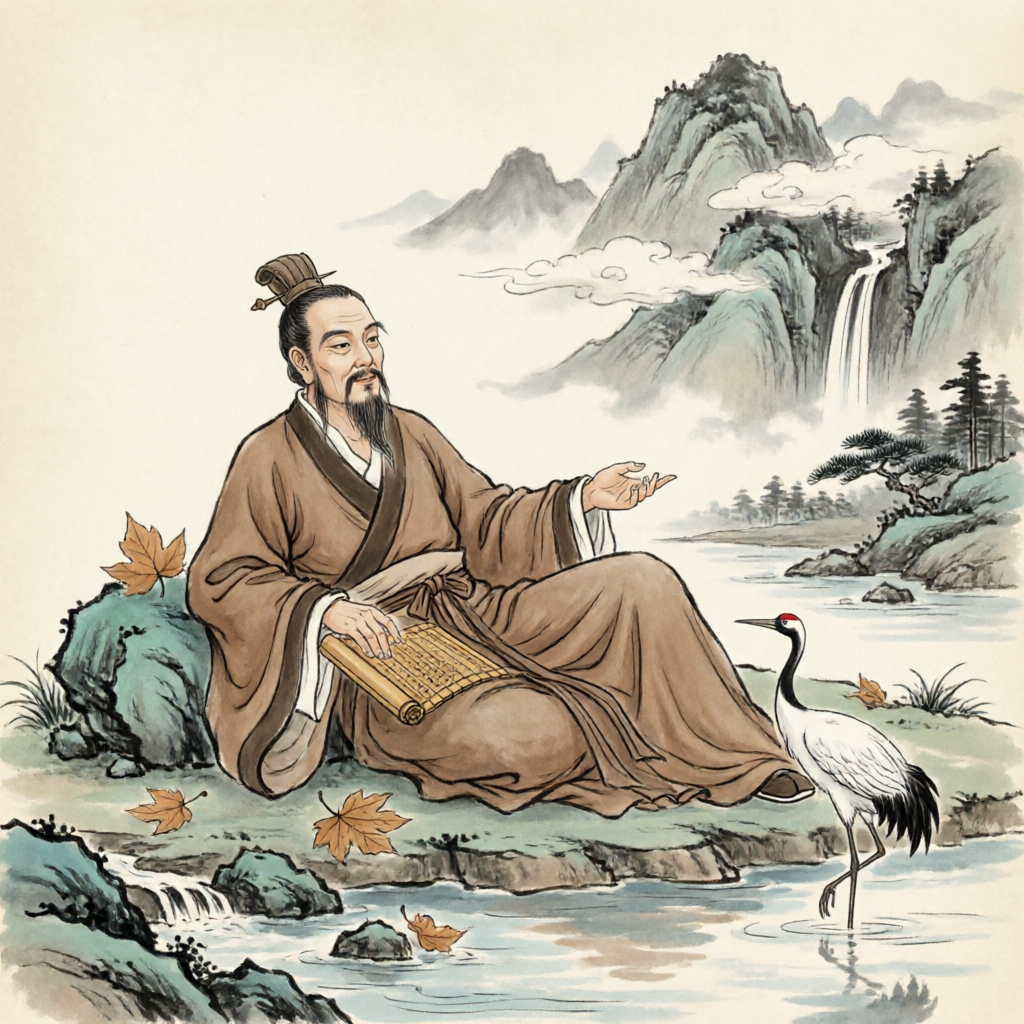
Zhuangzi (circa 369-286 BCE), also known as Zhuang Zhou, was a pivotal Chinese philosopher during the Warring States period who developed and expanded Taoist philosophy. His given name was Zhou, and he was styled Zixiu (also recorded as Zimu). He later became known as "Nanhua Zhenren" (Perfect Man of Nanhua) after being deified in Taoist tradition. Zhuangzi served briefly as an official in the state of Song before withdrawing from public life to pursue a philosophical existence. His magnum opus, the Zhuangzi, stands as one of the foundational texts of Taoist philosophy and a masterpiece of classical Chinese literature.
History
Early Life in Song
Zhuangzi was born around 369 BCE in Mengyi (present-day Dongming County in Shandong Province, though some scholars suggest locations in Henan or Anhui). He lived during the same era as King Hui of Liang and King Xuan of Qi. Historical records about his early life are scarce, with Sima Qian devoting only about 200 words to him in the Records of the Grand Historian (Shiji). The name "Zixiu" was actually added by later Tang dynasty scholars, not found in contemporary records.
Service as an Official
Around 344 BCE, Zhuangzi met his contemporary Hui Shi, who later became chancellor of the state of Wei. When Zhuangzi visited Hui Shi in this position, Hui Shi became fearful, which prompted Zhuangzi to use the parable of the "yuān chú" (a mythical bird) to mock his friend's anxiety about power.
Around 340 BCE, Zhuangzi served as an official in charge of the漆园 (Qiyuan) garden in Meng. In 339 BCE, King Wei of Chu offered Zhuangzi the position of chancellor, which he declined. Around 337 BCE, after a political upheaval in Song, Zhuangzi resigned his official position, likely disillusioned with court politics.
Travels and Later Life
After leaving official life, Zhuangzi traveled extensively, particularly to southern states. In 333 BCE, he may have traveled to Chu and advised against military campaigns against Yue. In 328 BCE, when King Min of Song claimed kingship, someone who had received ten carriages from the king tried to impress Zhuangzi, who mockingly referred to how the person must have "licked hemorrhoids to get carriages."
In 312 BCE, Zhuangzi's wife died. When his disciples prepared an elaborate funeral, Zhuangzi famously beat a basin and sang, arguing that death was a natural transformation of life. In 310 BCE, Hui Shi died, after which Zhuangzi reportedly fell into a deep silence. During his later years, he lived a reclusive life, teaching disciples and writing his philosophical works. He died around 286 BCE at approximately 84 years old.
Key Information
| Aspect | Details |
|---|---|
| Personal Name | Zhou (周) |
| Courtesy Name | Zixiu (子休) or Zimu (子沐) |
| Posthumous Title | Nanhua Zhenren (南华真人) |
| Era | Warring States Period (战国) |
| Ethnicity | Huaxia (华夏族) |
| Birthplace | Mengyi, State of Song (宋国蒙邑) |
| Birth Year | c. 369 BCE |
| Death Year | c. 286 BCE |
| Major Work | Zhuangzi (庄子) |
| Key Philosophical Concepts | Dao (道), Wuwei (无为), Ziran (自然), Xiaoyao (逍遥) |
Cultural Significance
Philosophy
Zhuangzi's philosophy represents a significant development of Laozi's teachings, establishing Taoism as a formal philosophical school. His work explores the nature of the Dao (the Way), emphasizing naturalness (ziran) and spontaneity. Zhuangzi's concept of the Dao differs from Laozi's more objective conception by elevating it to a cosmic spirit that humans can embody.
Central to Zhuangzi's philosophy is the pursuit of individual freedom and liberation from societal constraints. He introduces the concept of "xiaoyao" (carefree wandering) as the ideal state of existence, achieved through practices like "xin zhai" (heart fasting) and "zuo wang" (sitting forgetting). These practices involve transcending conventional distinctions and achieving unity with the Dao.
Zhuangzi's philosophy also incorporates elements of relativism and skepticism. In "Qi Wu Lun" (Equality of Things), he argues that human perspectives are limited and that true understanding requires seeing beyond conventional distinctions. His famous paradox "I know that I know nothing" (吾生也有涯,而知也无涯) reflects this epistemological humility.
Zhuangzi was critical of Confucian and Mohist teachings, particularly their emphasis on rigid moral codes and social hierarchies. He instead proposed a vision of the "Zhi De zhi Shi" (Age of Perfect Virtue), a society governed by natural spontaneity rather than artificial rules.
Literature
The Zhuangzi is not only a philosophical masterpiece but also a literary achievement of the highest order. Written in a distinctive style characterized by rich imagination, vivid imagery, and playful irony, it employs three main rhetorical devices: "yuyan" (parables), "chongyan" (repeated sayings), and "zhiyan" (nonsensical language).
The work's most famous sections include "Xiaoyao You" (Carefree Wandering), "Qi Wu Lun" (Equality of Things), and "Yang Sheng Zhu" (Mastering Life). Among these, the "Butcher Ding" story from "Yang Sheng Zhu" has become one of the most celebrated passages in Chinese literature, illustrating the principle of wuwei (effortless action) through the story of a butcher whose knife never needs sharpening because he follows the natural grain of the ox.
Zhuangzi's literary style profoundly influenced later Chinese literature, particularly the works of writers like Tao Yuanming, Li Bai, Su Shi, and Lu Xun. His free-flowing narrative, rich imagination, and satirical elements created a distinctive tradition that continues to resonate in modern Chinese literature.
Modern Status
Today, Zhuangzi remains one of the most influential philosophers in Chinese history. His ideas continue to shape Chinese thought and culture, particularly in Taoism, which regards him as a foundational figure. In 742 CE, Emperor Xuanzong of Tang posthumously honored Zhuangzi as "Nanhua Zhenren" (Perfect Man of Nanhua), and his work was renamed the Nanhua Zhenjing (Classic of Nanhua).
In academic circles, Zhuangzi is studied both as a philosopher and as a literary figure. His relativist and skeptical ideas have found parallels in Western philosophy, particularly in the works of thinkers like Nietzsche and Wittgenstein. His emphasis on individual freedom and critique of societal conventions also resonates with contemporary existentialist thought.
The Zhuangzi has been translated into numerous languages, making it one of the most widely read Chinese philosophical works internationally. Scholars continue to debate various aspects of his philosophy, including the extent of his influence on later Taoist developments and the precise meaning of key concepts like "wuwei" and "xiaoyao."
References
-
Graham, A.C. (1981). Chuang-tzu: The Seven Inner Chapters and other writings from the book Chuang-tzu. George Allen & Unwin.
-
Mair, Victor H. (1994). Wandering on the Way: Early Taoist Tales and Parables of Chuang Tzu. Bantam Books.
-
Roth, Harold D. (1999). Original Tao: Inward Training (Nei-yeh) and the Foundations of Taoist Mysticism. Columbia University Press.
-
Liu, James J.Y. (1962). The Art of Chinese Poetry. University of Chicago Press.
-
Watson, Burton (1968). The Complete Works of Chuang Tzu. Columbia University Press.