Chinese Martial Arts
Overview
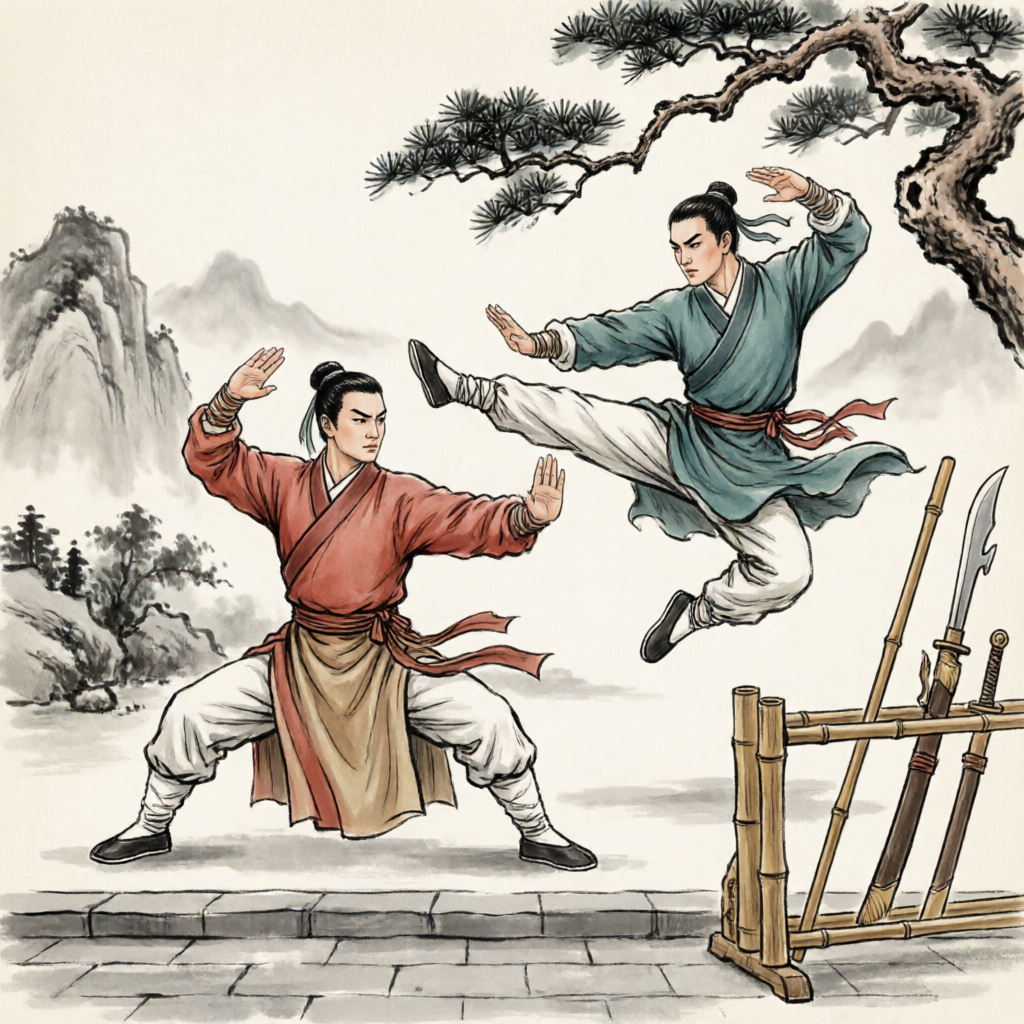
Chinese martial arts, commonly referred to as Wushu (武术) or Kung Fu (功夫), represent a comprehensive system of combat techniques and physical exercises that have evolved over thousands of years. These practices are deeply rooted in Chinese culture, philosophy, and tradition, serving both practical combat purposes and spiritual development. The term "Wushu" translates to "martial art" and embodies the principle of "zhī gē wéi wǔ" (止戈为武), meaning "to stop violence with martial skill." Chinese martial arts encompass a wide variety of styles, including both armed and unarmed combat techniques, and have significantly influenced combat sports and physical fitness practices globally.
History
The origins of Chinese martial arts can be traced back to primitive society, where humans developed basic fighting techniques for survival against both animals and other humans. In this early period, simple striking methods such as punching, kicking, grappling, and the use of primitive stone and wooden weapons emerged as the foundation of martial arts.
During the pre-Qin period (before 221 BCE), various states began formalizing combat techniques, with swordsmanship becoming particularly developed. The Han Dynasty (206 BCE-220 CE) saw the emergence of "Jiaodi" (角抵), a form of wrestling, and the development of iron weapons and organized combat sequences. By the Jin Dynasty (265-420 CE), martial practice had advanced to include oral formulas and techniques, marking the early formation of systematic martial arts.
The Tang Dynasty (618-907 CE) is considered a golden age for Chinese martial arts. Empress Wu Zetian established the martial examination system (武举), which produced many skilled martial artists. The earliest records of Shaolin martial arts also date to this period. During the Song Dynasty (960-1279 CE), martial arts reached maturity, with physical fitness and combat training becoming integral to the lives of scholars and warriors. Martial arts societies (社) began to form, and distinct styles started to emerge.
The Yuan Dynasty (1271-1368 CE) witnessed the establishment of martial arts schools (武馆) focused primarily on teaching combat skills. The Ming (1368-1644 CE) and Qing (1644-1912 CE) periods saw the flourishing of martial arts among common people, with numerous schools and hundreds of forms developing, leading to the establishment of many distinct styles that continue to practice today.
In modern times, traditional Chinese martial arts have faced challenges in the context of cultural globalization. While maintaining their cultural significance, they have also evolved into competitive sports and fitness systems. The Chinese government has actively promoted traditional martial arts as part of cultural preservation and national identity initiatives.
Key Information
| Aspect | Details |
|---|---|
| Chinese Name | 武术 (Wǔshù) |
| Alternative Names | 功夫 (Gōngfu) |
| Category | Traditional Chinese physical discipline |
| Origins | Primitive society, developed through various dynasties |
| Definition | System of combat techniques and physical exercises based on Chinese principles |
| Primary Purpose | Self-defense, physical fitness, and cultural preservation |
| Core Philosophy | "Zhī gē wéi wǔ" - stopping violence through martial skill |
Cultural Significance
Chinese martial arts extend beyond mere combat techniques to embody profound cultural and philosophical elements. The practice emphasizes not only physical skills but also moral development, with "Wude" (武德) - martial virtue - being a central concept. Wude encompasses principles of benevolence, righteousness, propriety, wisdom, and trustworthiness, guiding practitioners toward ethical conduct both in and out of practice.
Martial arts have significantly influenced Chinese literature, film, and performing arts. Traditional Chinese opera incorporates martial arts movements, while modern cinema has popularized martial arts globally through films featuring actors like Bruce Lee, Jackie Chan, and Jet Li. The visual representation of martial arts in media has shaped international perceptions of Chinese culture.
In Chinese society, martial arts serve multiple functions: as a means of self-defense, a path to physical fitness, a method of character building, and a vehicle for transmitting cultural heritage. Many schools incorporate martial arts into their curricula to teach discipline, respect, and perseverance while connecting students with traditional Chinese values.
Modern Status
Contemporary Chinese martial arts exist in various forms, including traditional styles, competitive sports, and performance arts. Traditional Wushu maintains its focus on practical combat applications and philosophical development, while modern competitive Wushu emphasizes standardized routines and athletic performance.
The Chinese government has recognized the importance of martial arts in cultural preservation and national identity. In 2019, the State Council issued the "Martial Arts Industry Development Plan (2019-2025)", positioning martial arts as an important component of China's cultural soft power. The plan outlines strategies for developing martial arts as both a competitive sport and a cultural practice.
From an international perspective, Chinese martial arts have gained significant global recognition. In 2020, Wushu was included as an official event at the Youth Olympic Games, marking a milestone in its Olympic recognition efforts. Additionally, martial arts have become popular fitness activities worldwide, with Tai Chi and Qigong being particularly widely practiced for their health benefits.
Types of Chinese Martial Arts
Traditional Styles
Traditional Chinese martial arts are categorized into two main types: traditional armed martial arts and traditional unarmed martial arts. Traditional armed martial arts include techniques with weapons such as swords, spears, staffs, and various other implements. These styles often originated from military combat systems and were formalized through imperial examinations.
Traditional unarmed martial arts encompass hundreds of distinct styles, each with unique techniques, training methods, and philosophical approaches. Major categories include:
- External styles (外家拳): Focus on physical strength, speed, and external power. Examples include Shaolin Kung Fu and Changquan (Long Fist).
- Internal styles (内家拳): Emphasize internal energy (Qi), relaxation, and mind-body coordination. Examples include Tai Chi Chuan, Baguazhang, and Xingyiquan.
- Southern styles (南拳): Characterized by powerful hand techniques and stable stances, originating from southern China.
- Northern styles (北拳): Known for their fluid, acrobatic movements and extensive use of kicks.
Competitive Wushu
Modern competitive Wushu consists primarily of two disciplines: Taolu (套路) and Sanda (散打).
Taolu refers to the performance of choreographed routines involving various techniques. Competitive Taolu emphasizes aesthetics, difficulty, and precision, with standardized judging criteria. The "Competitive Wushu Taolu Action Database" has been established to standardize techniques and preserve traditional elements.
Sanda (also known as Chinese boxing or Lei Tai) is a modern combat sport that incorporates techniques from various traditional styles. It includes punching, kicking, wrestling, and throwing techniques, but prohibits strikes to the back of the head and spine. Professional Sanda competitions are market-driven events that showcase high-level technical skill.
Performance Arts
Performance-oriented martial arts, often referred to as "Wushu performance," have gained prominence through cinema, television, and stage shows. These stylized presentations prioritize visual appeal and entertainment value over practical combat applications. While they have helped popularize martial arts globally, they have also contributed to misconceptions about the nature of traditional martial arts.
Despite the popularity of performance-oriented martial arts, traditional practitioners continue to maintain the combat effectiveness and philosophical depth of authentic martial arts, often keeping their teachings private and selective.
Cultural Impact and Global Spread
Chinese martial arts began spreading internationally during the Tang and Song dynasties, influencing combat practices in Japan, Korea, and Southeast Asia. In modern times, the global spread accelerated significantly, particularly in the 20th century through Chinese diaspora communities and popular media.
The term "Kung Fu" (功夫) has become widely recognized internationally, often used generically to refer to Chinese martial arts. Many Westerners' first exposure to Chinese culture comes through martial arts films and demonstrations, making them important cultural ambassadors.
Martial arts have also contributed to the development of combat sports worldwide. Techniques and training methods from Chinese martial arts have influenced various modern combat sports, including Mixed Martial Arts (MMA). Additionally, health-oriented practices like Tai Chi and Qigong have been adopted globally for their therapeutic benefits.
Challenges and Future Development
Traditional Chinese martial arts face several challenges in the contemporary world:
-
Cultural Authenticity: The commercialization and performance-oriented presentation of martial arts sometimes obscures their traditional values and practical applications.
-
Generational Transmission: Many traditional styles struggle with maintaining authentic transmission as younger generations show less interest in the rigorous training required.
-
Scientific Validation: While martial arts offer numerous health benefits, there is a need for more scientific research to document and validate these benefits for modern audiences.
-
Standardization vs. Tradition: Balancing the need for standardized competitive formats with the preservation of traditional variations and approaches remains a challenge.
Future development of Chinese martial arts likely involves:
- Strengthening educational programs in schools and universities
- Developing scientific research on health benefits and training methods
- Enhancing international exchange and cooperation
- Integrating traditional wisdom with modern sports science
- Expanding digital platforms for teaching and preservation
References
-
Guo, X. (2018). Chinese Martial Arts: History, Culture, and Philosophy. Beijing Sports University Press.
-
Luard, E. (2020). The Way of Wushu: Tradition and Innovation in Chinese Martial Arts. Routledge.
-
Wang, L., & Chen, Y. (2019). "Martial Arts as Cultural Heritage: Preservation and Development in Contemporary China." Journal of Chinese Traditional Medicine, 40(2), 145-162.
-
Zhang, Z. (2021). Globalization of Chinese Martial Arts: From Kung Fu Movies to Olympic Aspiration. Springer.
-
International Wushu Federation. (2022). Wushu Rules and Regulations. IW Publishing.
-
Chen, K. (2017). Traditional Chinese Martial Arts: History, Theory, and Practice. Beijing: Foreign Languages Press.