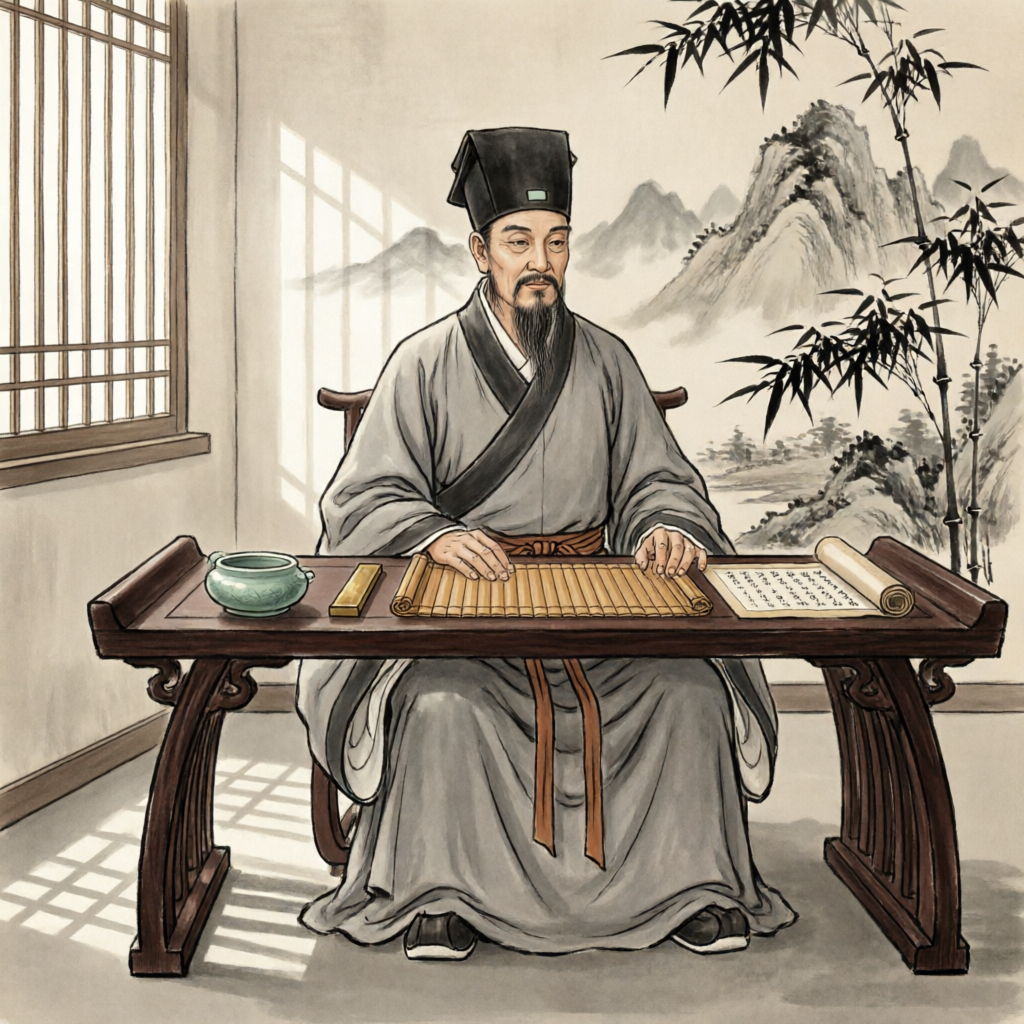
Huang Zongxi
Overview
Huang Zongxi (1610-1695), courtesy name Taichong, also known as Mr. Lizhou, was a prominent Chinese philosopher, historian, political theorist, and educator during the transition from the Ming to the Qing dynasties. Born in Yuyao, Zhejiang province, Huang came from a scholarly family and became known for his critical examination of Chinese political institutions and his development of proto-democratic ideas that challenged the absolute power of the emperor. His major works, including Waiting for the Dawn (Mingyi Daifang Lu) and Cases of Ming Scholars (Mingru Xue'an), have had a profound influence on Chinese intellectual history and are considered early expressions of Chinese Enlightenment thought.
History
Early Life and Education
Huang Zongxi was born on September 24, 1610, in Yuyao County, Zhejiang Province, to a family with literary traditions dating back to the Song Dynasty poet Huang Tingjian. His father, Huang Zunsu, was a Jinshi degree holder and served as a Censorate official during the Tianqi reign. As a member of the Donglin Academy faction, Huang Zunsu was imprisoned and tortured to death after impeaching the powerful eunuch Wei Zhongxian.
Following his father's death, Huang Zongxi developed a deep commitment to justice and scholarship. He studied under the renowned philosopher Liu Zongzhou of the Jishan School and became an active member of the Fu Society, a literary and political organization. Despite his scholarly efforts, Huang failed the metropolitan examination in 1642, which would have granted him access to official positions.
Resistance to Qing Rule
The fall of the Ming Dynasty in 1644 and the establishment of the Qing Dynasty in 1645 profoundly affected Huang Zongxi. Initially, he joined resistance forces supporting the Prince of Lu, a Ming claimant to the throne. He organized the "Shizhong Camp" and served in various military and administrative positions. After the defeat of the resistance forces, Huang went into hiding in the Siming Mountains and later lived in seclusion.
During his years in hiding, Huang devoted himself to scholarship and writing. He refused to serve the Qing government despite repeated invitations, including offers to participate in the compilation of the official History of the Ming Dynasty. Instead, he directed his efforts to documenting the Ming Dynasty's history and developing his political philosophy.
Later Years and Death
In his later years, Huang Zongxi focused on teaching and writing. He established schools in various parts of Zhejiang Province and mentored numerous students who would become influential scholars. Huang continued to write and revise his works until his death on August 12, 1695. In his final days, he composed "Lizhou Moming" (Lizhou's Final Instructions), specifying that his funeral should be simple and without elaborate ceremonies.
Key Information
| Category | Details |
|---|---|
| Alternative Names | Mr. Lizhou (世称梨洲先生) |
| Courtesy Names | Taichong, Debing (字太冲、德冰) |
| Art Names | Nanglei (号南雷) |
| Era | Late Ming and Early Qing dynasties (明末清初) |
| Ethnicity | Han Chinese (汉族) |
| Birthplace | Yuyao, Zhejiang (浙江余姚) |
| Birth Date | September 24, 1610 (万历三十八年八月初八) |
| Death Date | August 12, 1695 (康熙三十四年七月三日) |
| Major Achievements | Proposed democratic principles; criticized feudal monarchy |
| Major Works | Waiting for the Dawn, Cases of Ming Scholars, Nanglei Wending, Simingshan Zhi |
| Position | One of the Three Great Scholars of China (海内三大鸿儒), Father of Chinese Enlightenment (中国思想启蒙之父) |
Cultural Significance
Huang Zongxi is often regarded as the "Father of Chinese Enlightenment" for his pioneering critique of autocratic rule and development of democratic principles. His most influential work, Waiting for the Dawn (Mingyi Daifang Lu), contains radical ideas about the relationship between the ruler and the people. In this work, Huang proposed that "the world is the master, and the ruler is the guest" (天下为主君为客), fundamentally challenging the traditional Confucian view of absolute monarchical authority.
Huang's political philosophy emphasized several key principles:
1. The ruler's primary responsibility is to serve the welfare of the people, not to pursue personal or dynastic interests.
2. Political power should be constrained by institutions and the rule of law.
3. Schools should not only educate but also serve as venues for political discourse and criticism of government policies.
These ideas were revolutionary in the context of imperial China and foreshadowed modern democratic concepts. Huang's influence extended beyond his lifetime, affecting later Chinese reformers and intellectuals during the late Qing and Republican periods.
Modern Status
Today, Huang Zongxi is recognized as one of the most important thinkers in Chinese intellectual history. His works continue to be studied and debated by scholars of Chinese philosophy, political theory, and history. In contemporary China, Huang is often cited in discussions about political reform and the relationship between state and society.
His concept of "the world as master, ruler as guest" has been particularly influential in modern Chinese political discourse. Former Premier Wen Jiabao referenced Huang's ideas in a 2003 speech, connecting them to contemporary governance challenges. Huang's critique of excessive taxation, known as "Huang Zongxi's Law" (黄宗羲定律), continues to inform discussions about tax policy and public finance in China.
Huang's scholarly contributions extend beyond political philosophy. He made significant advances in historiography, mathematics, astronomy, and literary criticism. As the founder of the Zhejiang School of historiography, he emphasized empirical research and the practical application of historical knowledge.
References
-
Huang, Zongxi. Waiting for the Dawn: A Plan for the Prince of Yan. Translated by Wm. Theodore de Bary. Columbia University Press, 1993.
-
Ocko, Jonathan K. "Lineage and the State in Late Imperial China." In Kinship and the State in Late Imperial China, edited by Patricia B. Ebrey and James L. Watson, University of California Press, 1991.
-
Metzger, Thomas A. Escape from Predicament: Neo-Confucianism and China's Evolving Political Culture. Columbia University Press, 1977.
-
Brook, Timothy. The Confusions of Pleasure: Commerce and Culture in Ming China. University of California Press, 1998.
-
Elman, Benjamin A. A Cultural History of Civil Examinations in Late Imperial China. University of California Press, 2000.