Overview
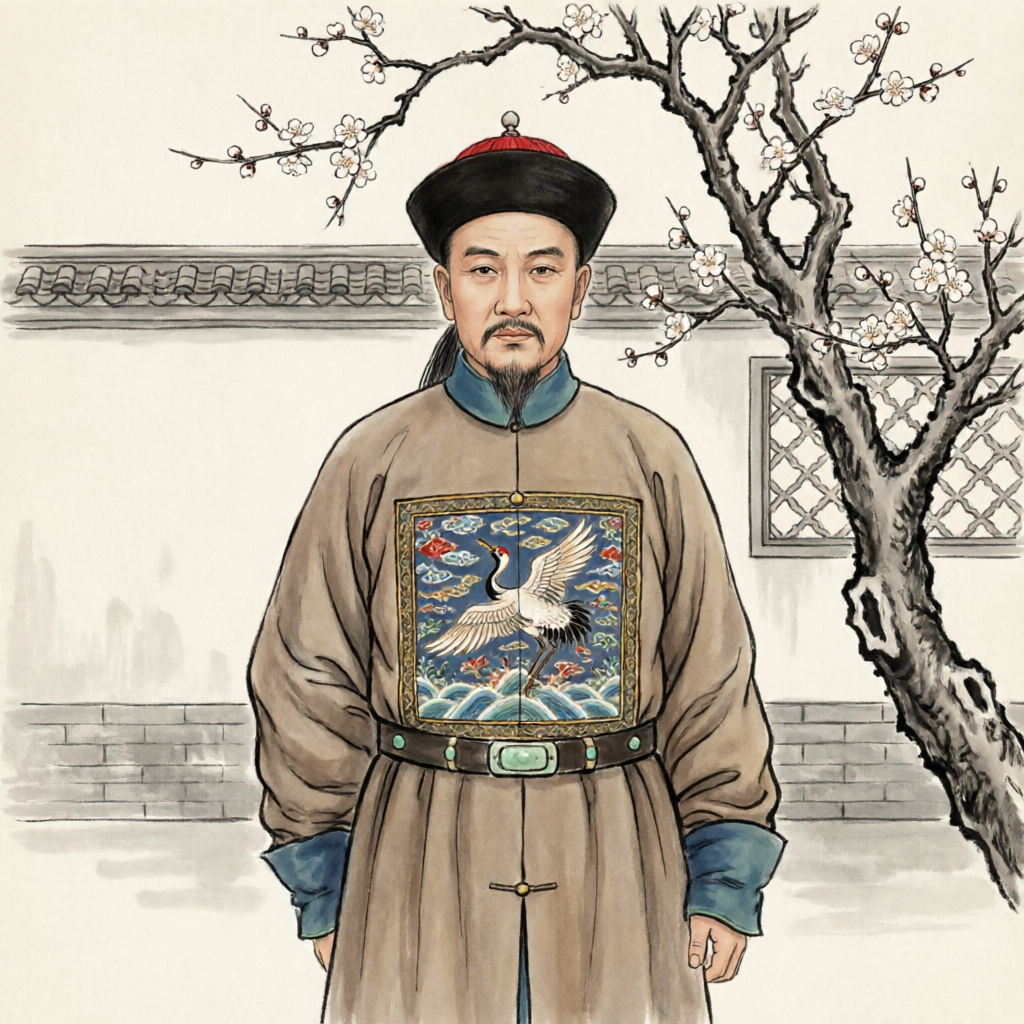
Lin Zexu (1785-1850) was a prominent Chinese scholar and official during the Qing Dynasty, best known for his firm opposition to the opium trade and his leadership in what would become the First Opium War. As a high-ranking official, Lin served in various posts throughout China, gaining recognition for his integrity, administrative abilities, and commitment to good governance. His most famous act was the destruction of opium stocks in what became known as the "Humen Destruction of Opium" (虎门销烟) in 1839, which precipitated the conflict with Britain. Lin is remembered in China as a national hero and a symbol of resistance to foreign imperialism.
History
Early Life and Education
Lin Zexu was born on August 30, 1785, in Houguan County (modern-day Fuzhou, Fujian Province) to a family that had fallen on hard times. His father, Lin Riyue, was a private tutor who had failed the imperial examinations, while his mother, Chen Zhi, came from a scholarly family. Despite their financial difficulties, Lin's parents emphasized education, and Lin showed exceptional talent from a young age. By age seven, he was already proficient in classical composition, and at eight or nine, he impressed his teachers with the poetic line "The sea has no bounds, with the sky as its shore; I stand atop the highest peak, myself the summit."
Lin's early education took place in private schools and later at the Aofeng Academy in Fuzhou. Under the guidance of its principal Zheng Guangce, Lin dedicated himself to his studies and was influenced by the practical, statecraft-oriented teachings of scholars like Chen Shouqi. In 1804, at the age of nineteen, Lin passed the provincial examination and became a juren (举人). The following year, he traveled to Beijing to participate in the metropolitan examination but failed. Returning to his hometown, Lin opened a private school to support himself.
Early Career
Lin's official career began in 1806 when he accepted a position as a secretary in Xiamen. This role exposed him to the growing opium problem in coastal China, as he was responsible for records related to foreign trade and military logistics. Lin witnessed firsthand how corrupt officials accepted bribes from opium smugglers, allowing the trade to flourish despite official prohibitions.
In 1807, Lin's abilities came to the attention of Zhang Shicheng, the governor of Fujian, who appointed him as an aide. Lin served in this capacity for four years, gaining valuable experience in governance, military affairs, and administration. During this period, he also participated in suppressing piracy and gained practical experience in coastal defense.
In 1811, Lin passed the metropolitan examination with high honors, earning the jinshi degree and being appointed to the Hanlin Academy as a compiler. Over the next decade, Lin distinguished himself through his diligent work ethic and commitment to practical scholarship. He studied extensively, particularly in areas of practical concern to governance, and authored works on hydraulic engineering and other statecraft subjects.
Rise to Prominence
Lin's career advanced rapidly in the 1820s. He served in various provincial posts, gaining a reputation for integrity and administrative competence. Notably, as Jiangsu Provincial Judge (按察使) in 1823, he gained the popular nickname "Lin Qingtian" (林青天, or "Lin Clear Sky") for his efforts to reform the judicial system and resolve numerous backlogged cases. He also demonstrated his concern for the common people during a devastating flood in 1823, implementing relief measures that prevented widespread famine and social unrest.
Throughout the 1820s and 1830s, Lin served in several key positions, including Governor of Jiangsu and Governor-General of Liangjiang. In these roles, he focused on practical reforms, improving water conservancy, disaster relief, and fiscal administration. His reputation as an honest and effective administrator grew, earning him the respect of both the imperial court and the common people.
Anti-Opium Campaign and the First Opium War
By the late 1830s, the opium trade had become a serious crisis for China. Large quantities of opium were being smuggled into the country from British India, leading to massive outflow of silver and widespread addiction. In 1838, Lin was appointed as Imperial Commissioner to Guangdong with the special mission to suppress the opium trade.
Upon arriving in Guangdong in early 1839, Lin immediately took decisive action. He demanded that foreign merchants surrender their opium stocks, famously declaring: "If opium is not eradicated, I will never return. I have sworn to carry out this mission to the end, without any halfway measures." When the British merchants, led by Charles Elliot, refused, Lin ordered the seizure of over 20,000 chests of opium. From June 3 to June 25, 1839, the confiscated opium was publicly destroyed at Humen (the Bogue), in what became known as the "Humen Destruction of Opium."
Lin's actions led to escalating tensions with Britain, which eventually resulted in the First Opium War (1839-1842). Despite his firm stance, Lin was criticized by some in the Qing court for his uncompromising approach. In 1840, as the conflict intensified, Lin was dismissed from his post and exiled to Ili in Xinjiang.
Later Years and Legacy
Lin spent his exile in Xinjiang from 1842 to 1845, where he focused on local development projects, including improving irrigation systems. After being recalled to Beijing, he was briefly reappointed to several posts before being sent to Guangxi in 1849 to suppress local unrest. He died on his way to Guangxi in 1850.
Lin Zexu is remembered today as a national hero in China, celebrated for his integrity, administrative abilities, and patriotic stance against foreign imperialism. His name is synonymous with resistance to the opium trade and foreign encroachment. The "Lin Zexu Memorial Museum" in Fuzhou preserves his legacy, and numerous statues and monuments commemorate him throughout China.
Key Information
| Category | Details |
|---|---|
| Birth Name | 林则 Xu (Lin Zexu) |
| Courtesy Names | 元抚 (Yuanfu), 少穆 (Shaomu), 石麟 (Shilin) |
| Literary Names | 俟村老人 (Sicun Laoren), 俟村退叟 (Sicun Tuisou), 七十二峰退叟 (Qishierfeng Tuisou), 瓶泉居士 (Pingquan Jushi), 栎社散人 (Yishe Sanren) |
| Posthumous Title | 文忠 (Wenzhong) |
| Birth Date | August 30, 1785 |
| Birth Place | Houguan County, Fujian Province (modern-day Fuzhou) |
| Death Date | November 22, 1850 |
| Death Place | Guangxi Province (while en route to suppress unrest) |
| Highest Position | Governor-General of Liangjiang (两江总督) |
| Major Achievements | Destruction of opium at Humen (虎门销烟), administrative reforms, disaster relief efforts |
| Notable Works | 《四洲志》 ("Si Zhou Zhi" or "Four Continents Gazetteer"), 《畿辅水利议》 ("Discussion on Water Conservancy in the Capital Region") |
Cultural Significance
Lin Zexu holds a significant place in Chinese cultural memory as a symbol of resistance to foreign imperialism and moral integrity. His name is frequently invoked in Chinese patriotic education as an example of a principled official who stood up against foreign aggression. The "Humen Destruction of Opium" is commemorated in Chinese textbooks as a heroic act of national resistance.
In popular culture, Lin has been portrayed in numerous films, television dramas, and literary works. His life story has become a staple of Chinese historical fiction, emphasizing his moral character and unwavering commitment to his principles. The phrase "苟利国家生死以,岂因祸福避趋之" ("If it benefits the country, I would give my life; how could I avoid danger for personal safety?"), often attributed to Lin, has become a famous expression of patriotic dedication in Chinese culture.
Modern Status
Today, Lin Zexu is widely revered in China as a national hero. The Lin Zexu Memorial Museum in Fuzhou preserves his personal effects, documents, and memorabilia. Numerous statues and monuments commemorate him throughout China, including a prominent statue in his hometown of Fuzhou and in the Humen area where he destroyed the opium.
In academic circles, Lin is studied as an example of Qing Dynasty officialdom and the challenges faced by Chinese officials in the face of Western imperialism. His administrative reforms and practical approach to governance are analyzed for their relevance to modern Chinese governance. His translation and compilation work, particularly "Si Zhou Zhi," is recognized as an important early effort by Chinese officials to understand the West.
Internationally, Lin is remembered primarily for his role in the First Opium War. Western scholars often view him as a complex figure - both a principled opponent of the opium trade and an official whose inflexibility contributed to the conflict with Britain. Despite differing interpretations, Lin's historical significance as a key figure in early Sino-Western relations is universally acknowledged.
References
-
Fairbank, John K., and Kwang-Ching Liu. The Cambridge History of China, Vol. 10: Late Ch'ing, 1800-1911. Cambridge University Press, 1978.
-
Spence, Jonathan D. The Search for Modern China. W.W. Norton & Company, 1999.
-
Wong, Young-tsu. Lin Tse-hsu and the Canton Trade, 1837-1839. Harvard University Press, 1971.
-
Hsü, Immanuel C.Y. The Rise of Modern China. Oxford University Press, 2000.
-
MacPherson, Kerrie L. A Wilderness of Marshes: The Origins of Public Health in Shanghai, 1843-1893. Oxford University Press, 1987.