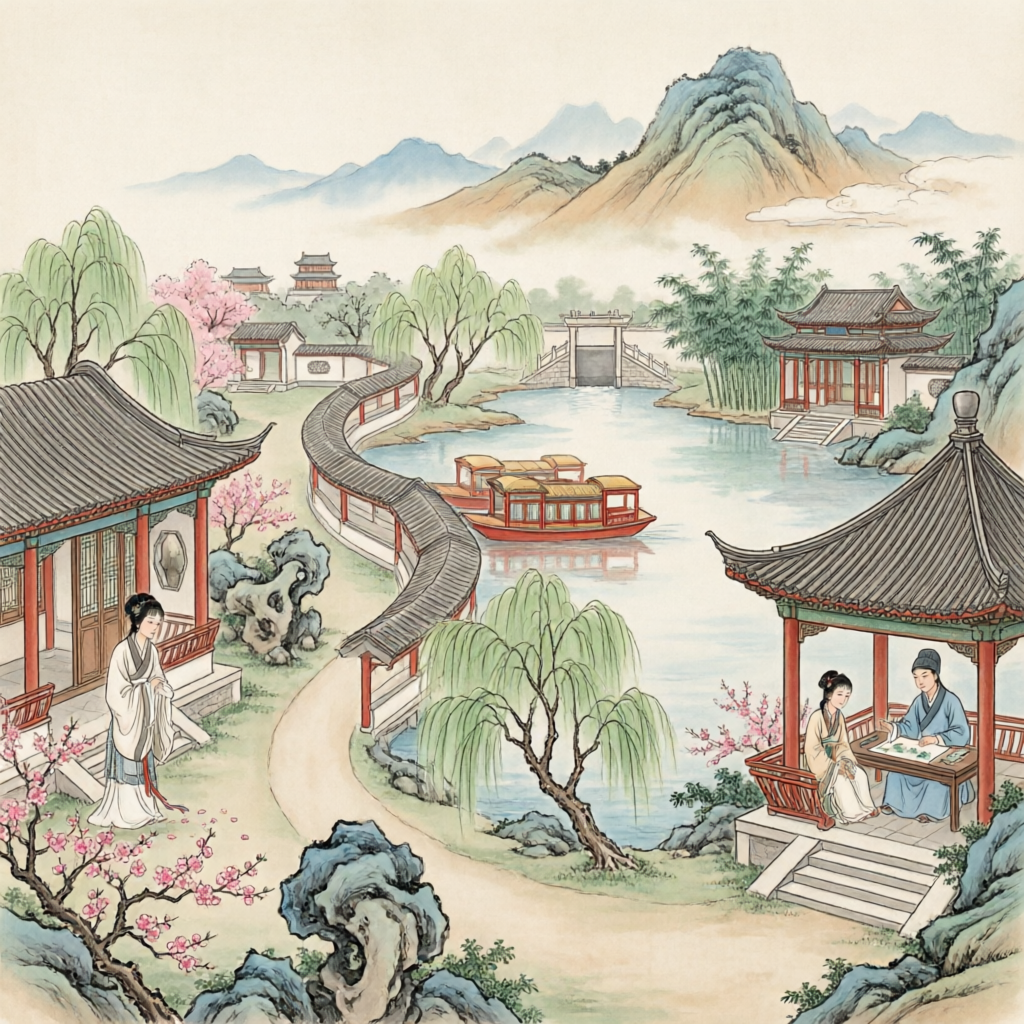
Dream of the Red Chamber
Overview
Dream of the Red Chamber (红楼梦), also known as The Story of the Stone, is one of China's Four Great Classical Novels. Written in the mid-18th century during the Qing Dynasty, this monumental work of Chinese literature is renowned for its psychological depth, detailed characterization, and exploration of China's feudal society. The novel follows the decline of the Jia family, a wealthy aristocratic household, through the experiences of its young heir, Jia Baoyu, and his relationships with numerous female characters. The narrative is celebrated for its realistic portrayal of family life, social customs, and philosophical themes of illusion versus reality.
History
The novel's origins are complex and shrouded in scholarly debate. The authorship is traditionally attributed to Cao Xueqin (曹雪芹), who reportedly wrote the first 80 chapters based on his own family's experiences. Cao Xueqin's family served as imperial textile commissioners in Nanjing for three generations before falling from imperial favor and being stripped of their wealth and position in 1728. This dramatic reversal of fortune is widely believed to have inspired the novel's central themes of decline and disillusionment.
The final 40 chapters were added by Gao E (高鹗) and Cheng Weiyuan (程伟元) in 1792, completing the 120-chapter version that is most commonly read today. These chapters provide a resolution to the narrative, though some scholars debate whether they reflect the author's original intentions.
The novel was initially circulated in manuscript form among literary circles before being published in print. Its reception evolved from being considered a "family novel" (世情小说) to being recognized as a masterpiece of world literature. By the early 20th century, Dream of the Red Chamber had established itself as a cornerstone of Chinese literary studies and continues to influence contemporary Chinese culture.
Key Information
| Aspect | Details |
|---|---|
| Original Title | 红楼梦 (Hóng Lóu Mèng) |
| Alternative Titles | 石头记 (Shítou Jì - The Story of the Stone), 情僧录 (Qíng Sēng Lù - Record of a Passionate Monk), 风月宝鉴 (Fēngyuè Bǎo Jiàn - The Precious Mirror of Romantic Love), 金陵十二钗 (Jīnlíng Shí'èr Chāi - The Twelve Beauties of Jinling) |
| Authorship | Attributed to Cao Xueqin (first 80 chapters); completed by Gao E and Cheng Weiyuan |
| Literary Genre | Novel (章回小说 - episodic novel form) |
| Approximate Completion Date | 1765 (first 80 chapters); 1792 (complete 120 chapters) |
| Setting | 18th-century China during the Qing Dynasty |
| Main Characters | Jia Baoyu, Lin Daiyu, Xue Baochai, Wang Xifeng, Jia Tanchun, Jia Xichun, Jia Yingchun, Shi Xiangyun, Jia Baoyu |
| Narrative Structure | 120 chapters divided into 80 chapters by Cao Xueqin and 40 by Gao E and Cheng Weiyuan |
Cultural Significance
Dream of the Red Chamber holds unparalleled significance in Chinese cultural history. Its influence extends far beyond literature into art, theater, film, television, and academic study. The novel has inspired countless adaptations, including operas, ballets, films, and television series, with multiple versions produced in China and internationally.
The novel's detailed portrayal of daily life in 18th-century China makes it a valuable source for historians studying Qing Dynasty social customs, family structures, and gender relations. Its psychological depth in character development represents a significant achievement in world literature, predating similar European novels by several decades.
The novel has also given rise to a specialized field of study known as "Redology" (红学), which encompasses literary criticism, textual analysis, and biographical research related to the novel and its author. This academic discipline has produced extensive commentaries and interpretations, reflecting the work's enduring complexity and richness.
Modern Status
Today, Dream of the Red Chamber remains one of the most widely read and studied works of Chinese literature. It is a standard text in Chinese education and continues to be translated into numerous languages, making it increasingly accessible to global audiences. Modern scholars continue to explore new interpretations of the novel, applying contemporary theoretical frameworks to its analysis.
The novel's themes of love, loss, family obligation, and the search for meaning in a complex world remain resonant in contemporary society. Its examination of gender roles and social hierarchies offers insights into historical Chinese society while also providing parallels to modern social issues.
Recent digital humanities projects have created new ways of engaging with the text, including searchable databases, digital editions, and data visualizations of character relationships. These innovations have introduced the novel to new generations of readers while facilitating new scholarly approaches to its study.
References
-
Cao, Xueqin. Dream of the Red Chamber. Translated by David Hawkes and John Minford, Penguin Classics, 1973.
-
Plaks, Andrew H. The Four Masterworks of the Ming Novel. Princeton University Press, 1987.
-
Pregadio, Fabrizio. "The Structure of the Dream of the Red Chamber." East Asian Journal of English Language and Literature, vol. 1, no. 2, 2004, pp. 123-145.
-
Waley, Arthur. The Dream of the Red Chamber. Constable & Co., 1929.
-
Yu, Anthony C. The Dream of the Red Chamber: A Critical Translation. Princeton University Press, 1997.