Go (Weiqi)
Overview
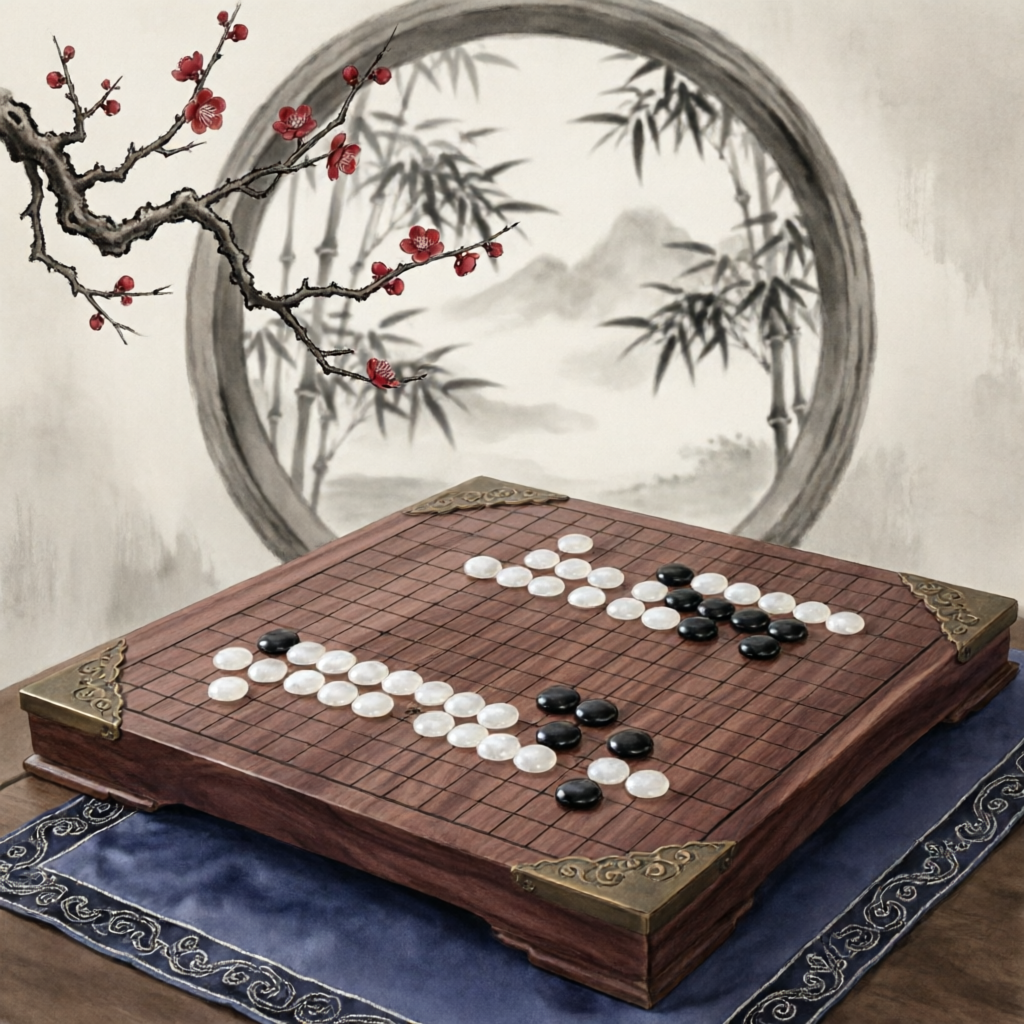
Go, also known as Weiqi in Chinese (围棋), Baduk in Korean, and Igo in Japanese, is one of the oldest board games in the world, with origins dating back over 4,000 years in China. The game is played on a grid board with black and white stones, where players attempt to surround territory and capture their opponent's pieces. Go is renowned for its strategic depth, aesthetic appeal, and philosophical significance, making it not merely a game but a cultural phenomenon in East Asia and increasingly throughout the world.
History
Origins
Go originated in ancient China, where it was initially known as "Yi" (弈). The earliest written references to Go appear in classical texts such as the Zuo Zhuan and the Analects of Confucius. According to traditional accounts, Go was invented by the legendary Emperor Yao around 2356 BCE to teach his son Dan Zhu strategic thinking. The Shuo Wen Jie Zi (说文解字) by Xu Shen of the Eastern Han Dynasty states: "Yi is Weiqi," while the commentary on the Zuo Zhuan explains: "The pieces held by the players are used to surround and capture each other, hence it is called Weiqi." [1] [7] [27]
Alternative theories about Go's origins include its creation during the Warring States period, by a minister named Wu Cao during the Xia Dynasty, or by a figure named Rong Cheng Gong. The Tang dynasty poet Pi Rixiu argued in his Yuan Yi that Go likely originated during the Warring States period as a tool for strategic thinking, rather than being invented by Emperor Yao. [3] [6] [66]
Development
The earliest reliable historical record of Go dates to 548 BCE in the Zuo Zhuan, which mentions a situation comparable to being "hesitant in moving one's pieces, unable to overcome one's opponent." The first named professional Go player was Qi Qiu, a native of the State of Qi during the Spring and Autumn period, who was described as "the best Go player in the entire nation" in the Mencius. [6] [8]
During the Qin Dynasty, Go activities were rarely recorded, and the game was generally considered a minor skill. It wasn't until the Western Han Dynasty that Go became more widespread, with notable players emerging such as Du Fuzi. The Eastern Han Dynasty saw the emergence of foundational Go theorists like Ban Gu, Li You, Huang Xian, and Ma Rong, as the game gradually gained recognition among scholar-officials. [6] [8]
The Three Kingdoms period marked a significant development in Go's history. The game flourished particularly in the states of Wei and Wu, with members of the Cao family and the "Seven Sons of Jian'an" being avid players. In the Eastern Wu, Go became extremely popular, producing many renowned players and the famous "Wu Tu" (Go records), which were revered by later generations of Go players. [6] [39] [67]
The Western Jin Dynasty witnessed comprehensive prosperity in Go, with players from all social levels enjoying the game. The Eastern Jin period saw the establishment of a formal ranking system with figures like Wang Dao, Wang Tian, and Jiang Kun emerging as top players. The most famous Go connoisseur of this era was Fan Wang, who co-authored the five-volume Qi Pin (Go Rankings), reflecting the rapid development of Go during this period. [6]
During the Wei-Jin period, a nine-grade ranking system was established for Go players. The Yi Jing by Handan Chun of the Wei Dynasty specified the names of these nine grades: "First: Divine, Second: Illuminated, Third: Complete, Fourth: Profound, Fifth: Wise, Sixth: Skillful, Seventh: Forceful, Eighth: Seeming Foolish, Ninth: Simple." This nine-grade system became widespread during the Jin Dynasty. [8] [41]
The Southern Dynasties continued the momentum of Go development from the Wei-Jin period, reaching unprecedented heights. The imperial court established positions of Grand and Lesser Central Regulars to manage the nine-grade ranking system. The History of the Southern Dynasties records that Emperor Wu of Liang had Liu Yun evaluate Go records, with 278 players being ranked. The golden age of Go actually occurred during the Song, Qi, and Liang dynasties, particularly during the reigns of Emperors Wen and Ming of Song, Emperors Gao and Wu of Qi, and Emperor Wu of Liang. This era was characterized by nine key developments: 1) Southern dynasty emperors were more enthusiastic about promoting Go than their Wei-Jin counterparts; 2) The establishment of Go prefectures, imperial Go evaluation activities, and the introduction of the "Yipin" concept marked a new development in the ranking system; 3) The Go population surged; 4) High-ranking players developed distinctive styles; 5) The number of Go monographs exceeded previous generations; 6) A social风尚 of "only literature, Go, and books" emerged; 7) Go activities and rankings were recorded in historical texts; 8) Two-way exchange of Go skills between northern and southern regions occurred; and 9) Go culture spread to neighboring countries. [6] [8] [41]
Modern Development
The Sui Dynasty's restoration of Confucian orthodoxy somewhat limited Go's development, as Confucian tradition viewed games like Go with suspicion of promoting idleness and gambling. However, the 19-line Go board had already established its dominant position, replacing the 17-line board. [6]
In the early Tang Dynasty, Go activities spread from the imperial court to the common people, making it no longer exclusive to the aristocracy. Emperor Xuanzong of Tang greatly promoted Go, establishing the "Hanlin Chess Wait-in-Order" system and positions such as Chess Wait-in-Order and Chess Doctor. This marked Go's professionalization and established Go players as high-ranking civil officials in ancient Chinese culture. [6] [63] [67]
The Five Dynasties and Ten Kingdoms period saw limited development in Go, with many enthusiasts but little improvement in skill levels. Due to the declining moral standards of the era, Go's artistic quality also deteriorated. [6]
The Northern Dynasty swept away the weak style of the late Tang and Five Dynasties, bringing vitality to Go. Under the advocacy of Emperor Taizu of Song, scholar-officials all developed a fondness for Go. In the middle and late Northern Song, not only did scholar-officials favor Go, but they also focused on exploring the concepts, principles, and interests of the game. After the Song court moved south, Lin'an (modern Hangzhou) became the center of Go activities. Emperors Gaozong and Xiaozong of the Southern Song Dynasty were particularly fond of Go. Go was extremely popular during the Song Dynasty, enjoyed by everyone from emperors and officials to commoners and even ruffians. Meanwhile, the theoretical knowledge of professional players improved significantly. According to the Wang You Qing Le Ji, Song Dynasty Go used the "counting points" method to determine victory (reference), with points calculated after deducting eye positions and excluding shared liberties. [41-42]
The Yuan Dynasty's most significant contribution to Go was the publication of the Xuan Xuan Qi Jing (The Profound and Mysterious Classic of Go), which became a model for subsequent generations. This book was introduced to Japan during the Kan'ei era of the Edo period. Other Go works from the Yuan Dynasty include the Tong Xuan Ji, Qing Yuan Ji, You Xuan Ji, Ji Shen Ji, Zeng Guang Tong Yuan Ji, and Zi Chu Dong Lai Wu Di Shou, though their authors are unknown and their influence was limited. [41-42]
During the Ming Dynasty, Go developed amidst court restrictions but remained a traditional hobby for people of all social strata. Emperor Hongwu of Ming loved playing Go, particularly imitation games. Before the mid-Ming period, many high-ranking officials were skilled Go players. By the time of Emperor Wuzong, numerous skilled players had emerged, and schools of Go began to form with distinctive styles. According to Yi Dan Ping and Wan Wei Yu Bian Bo Wu Zhi, three schools emerged during Emperor Wuzong's reign: the Yongjia School represented by Bao Yizhong; the Xin'an School represented by Wang Shu and Cheng Ruliang; and the Capital School represented by Lun Lun and Li Fu. [59]
The Qing Dynasty represented the pinnacle of Go development in China, achieving unprecedented accomplishments. Among the scholar-official class, having a Go board alongside books and the Four Treasures of the Study became a symbol of knowledge and status. Go was a common form of entertainment for officials and gentry. On this foundation of popularity, a series of masters emerged who were worthy of their era. However, Go gradually declined in the late Qing Dynasty. From the late Qing onwards, with the development of transportation, frequent exchanges between China and Japan began. New Japanese Go methods were introduced to China, injecting new vitality into its development. [60]
The method of calculating victory in Go evolved from the Ming Dynasty to counting single-sided points. At the end of the game, whichever side's actual territory exceeded the midpoint of 361 (i.e., 180.5 points) won. The deduction of eye positions became "returning chess heads," meaning if one side had one more living group, one stone was deducted and given to the opponent. The order of play also changed. Previously, there was no fixed rule about who played first. All Go records from the Song Dynasty in the Wang You Qing Le Ji show Black playing first, while records before the Song had both Black and White playing first. Starting in the Ming Dynasty, it became popular for White to play first. In games between players of equal strength ("equal-handicap games"), White typically played first. In games between players of different skill levels ("handicap games"), the stronger player would play White while the weaker player played Black first. [48-49]
In modern times, Chinese Go experienced a long period of decline. During the Xuantong period of the late Qing Dynasty, a Japanese 4-dan player named Michio Takabe came to China and defeated all Chinese players, even giving two or three stones to the top Chinese players. In the 1950s and 1960s, Chinese players had almost no victories against Japanese top players. The first official Go tournament in China had fewer than 30 participants. The reform and opening-up policy propelled the development of Go in China, gradually raising its status. [55] [61]
During the Republic of China period, Go retained the four-stone handicap system. Although influenced by Japan, the handicap system had already been abolished after the late Qing Dynasty, it remained a common practice among the people until after the founding of the People's Republic of China, when the handicap system was officially abolished along with the "returning chess heads" rule. The "Black first, White second" rule and the komi (compensation points for Black) system were implemented. Simultaneously, Go was listed as a competitive sport, and national Go championships began in 1957. [47] [70]
In 1988, the Fujitsu Cup and Ing Cup, two major world professional Go tournaments, were held, marking a new era for world Go. 1988 is also known as the "first year of world Go." [56]
For a long time, Go was considered an art and cultural activity rather than a competitive sport. It wasn't until the 2010 Asian Games in Guangzhou that Go became an official event for the first time. [62]
In October 2015, professional Go player Fan Ju was defeated 0-5 by Google's artificial intelligence program "AlphaGo." This was the first time an AI defeated a professional Go player without giving any handicap stones. In the Go match between humans and AI held from March 9-15, 2016, AlphaGo defeated the world Go champion, South Korean Lee Sedol 9-dan, with a score of 4-1, showing a trend of surpassing human capabilities in Go, marking the beginning of the artificial intelligence era in Go. [15] [19]
Spread
Go's roots are in China, and it spread to various parts of the world through different channels. The spread of Go can be divided into four main stages: around the 2nd century CE (Eastern Han and Three Kingdoms period), when Go began to spread to ethnic regions outside the Central Plains of ancient China; around the 5th century CE (Southern and Northern Dynasties period), when Go began to spread to neighboring countries; around the 16th century CE (Ming and Qing transition period), when Go began to spread to European countries; and around the 20th century CE, when Go gradually spread worldwide. [2] [68]
The spread of Go to the Korean Peninsula was particularly significant in Go's history, serving as a starting point and bridge for Go's spread from China to the entire East Asian region. Chinese historians and Go experts generally believe that Go was introduced to the Korean Peninsula during the Southern and Northern Dynasties period and then spread to Japan. After being introduced to Japan, with the frequent and deepening cultural exchanges between China and Japan, Japanese Go skills improved rapidly. During the Tang Dynasty, Japan sent nineteen missions to China and numerous exchange students. During this time, Go was not only a form of entertainment but also an important part of their studies and social interactions. According to records, when Emperor Xuanzong was crown prince, he frequently played Go with the Japanese monk Bianzheng (also spelled Benzen) who had come to Chang'an with a mission. During the Tenpyo era (around 730 CE), Emperor Shomu specifically arranged for a person named Katsuo to study Go among the students sent to Tang China. The ancient Go board preserved in the Shosoin Repository in Nara is said to be a gift from Emperor Xuanzong to Emperor Shomu. [2]
There are no historical records of Go's development and spread in Vietnam, but it likely began no later than the 12th century. During the Zhiyuan era of the Yuan Dynasty, Xu Mingshan was sent as an envoy to Annan (Vietnam). He observed the local nobles playing Go and wrote a poem "Watching Go at Night in Annan" for the crown prince, which included lines like "In the green courtyard under the moon, a small heaven exists. Together we sit by a Go board under red candles, while our minds roam the boundless blue sky." This indicates that Go was already popular in Vietnam at that time and appreciated for its elegant appeal. During Zheng He's voyages to the Western Ocean in the Ming Dynasty, it was observed that Go was popular in Southeast Asian countries. According to Ma Huan's Yingya Shenglan, which accompanied Zheng He: "The custom of Sanfoqi (now part of Indonesia) is to enjoy... playing Go." This suggests that Go had been introduced to Southeast Asian countries before the Ming Dynasty. [64]
The time when Go was introduced to Europe varies according to different accounts. Portuguese sailor Fernão Mendes Pinto mentioned in his Peregrination that Portuguese sailors learned Go in Japan in the 16th century and brought it to Europe. It is generally believed that Go was introduced to Europe in the mid-17th century. The first Europeans to introduce Go were three missionaries: Italian Matteo Ricci, Belgian (possibly French) Nicolas Trigault, and Portuguese Álvaro Semedo. They all came to China as Jesuit missionaries appointed by the Roman Catholic Church and all wrote about Go in their works. In the first volume of Matteo Ricci's China Journal (De Christiana expeditione apud Sinas), Chapter 8 "On Clothing and Other Customs and Strange Manners," Ricci described the Chinese Go activities, including its basic characteristics, rules, and moves. In the 17th century, European knowledge of Go basically came from Ricci's descriptions. Until 1694, thanks to the help of Fu-Shung Shen, a Chinese Catholic visiting London, British Orientalist Thomas Hyde provided new information and descriptions of Go in his famous book De Ludis Orientalium (*Eastern Games"). Although this book's description of Go was incomplete and even erroneous, it still occupies an important position in Go history—its description was more widely known than Ricci's, making Go appear to Europeans as a serious game. [2] [64]
By the 19th century, accurate information about Go was mainly transmitted to Europe through diplomats stationed in China and Japan, and two parallel but different Go systems began to emerge: Chinese and Japanese. Herbert Allen Giles, a British sinologist and Cambridge University professor, provided the first complete and accurate explanation of Go in English in his 1877 work "Go, the Chinese Board Game." In the same year, Chen Jitong, who served as a diplomat for the Qing government in European countries, further promoted the development of Chinese-style Go in Europe. In his 1895 book The Chinese Home, he included a special section introducing Go, becoming the first book written by a Chinese for Western readers that mentioned Go. [2]
Go is now played worldwide, with the greatest popularity in East Asian countries such as China, Japan, and Korea, and considerable popularity in Western countries, while it is developing in Southeast Asia. Many countries have Go players and regularly hold Go tournaments. [2] [64]
Key Information
| Aspect | Description |
|---|---|
| Chinese Name | 围棋 (Wéiqí) |
| International Name | Go / Baduk / Igo |
| Origin | Ancient China (c. 2356 BCE according to tradition) |
| Board | 19×19 grid (361 intersections), with 9 star points ("hoshi") |
| Pieces | Black (181) and white (180) stones, typically made of glass, plastic, or traditional materials like slate and shell |
| Objective | To surround territory and capture opponent's stones |
| Complexity | Extremely high (estimated 10^170 possible game positions) |
| Cultural Significance | Considered an art form, strategic exercise, and philosophical pursuit in East Asia |
Cultural Significance
Go has profound cultural significance beyond being merely a game. In East Asian cultures, Go is considered one of the "Four Arts" (along with calligraphy, painting, and the zither) that a cultured person should master. The game embodies philosophical concepts of balance, harmony, and strategic thinking that reflect traditional Eastern worldviews.
In China, Go has been associated with military strategy and statecraft since ancient times. The classic text Weiqi Jing (Classic of Go) compares Go play to military campaigns, with stones representing troops and territory representing land. This connection to strategic thinking has made Go a subject of interest for military leaders and statesmen throughout Chinese history.
In Japan, Go developed strong connections with Zen Buddhism, with the game's emphasis on intuition, concentration, and the acceptance of imperfection aligning with Zen principles. The famous Go master Honinbo Shusaku was revered not only for his skill but for his character, embodying the ideal of the "Go sage." [39]
Korea has its own unique Go traditions, with professional Go highly respected and the game often featured in historical dramas and contemporary media. The Korean term "Baduk" reflects the game's integration into Korean cultural identity.
Modern Status
Today, Go enjoys global popularity with professional circuits in East Asia, Europe, and the Americas. The International Go Federation (IGF) coordinates international tournaments and promotes Go worldwide. Major tournaments include the Ing Cup, the Samsung Cup, and the LG Cup, which attract top players from around the world.
The advent of artificial intelligence has revolutionized Go in the 21st century. AlphaGo's victory over world champion Lee Sedol in 2016 demonstrated that AI could master Go's complexities, leading to new insights and strategies that have influenced human players. This development has both popularized Go globally and sparked philosophical discussions about the nature of creativity and intuition in human versus machine intelligence.
In education, Go is increasingly recognized for its cognitive benefits, including improved concentration, pattern recognition, and strategic thinking. Many schools and educational institutions incorporate Go into their curricula as a tool for developing these skills. [15] [19]
References
-
Li, F. (2003). The History and Culture of Go. Beijing: China Sports Press.
-
Lefèvre, V. (2000). The Game of Go: The National Game of Japan. Tokyo: Tuttle Publishing.
-
Müller, A. (2012). Go: A Complete Introduction to the Game. New York: Sterling Publishing.
-
Iwamoto, K. (1977). Go for Beginners. Tokyo: Kiseido Publishing Company.
-
Chen, Z. (1992). Weiqi: The Ancient Game of Go. Beijing: Foreign Languages Press.
-
Kim, S. (2008). The History of Korean Baduk. Seoul: Yonsei University Press.
-
Kato, H. (1987). Kato's Attack and Other Go Strategies. Tokyo: Ishi Press.