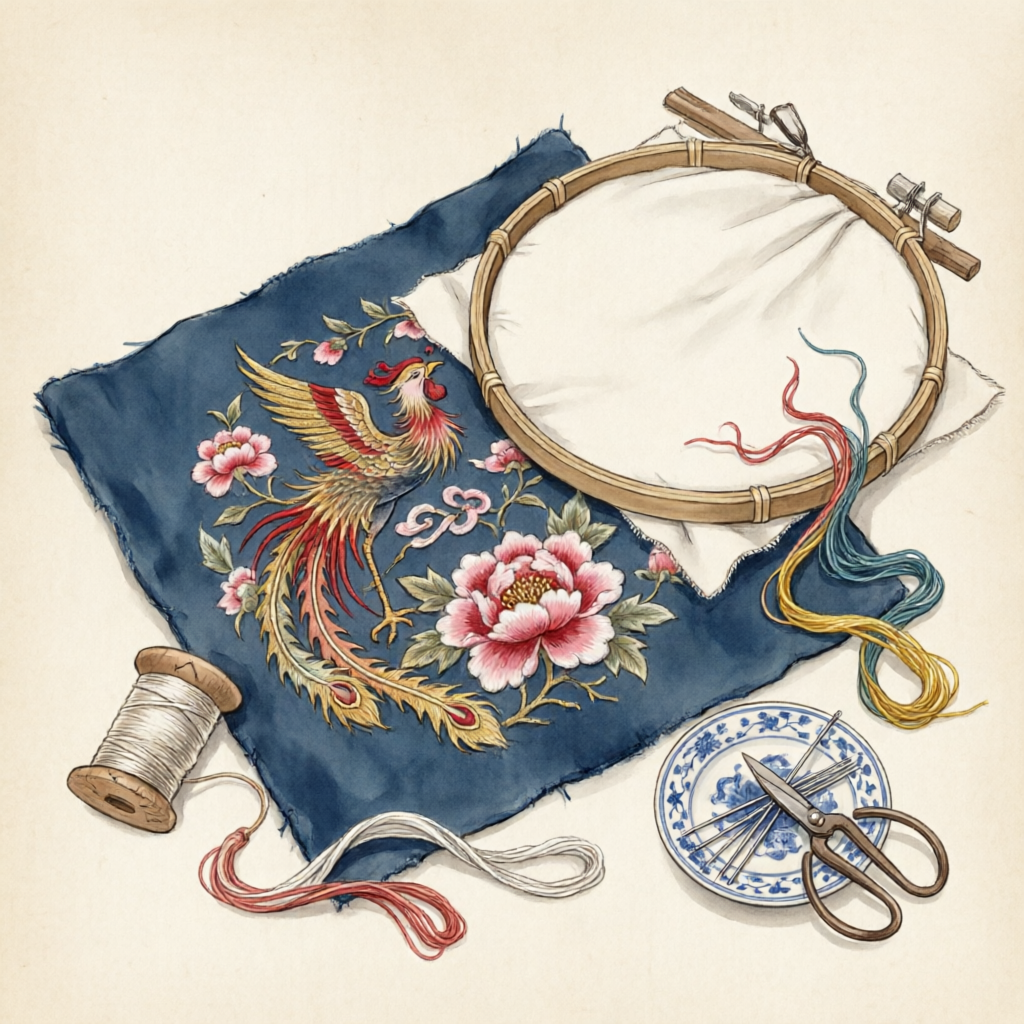
Cantonese Embroidery
Overview
Cantonese Embroidery (Yue Xiu) is a traditional Chinese embroidery style originating from Guangdong Province, with two main branches: Guang Embroidery from the Guangzhou area and Chao Embroidery from the Chaozhou region. Along with Suzhou Embroidery, Sichuan Embroidery, and Hunan Embroidery, it is recognized as one of China's Four Great Embroideries. This art form is characterized by its vibrant colors, elaborate designs, and distinctive techniques, including the use of gold and silver threads, and unique padding methods that create a three-dimensional effect.
History
The origins of Cantonese Embroidery can be traced back to the Tang Dynasty (618-907 CE), when embroidery techniques were brought to the Lingnan region by immigrants from the Central Plains. Lu Meiniang, a 14-year-old girl from Nanhai (present-day Guangzhou), is revered as the ancestor of Cantonese Embroidery. According to historical records in the Duyang Zabian, she embroidered seven volumes of the Lotus Sutra on a piece of silk cloth just one foot square, with characters smaller than millet grains yet perfectly clear and distinct. Emperor Shunzong of Tang was so impressed that he called her "Divine Girl," and Emperor Xianzong rewarded her with a golden phoenix ring for her exceptional skill.
During the Ming Dynasty (1368-1644), Cantonese Embroidery began to gain international recognition. In 1514, a Portuguese merchant purchased an embroidered dragon robe fragment in Guangzhou and presented it to his king, receiving a substantial reward. By the late Ming period, Cantonese Embroidery had developed distinctive characteristics, including diverse thread types, vibrant color contrasts, extensive use of gold threads for outlines, and elaborate decorative patterns. Notably, male artisans were commonly employed for embroidery work, which was unusual compared to other regions.
The Qing Dynasty (1644-1912) marked a golden age for Cantonese Embroidery. In 1757, the Qianlong Emperor restricted foreign trade to Canton (Guangzhou), which significantly boosted the embroidery industry. The establishment of the "Brocade and Embroidery Guild" in Guangzhou standardized production processes, including working hours, materials, designs, colors, specifications, and pricing. During this period, "leather gold embroidery" (pi jin xiu) became popular, featuring sheepskin gold leaf as a backing that created a shimmering effect. Cantonese embroidery artists also innovatively used peacock feathers and horsehair threads, showcasing exceptional craftsmanship.
In the modern era, Cantonese Embroidery has continued to evolve and gain recognition. In 1915, Yu De's "Peony and Peacock" embroidery won first prize at the Panama-Pacific International Exposition in San Francisco. In 1951, thirteen embroidery guilds were established in Chaozhou, and the following year, the Chaozhou Embroidery Department was organized for production and export. In 1979-1981, Chaozhou embroidery provided 250 pieces (sets) as national gifts for foreign exhibitions, receiving high praise both domestically and internationally.
Key Information
| Category | Details |
|---|---|
| Chinese Name | 粤绣 (Yue Xiu) |
| English Name | Cantonese Embroidery |
| Heritage Status | National Intangible Cultural Heritage (China) |
| Heritage Number | Ⅶ—20 |
| Declared Region | Guangdong Province |
| Classification | Guangzhou City |
| Approval Time | Multiple periods (ongoing) |
| Main Centers | Guangzhou and Chaozhou |
| Major Branches | Guang Embroidery (Guangxiu) and Chao Embroidery (Chaoxiu) |
| Recognition | One of China's Four Great Embroideries |
Cultural Significance
Cantonese Embroidery holds significant cultural value as both an art form and a cultural symbol. The embroidery motifs often carry auspicious meanings, with popular themes including "Three Goats Bringing Prosperity" (Sanyang Kaishai), "Peacock Displaying Its Feathers" (Kong Que Kaiping), "Hundred Birds Paying Homage to the Phoenix" (Bainiao Chaofeng), and "Flying Dragons and Dancing Phoenixes" (Longfei Fengwu). These designs reflect traditional Chinese aesthetics and cultural values.
The art form has also played an important role in cultural exchange between China and the West. During the Ming and Qing dynasties, Cantonese Embroidery was highly sought after by European royalty and aristocracy. Queen Elizabeth I of England was so impressed with Chinese gold and silver thread embroidery that she established the British Embroiderers' Guild, modeled after Cantonese embroidery workshops. Cantonese Embroidery was praised by Western scholars as "China's gift to the West," and examples of this embroidery can be found in museums across Europe and America.
Modern Status
Today, Cantonese Embroidery continues to thrive as both a traditional art form and a contemporary decorative craft. The art form has been recognized as a National Intangible Cultural Heritage of China, with several master artisans designated as inheritors of this tradition. Notable contemporary artists include Chen Shaofang, recognized as a national inheritor of Guang Embroidery, and Sun Qingxian, known for his "Tiger Roaring Ten Thousand Miles" embroidery piece.
Modern Cantonese Embroidery maintains traditional techniques while incorporating contemporary themes and designs. The art form has been adapted for various applications, from traditional items like clothing, wall hangings, and fans to modern decorative pieces and fashion accessories. In recent years, Cantonese Embroidery has been featured in major cultural events and exhibitions, helping to preserve and promote this important cultural heritage.
The future development of Cantonese Embroidery faces both opportunities and challenges. While there is growing interest in traditional crafts among younger generations, the art form also needs to adapt to changing tastes and market demands. Efforts are being made to integrate traditional embroidery techniques with modern design concepts, ensuring that this cultural heritage remains relevant and vibrant in the contemporary world.
References
-
Gao, J. (2018). Chinese Embroidery: Traditional Techniques and Contemporary Applications. Oxford University Press.
-
Chan, W. (2015). The Art of Cantonese Embroidery: History, Techniques, and Cultural Significance. Hong Kong University Press.
-
Li, Y. (2020). Intangible Cultural Heritage of China: Cantonese Embroidery. National Museum of China Press.
-
Wang, H. (2017). Traditional Chinese Handicrafts: Embroidery. Cultural Relics Publishing House.