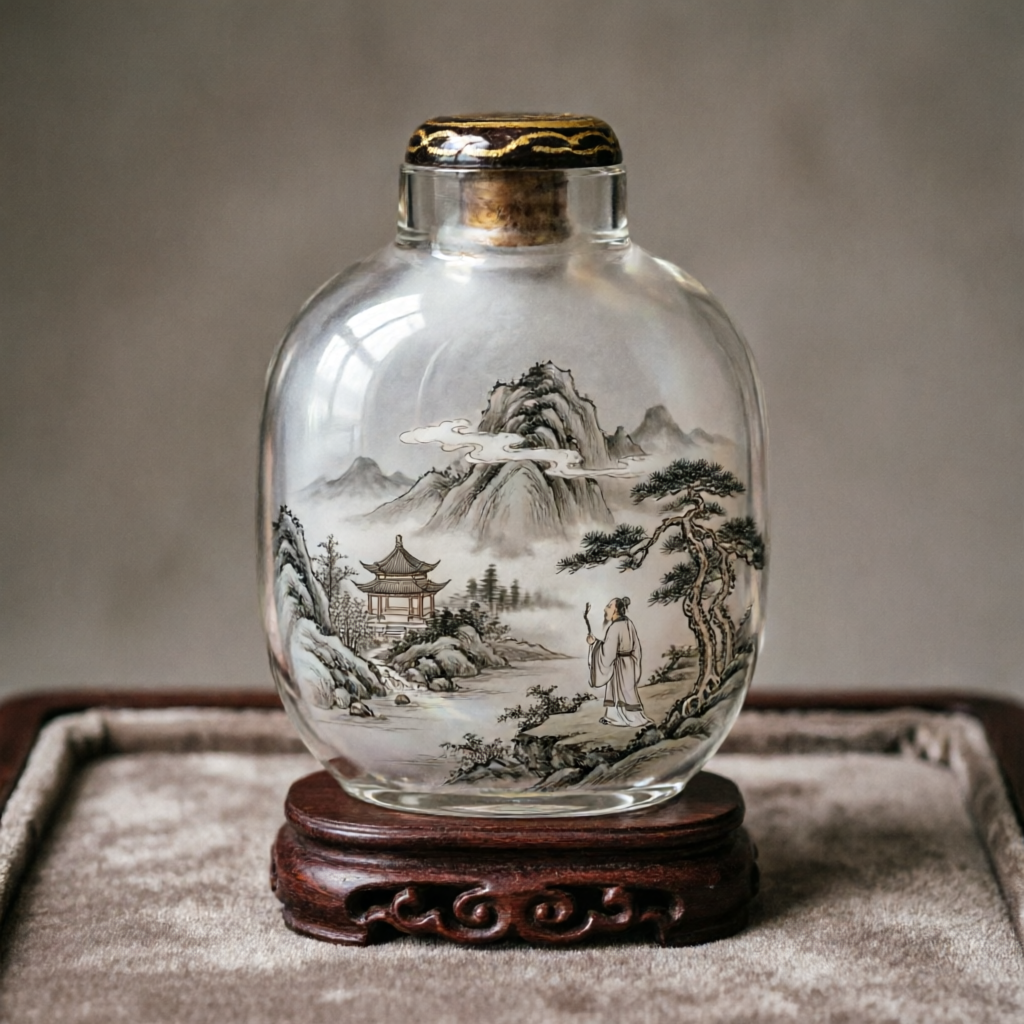
Inside Painting
Overview
Inside painting (内画) is a traditional Chinese art form that involves painting on the inner surface of glass or crystal vessels, most commonly snuff bottles. This intricate art requires artists to paint in reverse, with their work appearing correctly when viewed through the outer surface of the vessel. The craft originated during the early Qing Dynasty and has since developed into several distinctive schools, each with its own techniques and artistic styles. Inside painting has been recognized as an important element of China's cultural heritage, with several prominent artists and techniques receiving national and international recognition.
History
The origins of inside painting are somewhat uncertain, with several competing accounts of its inception. According to one popular legend, during the Jiaqing and Daoguang periods (1796-1850), an official staying at a temple scraped the remaining snuff from his bottle with a small tool, leaving scratches on the inner surface that resembled Chinese brush painting lines. A monk at the temple supposedly expanded this into the technique of inside painting bottles.
However, expert research suggests that the actual inventor was a young southern painter during the Jiaqing period who used small steel balls, quartz sand, and a small amount of water to create fine textures on the inner surface, allowing pigments to adhere better. He then used a bamboo pen with a curved hook to paint in reverse on the inner surface. This artist was identified as Gan Huanwen, with the earliest known inside painting bottle by him dating to 1816. He reportedly ceased painting in 1860.
The art form flourished during the late Qing Dynasty and developed into several major schools by the late 19th and early 20th centuries. By 1880-1930, prominent artists in Beijing (the "Jing School") included Zhou Leyuan, Ding Erzhong, Ma Shaoxuan, Yan Yutian, Ye Zhongsan, and Rong Rongjiu. From 1930-1960, notable artists included Ye Zhongsan, Ye Xiaofeng, and Ye Bengqi from Beijing, Rong Rongjiu (after 1900 in Shandong), Zhang Wentang, and Xue Jingwan from Shandong, and Wu Songling from Guangdong.
Key Information
| Feature | Description |
|---|---|
| Chinese Name | 内画 (Nèi Huà) |
| English Name | Inside Painting |
| Materials | Glass, crystal, amber |
| Origins | Early Qing Dynasty (early 19th century) |
| Major Schools | Beijing (Jing), Shandong (Lu), Hebei (Ji), Guangdong (Yue), Xi'an (Qin) |
| Heritage Status | National Intangible Cultural Heritage |
| Recognition | UNESCO "Excellence of Handicraft" certification |
Cultural Significance
Inside painting represents a unique fusion of traditional Chinese painting techniques and the craft of glassmaking. The art form demonstrates remarkable ingenuity in adapting traditional painting methods to the constraints of working in reverse on a curved, often small, surface. The various schools of inside painting reflect regional cultural influences and artistic preferences, from the scholarly elegance of the Beijing school to the vibrant colors of the Guangdong school.
The art form has also played a significant role in cultural exchange, with many pieces being collected by international enthusiasts and museums. Inside painting bottles have become valuable collector's items, with masterpieces fetching significant sums at auctions. The craft has also been adapted to modern contexts, with artists creating works that reflect contemporary themes while maintaining traditional techniques.
Modern Status
Inside painting continues to thrive in the 21st century, with several prominent artists carrying on the tradition. In 2025, inside painting art was featured as an important exhibit at the Shandong Arts and Crafts Expo and "Shandong Handmade" boutique exhibition in Jinan, showcasing innovative works created in琉璃 bottles with openings as narrow as 3 centimeters.
The four major schools of inside painting—Beijing (Jing), Shandong (Lu), Hebei (Ji), and Guangdong (Yue)—each continue to evolve while maintaining their distinctive characteristics. In recent years, there has been a movement toward innovation within the traditional form, with some artists exploring "new inside painting" concepts that emphasize artistic expression over traditional craftsmanship.
Several master artists continue to lead the development of inside painting. Wang Xisan, founder of the Hebei (Ji) school, remains influential, while artists like Zhang Guangqing (Shandong school), Lai Yining (Guangdong school), and Zhang Tieshan (Xi'an school) carry on their respective traditions. Contemporary artists like Yi Ding (Nie Lei) have gained recognition for their exceptional skills in inside calligraphy, creating miniature works that push the boundaries of the art form.
Inside painting has received official recognition as a national intangible cultural heritage, with several master artists designated as "inheritors" of this important cultural tradition. The art form has also received international recognition, including the UNESCO "Excellence of Handicraft" certification, helping to ensure its preservation and continued development.
References
-
Zhang, Wei. Chinese Snuff Bottles: Art and Innovation. Princeton University Press, 2018.
-
Li, Hong. Inside Painting: History, Techniques, and Masters. Cultural Relics Publishing House, 2020.
-
Chen, Ming. Intangible Cultural Heritage of China: Traditional Craftsmanship. China Social Sciences Press, 2019.
-
Wang, Xisan. The Art of Inside Painting: My Life Journey. Hebei People's Publishing House, 2016.
-
International Chinese Snuff Bottle Society. Journal of Chinese Snuff Bottle Studies. Vol. 15, 2015.