Qixi Festival
Overview
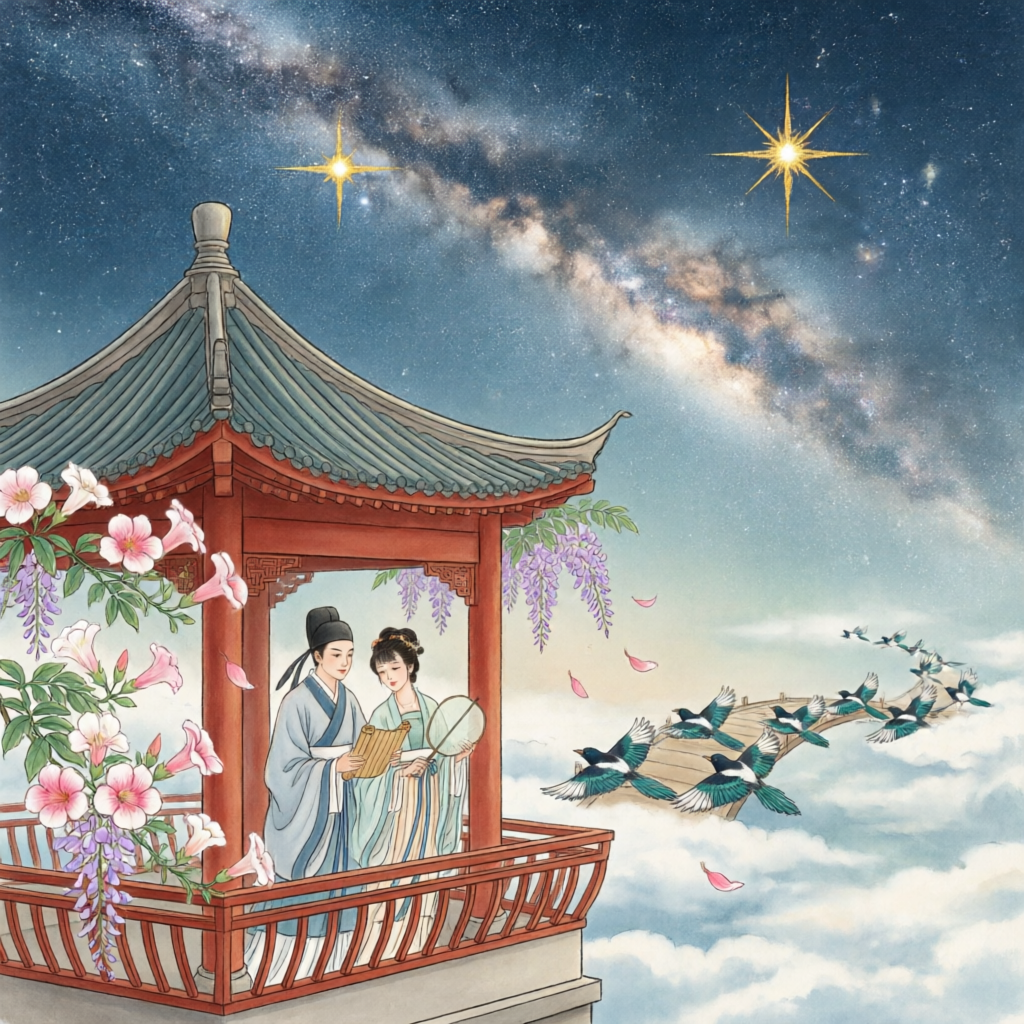
The Qixi Festival (七夕节), also known as the Double Seventh Festival or Chinese Valentine's Day, is a traditional Chinese holiday celebrated on the 7th day of the 7th lunar month. With origins dating back over 3,000 years, this festival has evolved from an ancient celebration of celestial phenomena and skilled craftsmanship to a modern celebration of love and romance. The festival is deeply rooted in Chinese mythology, particularly the famous love story of the cowherd and the weaver girl (牛郎织女), who are said to reunite once a year on this night across the Milky Way.
History
The Qixi Festival originated at least 3,000-4,000 years ago, closely connected to astronomical phenomena and seasonal changes. The earliest references to the stars associated with this festival appear in the Book of Songs (诗经), one of China's oldest collections of poetry. In ancient times, these stars served as agricultural calendar markers, helping farmers determine the changing seasons.
The festival began to take shape during the Han Dynasty (206 BCE-220 CE), when the stars of Altair and Vega were personified as the cowherd and weaver girl in folklore. By this time, rituals such as "threading the seven-eye needle" had emerged as popular customs.
During the Wei, Jin, and Northern and Southern Dynasties (220-589 CE), the festival gained popularity among the literati. Many famous poets of the era wrote poems celebrating Qixi, including Cao Pi, Lu Ji, and Xie Lingyun, who composed works like "Ode to the Cowherd and Weaver Girl on Qixi."
The Sui, Tang, and Song dynasties (581-1279 CE) marked a golden age for the festival. It became an official imperial celebration during the Tang Dynasty, with elaborate court rituals. The Song Dynasty designated Qixi as a national holiday, elevating its status and expanding its celebrations across all social classes. During this period, the festival reached its peak of popularity and elaborate celebrations.
In the Yuan Dynasty (1271-1368 CE), the festival's customs stabilized, with few new traditions emerging. During the Qing Dynasty (1644-1912 CE), the festival began to decline in popularity, particularly after the mid-Qing period. By the Republican era (1912-1949), many traditional customs had faded or disappeared in urban areas.
Key Information
| Aspect | Details |
|---|---|
| Chinese Name | 七夕节 (Qixi Festival) |
| Alternative Names | 七巧节 (Qiqiao Festival), 七姐节 (Qijie Festival), 女儿节 (Daughter's Festival), 中国情人节 (Chinese Valentine's Day) |
| Date | 7th day of the 7th lunar month |
| Origin | Ancient astronomical observation and folk traditions |
| Main Activities | Praying for dexterity (乞巧), worshiping the Weaver Girl, needlework competitions, romantic celebrations |
| Cultural Significance | Celebrates love, craftsmanship, and the reunion of separated lovers |
Cultural Significance
The Qixi Festival embodies several important cultural values in Chinese tradition. Historically, it has served as a celebration of feminine skills and craftsmanship, particularly needlework. The "begging for dexterity" (乞巧) custom allowed women to showcase their talents and pray for improvement in their domestic arts.
The festival is also deeply connected to Chinese concepts of love and marriage. The story of the cowherd and weaver girl symbolizes enduring love despite separation and obstacles. This narrative has made Qixi particularly significant in contemporary China as a "Chinese Valentine's Day," offering an alternative to Western romantic celebrations.
In various regions of China and among Chinese communities in Southeast Asia, the festival has developed unique local customs. In Guangdong and Hong Kong, for example, the tradition of "worshiping the Seven Sisters" (拜七姐) remains strong, featuring elaborate displays of handicrafts and special rituals. In Taiwan, the festival is associated with worshiping the Seven Mother Goddesses (七娘妈), who protect children and are particularly venerated during coming-of-age ceremonies.
Modern Status
In contemporary China, the Qixi Festival has experienced a remarkable revival, particularly since the early 21st century. While many traditional customs had faded by the mid-20th century, cultural preservation efforts and commercial interests have contributed to its renewed popularity.
Today, Qixi is widely celebrated as "Chinese Valentine's Day," with couples exchanging gifts, going on dates, and expressing romantic sentiments. Commercial establishments have embraced the festival, with restaurants, hotels, and retailers offering special promotions and themed events.
The festival has also gained international attention, with celebrations in Chinese communities worldwide. In 2006, the Qixi Festival was included in China's first batch of national intangible cultural heritage, further cementing its cultural importance.
Despite its modern romantic associations, efforts are also being made to preserve and revive traditional customs. In some regions, particularly rural areas, the ancient practices of needlework competitions, worship ceremonies, and traditional foods are being reintroduced to younger generations.
References
-
Yu, H. (2012). Chinese Festivals: Their Origin, Symbolism, and Customs. China Intercontinental Press.
-
Zhang, J., & Yung, B. (2008). Studies in Chinese Ritual, Theatre, and Folklore. Brill.
-
Chau, A. Y. (2006). Miraculous Response: Doing Popular Religion in Contemporary China. Stanford University Press.
-
Schipper, K. W. (2008). The Taoist Body. University of California Press.
-
Cohen, A. (2003). Chinese Festivals. Oxford University Press.