Overview
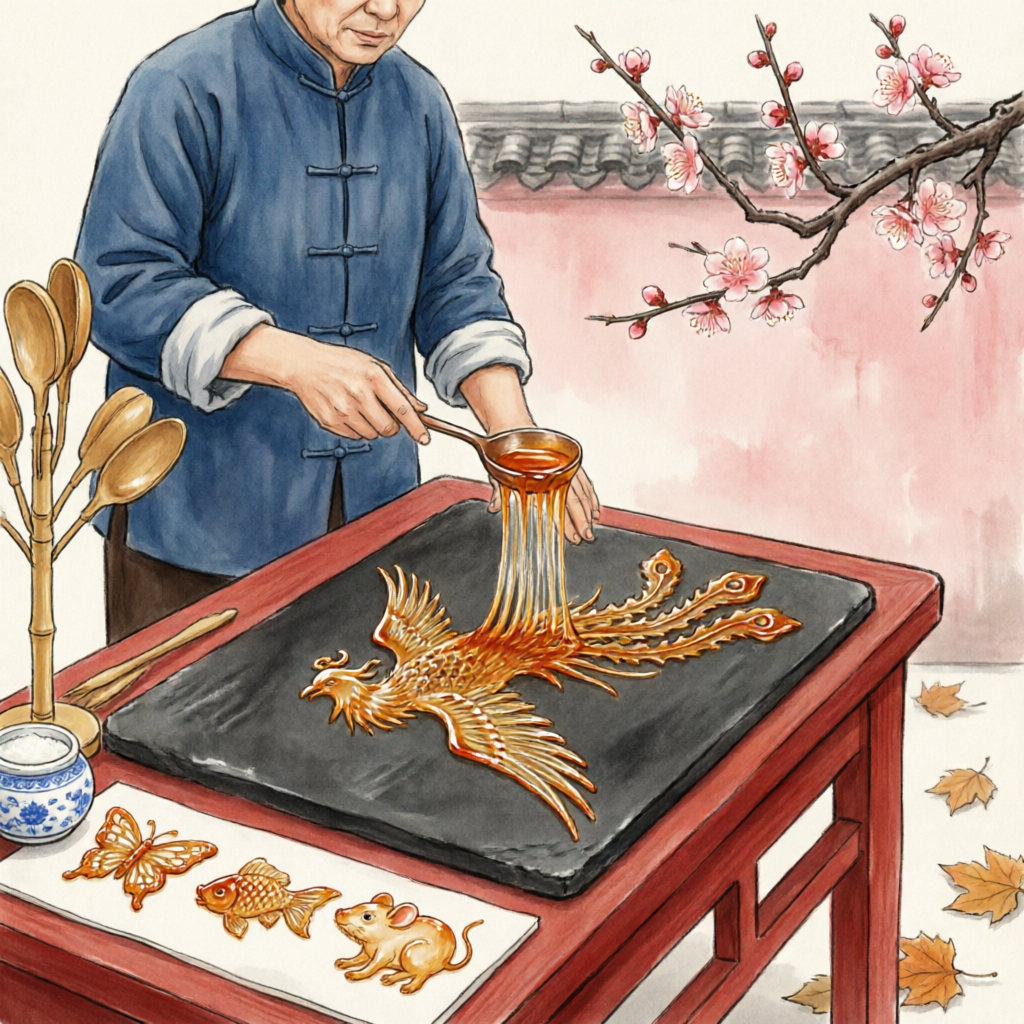
Sugar painting (糖画, táng huà) is a traditional Chinese folk art that uses molten sugar to create edible artworks. This unique craft combines visual art with culinary elements, resulting in pieces that are both decorative and consumable. Recognized for its cultural significance, sugar painting was listed as a National Intangible Cultural Heritage of China in 2008. The art form typically features figures from Chinese mythology, zodiac animals, flowers, and other decorative patterns, all crafted with liquid sugar that solidifies into intricate designs.
History
The origins of sugar painting can be traced to several historical accounts. One theory suggests it began during the Ming Dynasty with what was known as "sugar chancellors" (糖丞相). According to the "Jianhu Buji" (《坚瓠补集》) by Qing Dynasty novelist Chu Renhuo, during the Ming Dynasty, people would melt sugar and cast it into various animal and human figures as offerings to deities. These figures were so elaborately made that they resembled high officials, hence the playful name "sugar chancellors."
Another popular legend traces sugar painting back to the Tang Dynasty, when it was called "sugar cakes" (糖饼) or "sugar clouds." The poet Chen Zi'ang was said to have melted sugar and cast it into patterns for appreciation. This technique later entered the imperial court and spread among common people, becoming one of the origins of sugar painting.
During the Qing Dynasty, sugar painting became increasingly popular with more refined techniques and a wider range of subjects, mostly featuring auspicious patterns like dragons, phoenixes, fish, and monkeys that were favored by the general public. By the mid-Qing Dynasty, sugar painting had spread to Sichuan Province, where it deeply integrated with Bashu culture. The rise of Sichuan opera at the end of the Qing Dynasty gave it cultural soul, and by the early Republican period, it had become prevalent in Chengdu and other areas, with the industry organization "Taiyang Hui" (Sun Association) being established.
The technique evolved from early mold-imprinting to spoon-casting, gradually absorbing artistic methods from shadow puppets and paper-cutting to develop its mature form.
Key Information
| Aspect | Details |
|---|---|
| Chinese Name | 糖画 (táng huà) |
| English Name | Sugar painting |
| Heritage Level | National (国家级) |
| Heritage Category | Intangible Cultural Heritage (非物质文化遗产) |
| Category | Handicraft (手工艺) |
| Materials | Brown sugar, white sugar, malt sugar, rock sugar (红糖、白糖、饴糖、冰糖) |
| Nicknames | "Sugar figures" (倒糖人儿), "sugar cakes" (倒糖饼儿), "sugar shadows" (糖灯影儿) |
| Taste | Sweet (甜) |
| Recognition Year | 2008 |
| Main Regions | Sichuan Province, especially Chengdu; also popular in Chongqing, Jiangsu, Shandong, and other regions |
Cultural Significance
Sugar painting represents an important aspect of Chinese folk culture, reflecting the aesthetic preferences and daily life of ordinary people. The patterns and themes mainly draw from popular cultural life, reflecting people's daily preferences, local customs, stories, and legends. Modern sugar painting has incorporated themes from Sichuan opera and animation.
The craft demonstrates how traditional Chinese folk art can integrate practical function with aesthetic value. Being both edible and decorative, sugar paintings often appear at festivals, fairs, and other cultural events, serving as both treats and art objects. They are particularly popular during Chinese New Year, where zodiac animals and other auspicious symbols are commonly created.
The techniques used in sugar painting reflect influences from other traditional Chinese arts. The art form incorporates elements from shadow puppetry and paper-cutting in its methods, while also borrowing the line drawing techniques of traditional Chinese painting and sketching methods from Western art. This fusion of techniques has created a unique artistic style characterized by full, balanced lines.
Modern Status
In recent years, sugar painting has gained formal recognition and protection as an intangible cultural heritage. Chengdu sugar painting was listed as a National Intangible Cultural Heritage of China in 2008. Other regional variations have also received recognition at provincial and municipal levels, such as Fushun sugar painting (2021), Rongxian Chen's sugar painting (2021), and Chongqing sugar painting (2009).
The craft has seen a revival of interest, with new generations of artists bringing innovation while preserving traditional techniques. Contemporary sugar painters are incorporating modern elements like cartoon characters, anime figures, and even modern vehicles into their work. Some artists are experimenting with new materials and techniques, such as creating sugar paintings sealed in epoxy resin for permanent preservation or developing sugar-free versions of the traditional craft.
Sugar painting has found new platforms for exhibition and education, frequently appearing at cultural tourism festivals, intangible cultural heritage fairs, and holiday celebrations. It has also become part of educational initiatives, with "intangible cultural heritage entering schools" programs introducing sugar painting to primary and secondary school students. In some cases, specialized courses have been developed, such as "Chengdu Sugar Painting" courses for Korean schoolchildren.
The art form has also gained international exposure, participating in cultural exchange events and being featured in international tourism promotions. This cross-cultural engagement has helped promote understanding of Chinese traditional arts and crafts globally.
References
-
Wang, L. (2019). Chinese Folk Arts: Tradition and Innovation. Beijing: Cultural Relics Publishing House.
-
Chen, H. (2020). Intangible Cultural Heritage of China: Sugar Painting. Chengdu: Sichuan Publishing Group.
-
Zhang, Y., & Li, M. (2021). Traditional Crafts in Modern China: Preservation and Revival. Shanghai: Shanghai People's Publishing House.
-
Ministry of Culture and Tourism of the People's Republic of China. (2008). National Intangible Cultural Heritage名录 (National Intangible Cultural Heritage List). Beijing: China Intercontinental Press.