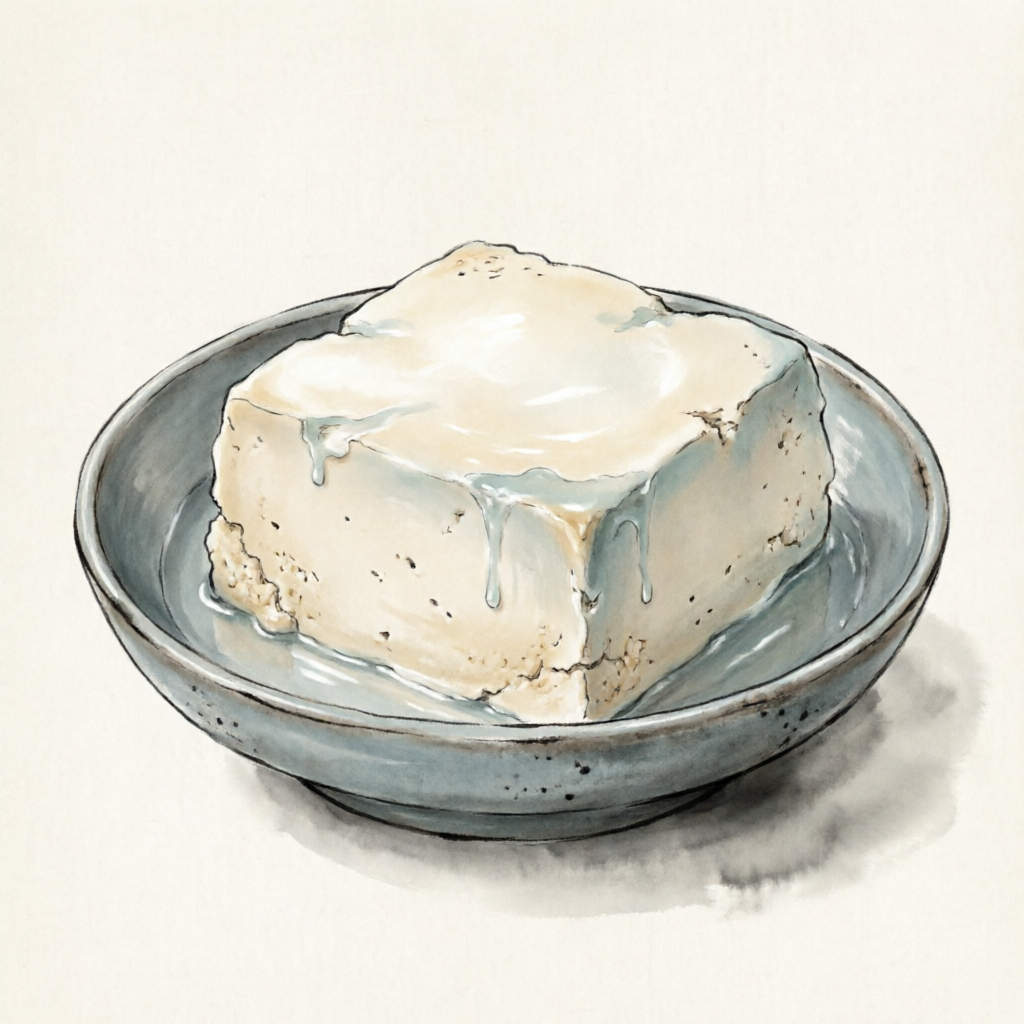
Tofu
Overview
Tofu, also known as bean curd, is a food prepared by coagulating soy milk and pressing the resulting curds into soft white blocks. It originated in ancient China and has become a staple ingredient in East and Southeast Asian cuisines. Tofu is renowned for its versatility, nutritional value, and ability to absorb flavors from other ingredients. The production of tofu involves several steps including soybean preparation, milk extraction, coagulation, and pressing, resulting in various textures and forms suitable for diverse culinary applications.
History
China is the birthplace of tofu. According to historical accounts, Liu An (179-122 BCE), the Prince of Huainan, is credited with its invention. Legend has it that Liu An's mother was fond of soybeans but became too ill to eat them whole. He instructed his servants to grind the beans into powder, which they then mixed with water to create soy milk. To improve the flavor, they added salt brine, which unexpectedly caused the mixture to solidify into curds (tofu flower). The prince's mother recovered after eating this new food, and thus tofu was born. It is believed that Liu An developed tofu during his organization of alchemical experiments with Daoist practitioners, who discovered that minerals and salts like gypsum could coagulate soy milk.
The famous Song Dynasty poet Zhu Xi wrote in his poem: "Planting beans, the plants grow sparse, exhausted heart has rotted. Had I known Huainan's technique earlier, I could have obtained wealth effortlessly." He added a note: "It is said that tofu originated from Huainan Prince's technique." The Ming Dynasty pharmacologist Li Shizhen, in his "Compendium of Materia Medica," confirmed: "The method of making tofu began with Liu An, the Prince of Huainan in the Western Han Dynasty."
During the Ming Dynasty, detailed accounts of tofu production methods appeared in various texts. Li Shizhen described in detail the rapid preparation method and use of coagulants: "The method of making tofu can use black soybeans, yellow soybeans, white soybeans, or mung beans. The process involves: soaking, crushing, removing dregs, steaming and boiling, then adding salt brine, alum solution, or vinegar sediment to set it in the pot. Some add gypsum powder in a jar to set it. Generally, salty, bitter, sour, or pungent substances can cause coagulation. The coagulated layer on top can be lifted and dried, becoming tofu skin, which is excellent for cooking." Most of these coagulants are still in use today.
The Ming Dynasty poet Su Bingheng wrote in "Tofu Poem": "The technique passed down from Huainan is the best, after removing the skin, the essence is revealed. Flowing like jade liquid on the mill wheel, rolling like snowflakes in boiling water. Steamed in earthenware pots, it has the moon's shadow, cut with a golden knife, it's flawless jade. Who knows the taste within? Mostly found in Buddhist and Taoist kitchens." This poem vividly describes tofu's invention, preparation, characteristics, and culinary traditions.
In the Qing Dynasty, Li Diaoyuan's "Tongshan Poetry Collection" summarized the production of tofu, tofu skin, five-spiced dried tofu, Suzhou fermented tofu, stinky tofu, and tofu paste. Wang Rizhen's "Huya" detailed various tofu forms: "Soybean milk set with gypsum or salt brine becomes tofu; unset is soy milk; set and cloth-wrapped into a whole block is dried tofu; placed on a square board is tofu box, so a whole block is called one box; slightly softer is water tofu, even softer is soft block, also called water tofu or basin tofu; the softest that cannot form a block is tofu flower or tofu brain; spread with fine cloth, poured with tofu slurry, covered with fine cloth, pressed alternately becomes sheets, called thousand sheets or hundred layers; the skin formed on the surface when lifted is tofu skin; dried tofu cut into small squares and fried in oil becomes tofu with a skin but hollow inside, called oil tofu; cut into triangles, called corner tofu."
Japanese scholar of Chinese food history, Takeo Yoshida, wrote "Research on Tofu." After examining various Song Dynasty and earlier agricultural books, as well as Tang Dynasty essays and collections, he found no records of tofu. Finally, he discovered the earliest mention in Tao Gu's "Qing Lu Lu" from the early Song Dynasty: "Several tofu are sold daily in the market, and locals call tofu 'little sheep,'" referring to its nutritional value.
Key Information
| Aspect | Details |
|---|---|
| Chinese Name | 豆腐 (dòufu) |
| Classification | Tofu/Bean Curd |
| Main Types | Southern tofu (soft), Northern tofu (firm), Lactone tofu (silky) |
| Origin | China (traditionally attributed to Liu An, Prince of Huainan) |
| Primary Ingredients | Soybeans, water, coagulants (gypsum, nigari, etc.) |
| Nutritional Value | High in protein, low in calories, contains essential amino acids, calcium, iron, and other minerals |
| Cultural Significance | Staple in East Asian cuisines, associated with Buddhist vegetarian traditions, symbolizes simplicity and purity |
Cultural Significance
Tofu holds significant cultural importance across Asia, particularly in China, Japan, Korea, and other countries where it has been integrated into traditional cuisines for centuries. In Chinese culture, tofu is often associated with simplicity, purity, and humility, qualities that align with Buddhist vegetarian traditions. Buddhist monks, who were often at the forefront of tofu development and preparation, valued it as an excellent source of protein that could substitute for meat.
The versatility of tofu in culinary applications has made it a symbol of adaptability. It can be prepared in numerous ways—steamed, fried, grilled, raw, fermented—and absorbs flavors readily, making it a favorite ingredient in both simple home cooking and elaborate restaurant dishes. In Chinese literature and poetry, tofu has been celebrated for its nutritional benefits and humble origins, often appearing in verses that praise its simplicity and health-giving properties.
Tofu also plays a role in traditional Chinese medicine, where it is considered a cooling food that can help balance the body's "heat". Its nutritional profile—high in protein, low in fat, and containing various minerals—has made it a staple in health-conscious diets throughout Asia and increasingly worldwide.
Modern Status
Today, tofu has transcended its regional origins to become a global food product consumed in nearly every country. Modern production methods have standardized tofu making, though traditional techniques still persist, particularly in artisanal and small-scale operations. The global market offers a wide variety of tofu products, from traditional soft and firm tofu to flavored, smoked, and fermented versions.
Nutritional science has confirmed many of the health benefits traditionally attributed to tofu. It is recognized as an excellent source of plant-based protein, making it particularly valuable in vegetarian and vegan diets. Research has highlighted its potential benefits for heart health, bone health, and cancer prevention, though studies on these aspects continue.
In contemporary culinary contexts, tofu has been embraced by chefs worldwide for its versatility and adaptability. It serves as a meat substitute in Western vegetarian cuisine while continuing to be a fundamental ingredient in traditional Asian dishes. Innovations in tofu preparation have led to new textures and forms, making it accessible to diverse palates and cooking styles.
Despite its widespread acceptance, tofu remains subject to misconceptions, particularly regarding its taste and nutritional value. Educational efforts continue to highlight its benefits and proper preparation methods to overcome these barriers.
References
-
Anderson, E. N. (1988). The Food of China. Yale University Press.
-
Shurtleff, W., & Aoyagi, A. (2013). History of Tofu and Tofu Products in China, Japan, and Other East Asian Countries. Soyfoods Center.
-
Li, Y. (2009). Chinese Culinary History. China Light Industry Press.
-
Huang, H. K. (2010). Handbook of Food Products Manufacturing. John Wiley & Sons.
-
Kim, J. O. (2015). Traditional Korean Foods: History and Culture. Seoul National University Press.