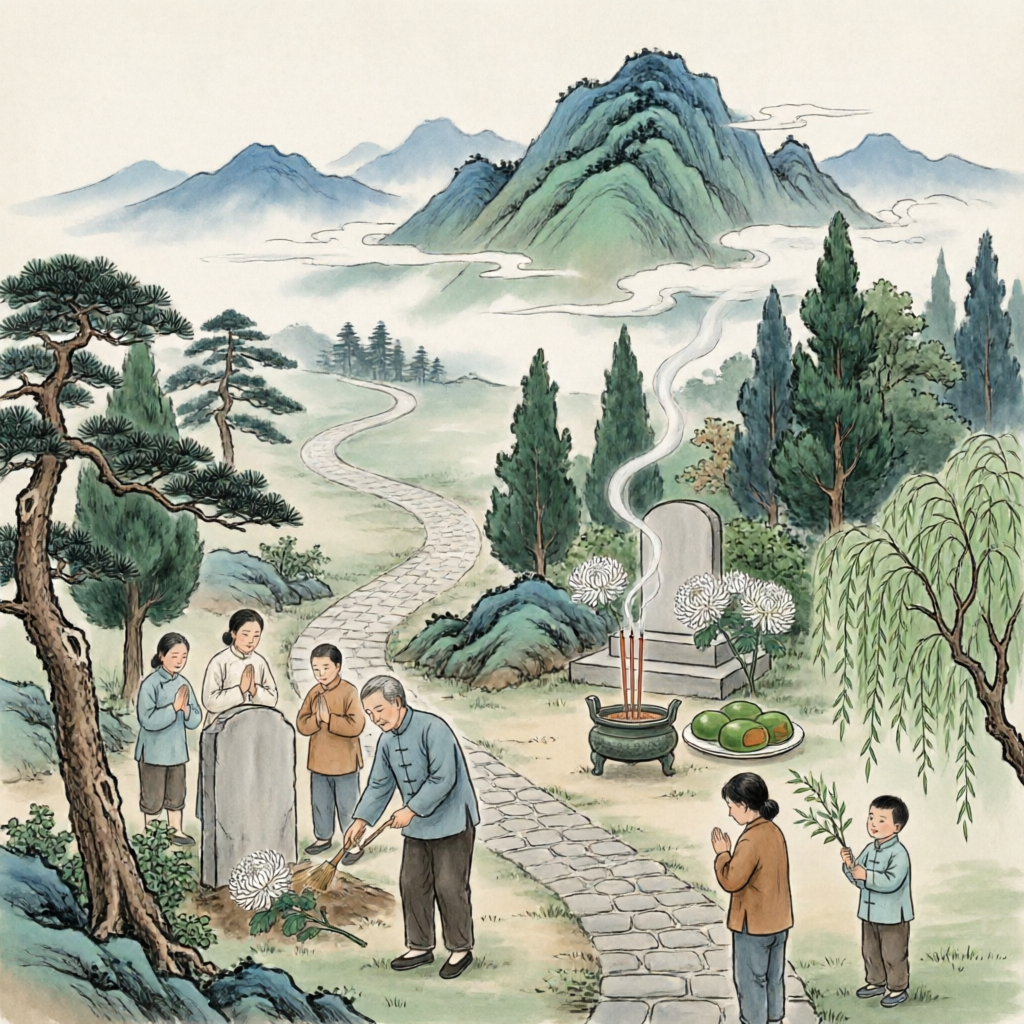
Qingming Festival
Overview
Qingming Festival, also known as Tomb-Sweeping Day, Spring Festival, or Ancestors' Day, occurs on the 15th day after the Spring Equinox in the lunar calendar, typically around April 5th in the Gregorian calendar. It is one of the 24 solar terms in the traditional Chinese calendar and a traditional festival for ancestor worship. The 24 solar terms originated from ancient agricultural civilization and are connected with the Ganzhi timekeeping system and the Eight Trigrams (Bagua), having a long historical source. These solar terms not only guided agricultural production but also influenced ancient Chinese people's daily lives, including clothing, food, housing, transportation, and even cultural concepts.
Qingming Festival is an important traditional festival of the Chinese nation, historically second only to the Spring Festival in scale. In traditional society, the festival period lasted longer (five to ten days, varying by region and era), serving both as a time for tomb sweeping and honoring deceased relatives and as a season for spring outings and enjoying nature. Today, Qingming Festival remains one of the most significant holidays for the Chinese people, including overseas Chinese communities.
History
Solar Term Origin
In ancient times, Qingming was initially only a solar term reminding farmers to begin spring plowing and planting. The Huainanzi Astronomical Canon records: "Fifteen days after the Spring Equinox, when the handle of the Big Dipper points to the 'Yi' position, the Qingming wind arrives." The Hundred Questions About Seasons explains: "At this time, all things grow clean and bright, hence it is called Qingming (Pure Brightness)." When Qingming arrives, temperatures rise and rainfall increases, making it an ideal season for spring plowing and planting.
The Seventy-Two Seasons of the Monthly Ordinances states: "According to the Guoyu, there are eight directional winds, but the almanac specifically refers to the Qingming wind as the third month's wind. This wind belongs to the Xun trigram. All things align with Xun, and at this time, all things become clean and bright." The "eight directional winds" refer to winds from all directions. The "Qingming wind" mentioned in ancient almanacs comes from the southeast, which corresponds to the Xun direction in the I Ching (Book of Changes). The I Ching also states that all things "align with Xun," where "align" means "clean and orderly." When the third lunar month arrives, the air is clear and the scenery bright, and all things become manifest, which is the origin of the name "Qingming."
Festival Evolution
According to historical records, traditional Chinese tomb sweeping began in the Zhou Dynasty, over 2,500 years ago. The Rites of Zhou documents tomb worship customs, establishing officials to manage imperial and commoner cemeteries. During the Warring States period, the Mencius describes a person from Qi state begging for food from tomb sacrifices, indicating that tomb rituals were already common by then. During the Qin and Han dynasties, tomb sweeping had become an indispensable ritual activity, as recorded in the Book of Han.
However, during the Zhou, Qin, and Han dynasties, these ancestor worship activities did not specifically occur on the Qingming date, and there was no Qingming Festival as such.
In the Tang Dynasty, Hanshi (Cold Food) Festival and Qingming Festival were two separate occasions. Due to the rulers' emphasis on Confucian governance and filial piety, tomb sweeping and ancestor worship flourished. Emperor Xuanzong incorporated tomb worship into the Five Rites and issued an edict designating tomb sweeping during the Cold Food Festival as one of the Five Rites, granting a three-day holiday starting two days before Qingming. From the imperial court to common people, tomb sweeping during the Cold Food Festival was considered a ritual of returning to one's roots and honoring ancestors.
At this point, Qingming Festival began to form as a festival, absorbing customs from the Cold Food Festival. Meanwhile, the Shangsi Festival's purification rituals became more entertainment-oriented in the Tang Dynasty, with activities like "qu shui liu shang" (floating wine cups along a stream) gaining popularity, and Shangsi Festival elements were also incorporated into Qingming Festival.
During the Song and Yuan dynasties, Qingming Festival gradually rose from being subordinate to the Cold Food Festival to replacing it. As the Yuan people abandoned the Cold Food Festival and the Shangsi Festival faded, Qingming Festival absorbed the essence of customs from both festivals—such as cold food, swinging, and spring outings—forming a traditional festival centered around ancestor worship and tomb sweeping. The Song dynasty poet Gao Juqing's poem "Qingming" reflects the scene of tomb worship during this period: "On the north and south hills, many tombs appear, On Qingming, people swarm to sweep them far and near. Ashes turn to white butterflies in flight, Tears and blood stain red azaleas bright. At sunrise, foxes sleep on graves, At night, children laugh before lantern waves. Life has wine, one must drink with cheer, But not a drop reaches the nether sphere."
The Ming and Qing dynasties largely continued previous traditions, with customs of ancestor worship and mourning deceased relatives remaining prevalent. During these periods, the practice of welcoming the "City God" (Chenghuang) and worshiping "Li" (spirits of the unclaimed dead) was also popular during Qingming. The "City God" is a protective deity of cities in Chinese folk belief and also governs souls, while "Li" refers to homeless, wandering ghosts.
The Republic of China government designated Qingming Festival as a national holiday, also called the National Tomb Sweeping Day. Shortly after the founding of the Republic of China, an important change occurred in the development of Qingming Festival: in 1915, it was designated as Arbor Day. On this day, government agencies and schools conducted tree planting activities. This choice reflected the advocacy for afforestation and forest conservation, and the government linked this activity closely with agriculture. By 1928, Arbor Day was moved to the anniversary of Sun Yat-sen's death (March 12), ending Qingming's history as Arbor Day, though some regions retained the practice of tree planting during Qingming.
After the founding of the People's Republic of China, Qingming customs underwent significant changes, particularly in two aspects. First, in tomb sweeping customs, due to government promotion, visiting revolutionary martyrs' cemeteries to commemorate their deeds became a choice for many organizations and individuals. Second, apart from tomb sweeping and spring outings, most Qingming customs were in rapid decline. Before the mid-20th century, activities such as swinging, flying kites, and egg fighting still brought much joy during Qingming, but today few people can experience that pleasure and fun.
Key Information
| Aspect | Details |
|---|---|
| Chinese Name | 清明节 (Qingming Jie) |
| English Name | Tomb-Sweeping Day, Pure Brightness Festival |
| Also Known As | Spring Festival, Ancestors' Day, Hanshi Festival (historically) |
| Time | 15th day after Spring Equinox (lunar), around April 5 (Gregorian) |
| Type | Traditional Chinese festival, solar term |
| Significance | Ancestor worship, spring outing, family reunion |
| Duration | Traditionally 5-10 days, now typically 1-3 days |
| Main Activities | Tomb sweeping, spring outings, kite flying, tree planting |
| Food | Green rice balls (Qingtuan), cold food, rice cakes |
| Cultural Status | Intangible Cultural Heritage of China |
Cultural Significance
Qingming Festival embodies the Chinese cultural values of filial piety, respect for ancestors, and the importance of family continuity. The festival reflects the Chinese concept of "xiao" (filial piety) and "shizhong zhuiyuan" (mindfully honoring ancestors from afar). During tomb sweeping ceremonies, people express their respect and remembrance for deceased family members, maintaining the connection between past and present generations.
The dual nature of Qingming Festival—as both a time for mourning and a time for celebrating spring—reflects the Chinese philosophical balance between yin and yang. The somber activities of tomb sweeping represent the yin aspect of honoring the deceased, while the joyful spring outings represent the yang aspect of embracing new life and the vitality of nature.
Qingming Festival also plays an important role in maintaining family ties and clan identity. For overseas Chinese, returning home to participate in Qingming ceremonies is a significant way of reconnecting with their cultural roots and maintaining family bonds across generations.
Modern Status
Today, Qingming Festival remains one of the most important traditional festivals in China. In 2006, it was listed as one of the first national intangible cultural heritages of China. In 2008, it became a public holiday in mainland China, allowing people to travel to their ancestral hometowns to participate in tomb sweeping ceremonies.
Modern celebrations of Qingming Festival often blend traditional customs with contemporary practices. While tomb sweeping remains central, many families also take the opportunity for family reunions and spring outings. Environmental considerations have led to changes in some practices, such as the promotion of flower offerings instead of burning paper money in some areas to reduce fire hazards and pollution.
In recent years, online "virtual tomb sweeping" has emerged as an alternative for those unable to return to their ancestral homes. Digital platforms offer online memorial services where people can leave virtual offerings and messages for their ancestors.
The festival has also gained recognition internationally, with Chinese communities worldwide celebrating Qingming Festival through various cultural activities that blend traditional elements with local customs.
References
-
Needham, Joseph. (1959). Science and Civilisation in China, Volume 3: Mathematics and the Sciences of the Heavens and the Earth. Cambridge University Press.
-
Kwok, D.W.Y. (1986). Orthodoxy and Heterodoxy in Imperial China: The Religious Dimension of Intellectual Life. University Press of America.
-
Dean, Kenneth. (1998). Taoist Ritual and Popular Cults of Southeast China. Princeton University Press.
-
Chinese Folklore Research Institute. (2004). Chinese Traditional Festivals. Beijing: Commercial Press.
-
Chau, Adam Yuet. (2006). Miraculous Response: Doing Popular Religion in Contemporary China. Stanford University Press.