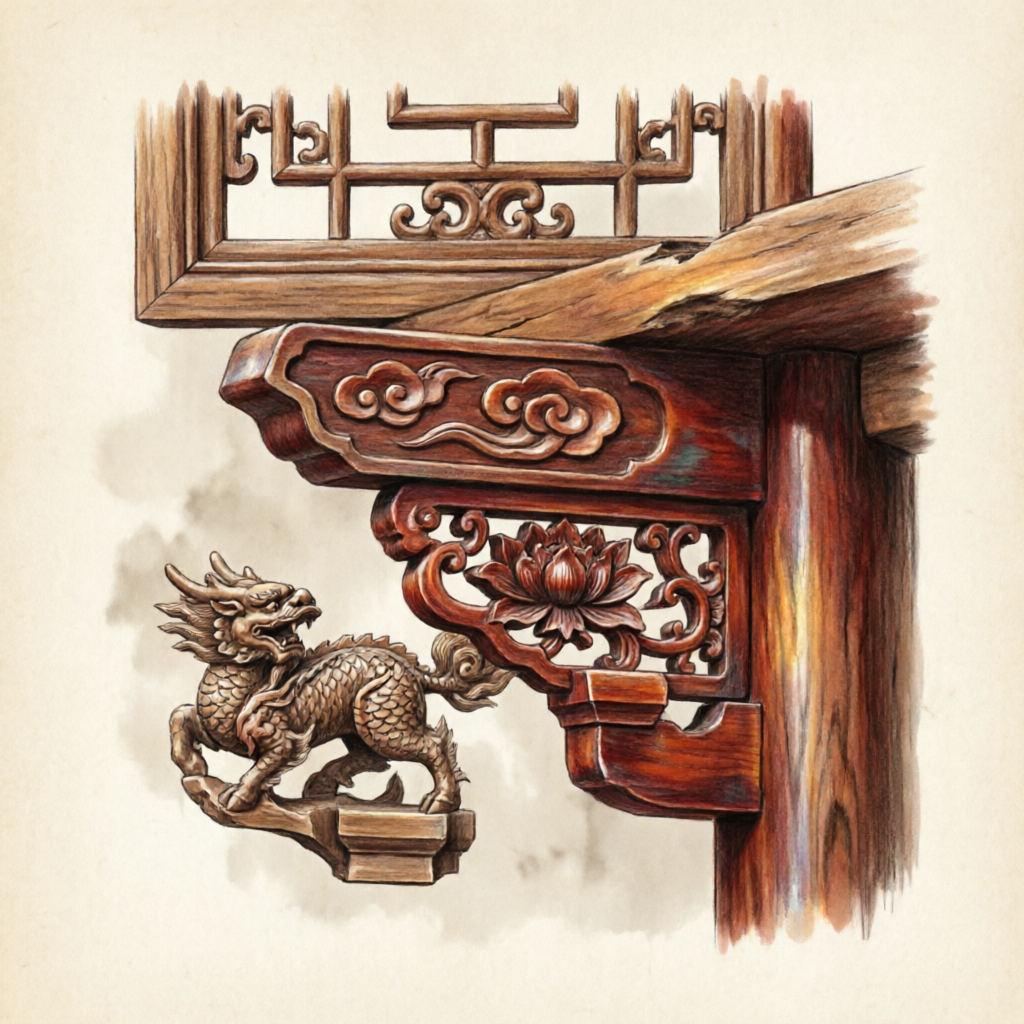
Wood Carving
Overview
Wood carving is a traditional sculptural art form that involves shaping wood through cutting, carving, and abrasion. As one of the important categories of traditional Chinese sculpture, wood carving has a rich history spanning over 7,000 years, dating back to the Neolithic period. This art form encompasses a wide variety of styles and techniques, ranging from intricate decorative pieces to large-scale architectural elements. Wood carving has been recognized as an important form of "folk craft" (民间工艺) in China and represents a significant cultural heritage that continues to evolve while maintaining traditional techniques.
History
Origins
The generally accepted view is that Chinese wood carving art originated during the Neolithic period. Archaeological evidence from the Hemudu culture (c. 7000 years ago) in Yuyao, Zhejiang Province, includes carved wooden fish, representing the earliest known wooden artifacts in China's wood carving history. However, like other sculptural arts, wood carving likely emerged alongside human development, initially as an unconscious activity that became a true art form when humans developed aesthetic appreciation.
During the Qin and Han dynasties (221 BCE-220 CE), wood carving techniques matured, with exquisite and perfect painting and carving skills. The emergence of painted wood carvings marked a significant achievement in ancient wood carving craftsmanship.
The Tang Dynasty (618-907 CE) witnessed a flourishing period for wood carving, with techniques becoming increasingly sophisticated. Many surviving wooden Buddha statues from this period are considered masterpieces of ancient Chinese art, characterized by concise modeling, skilled and flowing knife work, and clear, crisp lines. These works have become highly sought after in today's domestic and international art markets.
Development Through Dynasties
During the Ming and Qing dynasties (1368-1912), wood carving themes often depicted daily life customs and mythological stories. Popular motifs included "Jiqing Youyu" (吉庆有余, abundance and celebration), "Wugu Fengdeng" (五谷丰登, bountiful harvest), "Longfeng Chengxiang" (龙凤呈祥, dragon and phoenix bringing auspiciousness), "Ping'an Ruyi" (平安如意, peace and good fortune), and "Songhe Yannian" (松鹤延年, pine and crane symbolizing longevity). These works were widely popular in contemporary society.
Wood carving varieties are numerous and complex. After hundreds of years of development, various schools have formed their own unique craft styles, gaining nationwide recognition. Dongyang wood carving, born in the Song Dynasty in Dongyang, Zhejiang, excels in carving with beautiful patterns and exquisite structures. During the Qianlong period of the Qing Dynasty, the Dongyang region, known as the "carving hometown" (雕花之乡), had over 400 craftsmen summoned to the capital to repair palaces. Leqing yellowwood carving became one of China's folk wood carving crafts from the mid-Qing Dynasty, renowned for carving small yellowwood ornaments. Guangdong gold-painted wood carving originated in the Tang Dynasty, using camphor wood carved and then lacquered and gilded, creating a magnificent artistic effect.
Modern Development
From the late Qing Dynasty to the Republic of China period, due to government corruption, national decline, foreign aggression, and suffering of the people, wood carving art declined, and artisans could only work as craftsmen to make a living. After the founding of New China, under the care of the Party and state, folk crafts received protection and excavation, and wood carving regained vitality with the emergence of a group of national masters. Their works, exquisite in craftsmanship, inherited tradition, profound in conception, and praising the era, reflected the masters' commitment to tradition, innovation, and their gratitude to the country.
Since the reform and opening-up, China's economic boom and the state's strong support for folk arts have aroused people's love and pursuit of traditional arts and crafts. In this prosperous era, folk arts and crafts have taken a new leap, and wood carving is no exception. However, facing the reality that excellent works in national craft exhibitions are mostly created by older artists with few young participants, a serious challenge has emerged: how to stimulate young people's interest in making folk crafts and how to cultivate qualified successors to prevent the discontinuation of these art forms.
Key Information
| Aspect | Details |
|---|---|
| Chinese Name | 木雕 (Mùdiāo) |
| English Name | Wood Carving |
| Origin | Neolithic Period (新石器时期) |
| Nature | A form of sculpture (雕塑的一种) |
| Classification | Decorative craft (观赏性工艺品) |
| Golden Age | Tang Dynasty (唐朝) |
| Major Schools | Dongyang, Leqing Yellowwood, Guangdong Gold-painted, etc. |
| Heritage Sites | Junxian, Qufu, Macau, Qiaokou District of Wuhan, Putian of Fujian |
Cultural Significance
Wood carving holds significant cultural value in Chinese society, reflecting traditional aesthetics, beliefs, and craftsmanship. Different regional styles have developed distinctive characteristics influenced by local culture, resources, and artistic traditions. For example, Dongyang wood carving is known for its architectural applications and intricate relief work, while Leqing yellowwood carving specializes in small, detailed figurines.
Wood carving themes often incorporate symbolic elements that reflect Chinese cultural values. Common motifs include mythical creatures (dragons, phoenixes), plants (pine, plum blossoms), and auspicious symbols representing prosperity, longevity, and good fortune. These symbolic elements are not merely decorative but carry deep cultural meanings that have been passed down through generations.
Modern Status
Today, wood carving faces both challenges and opportunities in the contemporary cultural landscape. On one hand, machine manufacturing has increasingly replaced handcrafted work due to cost considerations, leading to a decline in the market for hand-carved items. Many artisans struggle to compete with mass-produced goods that can be created in minutes rather than days or weeks of manual labor.
On the other hand, there has been a growing appreciation for traditional craftsmanship and cultural heritage. The Chinese government has recognized wood carving as an important intangible cultural heritage, providing support for preservation efforts. Master craftsmen have been designated as cultural inheritors, and workshops and training programs have been established to pass down traditional techniques to younger generations.
Contemporary wood carving artists are exploring new directions while maintaining traditional techniques. Some incorporate modern themes and experimental approaches, while others focus on reviving classical styles. Educational institutions have begun including wood carving in their curricula, helping to ensure the transmission of this art form to future generations.
Tools and Techniques
Tools
Wood carving requires specialized tools that directly influence the quality and outcome of the work. Essential tools include carving knives and auxiliary implements. As the saying goes, "A craftsman's skill is as much in their tools as in their hands." The primary carving knives fall into two categories: "tubular" roughing knives (坯刀) for initial shaping and "drill-shaped" finishing knives (修光刀) for detailed work and surface refinement.
Common types of carving knives include:
- Round knives (圆刀): With curved edges, used for circular shapes and concave surfaces
- Flat knives (平刀): With straight edges, used for planing and creating flat surfaces
- Bevel knives (斜刀): With 45-degree angled edges, used for corners and tight spaces
- Yuwan knives (玉婉刀): A hybrid between round and flat knives for gentle surface refinement
- Medium steel knives (中钢刀): Used for maintaining straight lines and creating patterns
- Triangular knives (三角刀): Used for fine lines, hair, and decorative patterns
Auxiliary tools include hammers, files, axes, saws, and specialized workbenches with clamps. Modern practitioners may also use electric polishing machines and drills for certain tasks.
Techniques
The wood carving process involves several key stages:
-
Material Selection: Different woods have varying characteristics. Hardwoods like mahogany, boxwood, and rosewood are durable but difficult to carve, while softer woods like basswood and pine are easier to work with but may require coloring. The choice of wood depends on the intended work and the artist's skill level.
-
Wood Preparation: Wood must be properly dried to prevent cracking. Methods include:
- Artificial drying: Using steam chambers to remove moisture
- Natural drying: Air-drying in well-ventilated areas for months or years
-
Simple artificial methods: Fire-drying or boiling to remove resins
-
Carving Process: The fundamental technique is "reductive carving"—removing material to reveal the form within. This involves:
- Concept drawing: Creating initial designs on the wood surface
- Roughing (粗坯): Establishing basic forms and proportions
- Refining (细坯): Developing details and finalizing the form
- Surface finishing (修光): Creating smooth surfaces and final details
- Sanding: Using progressively finer sandpaper to achieve smoothness
- Coloring and polishing: Applying finishes to enhance the wood's natural beauty
Conservation
Proper care is essential for preserving wood carvings. Key recommendations include:
- Avoiding prolonged exposure to direct sunlight
- Maintaining stable humidity levels (not too dry or too damp)
- Keeping away from heat sources like radiators or fireplaces
- Using dry, soft cloths for dusting
- Occasionally applying wax or oil to maintain the wood's luster
Classification
Wood carving in China can be classified by region, with numerous distinctive schools:
Regional Schools
- Dongyang Wood Carving (Zhejiang): Known for architectural applications and relief work
- Leqing Yellowwood Carving (Zhejiang): Specializes in small figurines and decorative objects
- Guangdong Gold-painted Wood Carving: Features elaborate gilded designs
- Qufu Kaimu Carving (Shandong): Uses local paulownia wood
- Jianchuan Wood Carving (Yunnan): Incorporates ethnic minority cultural elements
- Hubei Wooden Boat Carving: Focuses on maritime themes
Each regional school has developed unique characteristics based on local wood availability, cultural influences, and historical development. This diversity has contributed to the rich tapestry of Chinese wood carving traditions.
References
-
Sullivan, M. (1999). The Arts of China. University of California Press.
-
Clunas, C. (2009). Art in China. Oxford University Press.
-
Wang, S. (2012). Chinese Folk Arts: Traditions and Modernity. China Intercontinental Press.
-
Andrews, J. (1994). The Art of Chinese Craftsmen. Oxford University Press.
-
Little, S. (2000). Chinese Lacquer and Wood Carving: The Charles B. Hoyt Collection. Museum of Fine Arts, Boston.