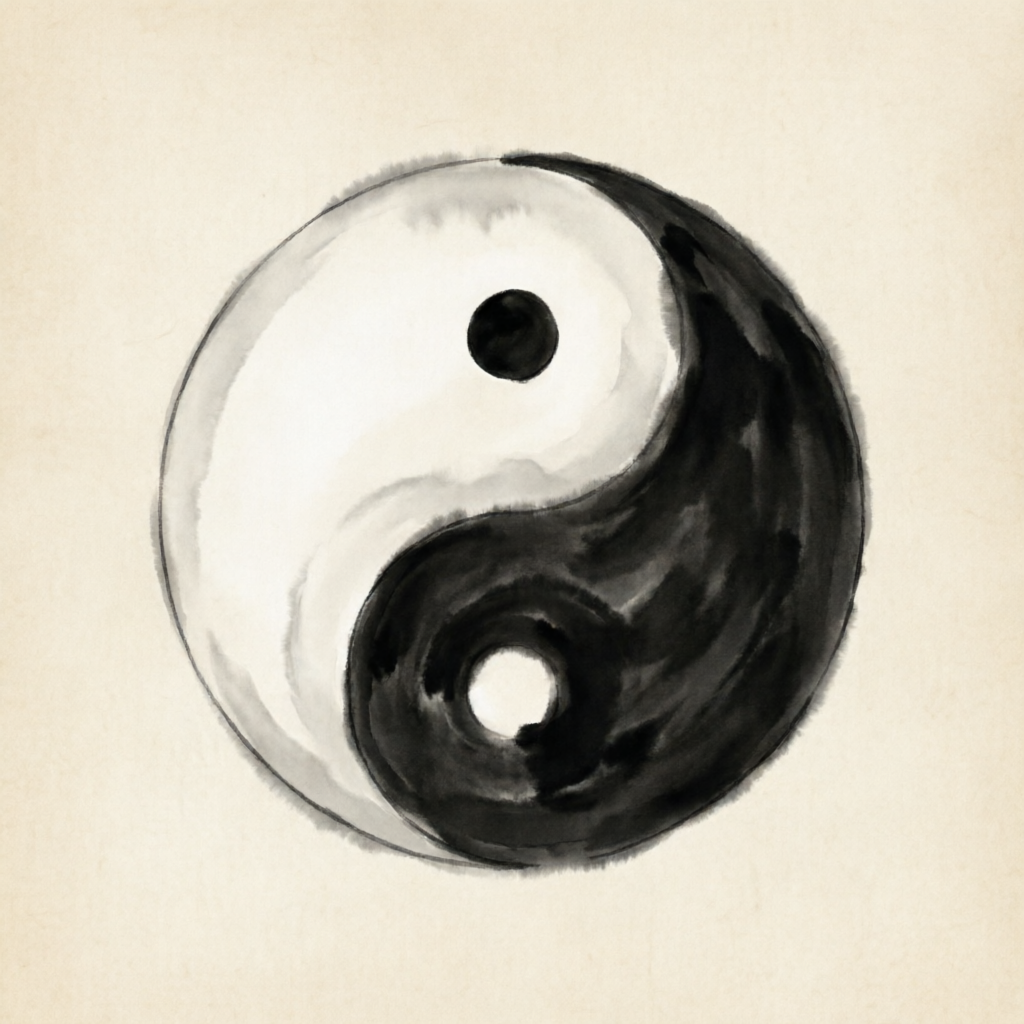
Yin and Yang
Overview
Yin and Yang (Chinese: 阴阳) represent the ancient Chinese philosophical concept of dualism, describing how seemingly opposite or contrary forces may actually be complementary, interconnected, and interdependent in the natural world. This fundamental concept originates from Chinese cosmology and has influenced various aspects of Chinese culture, including philosophy, medicine, martial arts, and daily life for over two millennia. The symbol of Yin and Yang, often depicted as a circle with a black and white fish-like pattern, has become one of the most recognizable symbols worldwide, representing the dynamic balance of opposing forces.
History
The concept of Yin and Yang dates back to the Western Zhou Dynasty (1046-771 BCE), where it was initially used to describe the shady and sunny sides of hills and mountains. The term appears in ancient texts such as the I Ching (Book of Changes), one of the oldest Chinese classics, which states: "One Yin and one Yang is called the Dao" (一阴一阳之谓道). By the Spring and Autumn period (771-476 BCE), the concept had evolved into a sophisticated philosophical framework used to explain the natural world and human existence.
The systematic development of Yin-Yang theory is attributed to the philosopher Zou Yan (305-240 BCE) of the Yin-Yang School during the late Warring States period. He applied the concept to cosmology, creating a theory of the Five Elements (Wu Xing) that interacted through Yin and Yang principles. During the Han Dynasty (206 BCE-220 CE), Yin-Yang theory became an integral part of Chinese philosophical thought, particularly through the work of Dong Zhongshu, who synthesized it with Confucianism.
Key Information
| Aspect | Yin | Yang |
|---|---|---|
| Symbol | ☯ (Black portion) | ☯ (White portion) |
| Characteristics | Passive, dark, cold, receptive, feminine | Active, bright, hot, creative, masculine |
| Natural Examples | Moon, night, winter, water, earth | Sun, day, summer, fire, heaven |
| Direction | North, bottom, interior | South, top, exterior |
| Season | Autumn and winter | Spring and summer |
| Element | Water and earth | Fire and air |
Cultural Significance
Yin-Yang theory has profoundly influenced Chinese culture across multiple domains:
Traditional Chinese Medicine
In Traditional Chinese Medicine (TCM), Yin-Yang forms the theoretical foundation for understanding health and disease. Health is viewed as a balance between Yin and Yang energies within the body, while illness results from their imbalance. TCM diagnosis and treatment aim to restore this balance through various methods including acupuncture, herbal medicine, and dietary adjustments.
Martial Arts
Many Chinese martial arts incorporate Yin-Yang principles in their training philosophy and techniques. For example, Tai Chi Chuan emphasizes the balance of soft (Yin) and hard (Yang) techniques, while Baguazhang focuses on circular movements that embody the continuous transformation between Yin and Yang states.
Art and Design
The Yin-Yang symbol has become a ubiquitous design element in East Asian art and architecture. Beyond its direct representation, the principle of balancing opposing elements influences composition in painting, calligraphy, and garden design, where elements of light and shadow, solid and empty, are carefully balanced.
Daily Life
Traditional Chinese customs and practices often reflect Yin-Yang principles. This includes considerations of directional orientation (feng shui), timing of activities based on阴阳历 (Yin-Yang calendar), and the arrangement of living spaces to promote harmony between opposing forces.
Modern Status
In contemporary times, Yin-Yang theory continues to be relevant both within Chinese culture and globally:
Academic Study
Yin-Yang has become a subject of academic research across disciplines including philosophy, physics, psychology, and systems theory. Scholars have drawn parallels between Yin-Yang concepts and modern scientific theories such as quantum mechanics, where complementary principles like wave-particle duality exhibit similar characteristics of opposition and interdependence.
Popular Culture
The Yin-Yang symbol has achieved global recognition as a design element in popular culture, appearing in logos, tattoos, and artwork worldwide. Its representation of balance has made it appealing to diverse audiences seeking harmony in increasingly polarized societies.
Contemporary Applications
Modern applications of Yin-Yang principles extend to fields such as:
- Business Management: Creating balanced organizational structures that incorporate both competitive (Yang) and collaborative (Yin) approaches
- Environmental Science: Developing sustainable systems that balance human needs (Yang) with ecological preservation (Yin)
- Psychology: Integrating opposing personality traits as complementary rather than contradictory
References
-
Needham, J. (1956). Science and Civilisation in China, Volume 2: History of Scientific Thought. Cambridge University Press.
-
Little, S. (1990). Taoism and the Arts of China. University of Chicago Press.
-
Kohn, L. (2000). Daoism Handbook. Brill Academic Publishers.
-
Zhang, D., & Rose, K. (1992). Yin-Yang in the Modern World: A Philosophical Interpretation. State University of New York Press.
-
Unschuld, P. U. (1985). Medicine in China: A History of Ideas. University of California Press.