Overview
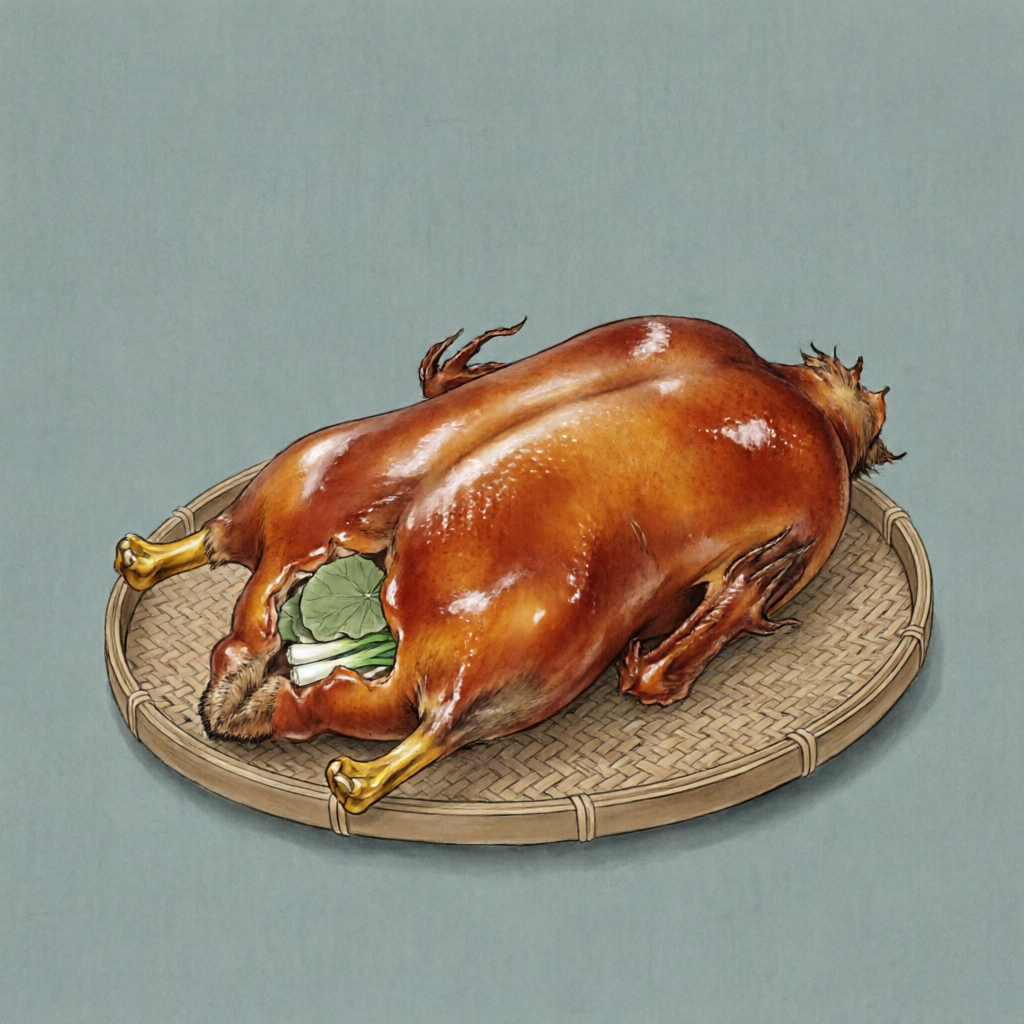
Beijing Roast Duck, also known as Peking Duck, is a famous dish originating from Beijing, China. It has been a culinary icon for over 600 years and is celebrated worldwide for its distinctive preparation method, characterized by thin, crispy skin and tender, flavorful meat. The dish represents the pinnacle of Chinese culinary artistry and has become a symbol of Chinese cuisine globally.
History
The origins of Beijing Roast Duck can be traced back to the early Ming Dynasty (14th century). Initially, people in the capital city of Nanjing (known as Jinling at the time) enjoyed roasted duck, with historical accounts noting that Emperor Hongwu (Zhu Yuanzhang) reportedly consumed roasted duck daily. Court chefs developed new duck preparations to please the emperor, creating both spit-roasted and oven-roasted duck methods.
According to historical records, after Emperor Yongle (Zhu Di) usurped the throne and moved the capital to Beijing, he brought many duck roasting masters from Nanjing. By the Jiajing era (1522-1566), roasted duck had spread from the imperial court to common people. The first recorded roast duck shop in Beijing, "Bianyifang," opened in Caishikou's Mishi Hutong, originally called "Jinling Piyan Duck" (Jinling Sliced Skin Duck).
In 1864, the renowned "Quanjude" roast duck restaurant opened in Beijing, advancing duck roasting techniques to the "hung oven" method. This method uses fruitwood for an open flame roasting, giving the duck a special aromatic flavor. This innovation helped "Beijing Roast Duck" surpass "Nanjing Roast Duck" in fame, with the latter becoming primarily found in southern Chinese cities like Hong Kong, Macau, Shenzhen, and Guangzhou.
Key Information
| Aspect | Description |
|---|---|
| Main Ingredient | Beijing duck (specifically "Beijing fill duck" - a breed force-fed to plumpness) |
| Cooking Method | Two main techniques: "hung oven" (Quanjude style) and "oven-roasted" (Bianyifang style) |
| Key Feature | Crispy skin with thin layer of fat underneath |
| Serving Style | Sliced with thin pancakes, scallions, cucumber, and sweet bean sauce |
| Cultural Significance | Represents Chinese culinary excellence and hospitality |
Cultural Significance
Beijing Roast Duck holds significant cultural importance in China and beyond. It has traditionally been served at important banquets and diplomatic functions, symbolizing Chinese hospitality and culinary excellence. Former Premier Zhou Enzhai was particularly fond of the dish and often served it to foreign guests.
The dish has also influenced Chinese language and culture. The term "tian ya jiao shi" (literally "duck-stuffed teaching method") refers to an educational approach that forces information onto students without proper engagement, drawing a parallel to how ducks are force-fed for this delicacy.
The preparation and serving of Beijing Roast Duck is considered a performance art in itself, with skilled chefs demonstrating their knife techniques by slicing the duck into precise pieces at the dining table. This theatrical element adds to the dining experience and cultural value of the dish.
Modern Status
Today, Beijing Roast Duck continues to evolve while maintaining its traditional essence. Two main styles dominate the culinary landscape:
-
Quanjude Style (Hung Oven): This method involves hanging ducks in an open oven using fruitwood (primarily jujube wood) as fuel. The ducks are rotated during cooking to ensure even roasting. This technique produces ducks with redder skin and a distinctive fruitwood aroma.
-
Bianyifang Style (Oven-Roasted): This closed-oven method uses indirect heat from the oven walls and charcoal. The ducks are not rotated during cooking, resulting in whiter skin and more tender meat. Bianyifang's technique has been recognized as a "National Intangible Cultural Heritage" due to its nearly 600-year history.
Modern establishments like "Dajiang" (Big Onion) have introduced contemporary interpretations, focusing on presentation and ambiance while maintaining the core cooking principles. Dajiang, established in 1985, targets high-end clientele with its elegant decor and refined dining experience.
In recent years, there has been debate about modernization versus tradition. Some restaurants have introduced electronic ovens for efficiency, while purists argue that the traditional手工 (shougong - handmade) approach is essential to preserving the cultural and culinary integrity of the dish.
References
-
Anderson, E. N. (2014). The Food of China. Yale University Press.
-
Goldstein, D. R. (2015). "The Emperor's Feast: Food and Drink in Imperial China" in Journal of the Royal Asiatic Society, 25(3), 357-376.
-
Luo, X. (2018). Beijing Cuisine: A Culinary History. China Intercontinental Press.
-
Wang, J., & Zhang, Y. (2020). "Traditional Chinese Roasting Techniques: Preservation and Innovation" in Food Culture and Society, 23(1), 45-62.
-
Ye, M. (2019). "Peking Duck: A Cultural History of China's Most Famous Dish" in Asian Food Studies, 4(2), 112-135.