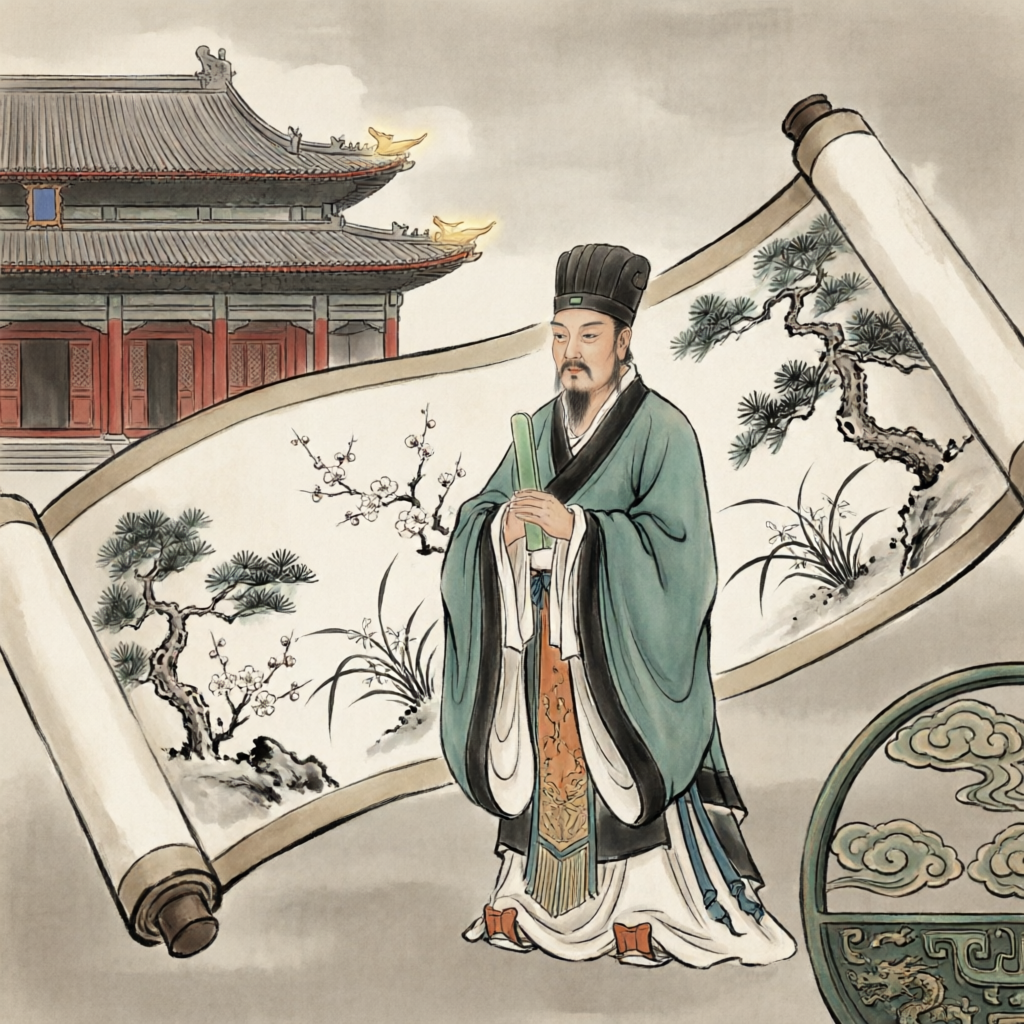
Confucianism
Overview
Confucianism, known as "Rujia" (儒家) in Chinese, is a philosophical and ethical system originating from ancient China. It is based on the teachings of Confucius (551-479 BCE) and his followers, emphasizing moral virtue, social harmony, and proper relationships as the foundations of a stable society. The term "ru" (儒) has multiple interpretations, ranging from "scholar" or "gentleman" to "priest" or "ritual specialist," reflecting the complex historical development of this tradition.
History
Origins of Confucianism
The term "ru" has been subject to various interpretations throughout Chinese history. According to the Kangxi Dictionary, "ru" was originally pronounced "ru" and referred to "scholars." The Book of Rites (周礼) mentions "ru" as one of the officials responsible for "governing the people through the Dao." The Book of Han suggests that "ru" were those who "possessed the Dao" and were experts in rituals and governance.
Scholar Zhang Taiyan in Gu Gu Lun Heng proposed that "ru" had three meanings, with the most general being "scholars" or "specialists in certain arts." Hu Shi, in his work Shu Ru, interpreted "ru" as "soft" or "gentle," suggesting that Confucians were descendants of the Yin people who, after their state's fall, became ritual specialists and were looked down upon by the Zhou dynasty.
Xu Zhongshu's research on oracle bone inscriptions suggests that the character "ru" depicts a person bathing, indicating that early "ru" were ritual specialists who purified themselves before performing ceremonies. Li Zehou also argued that Confucians evolved from shamans, though Confucius himself distinguished his teachings from those who merely communicated with spirits.
Spring and Autumn Period - Establishment
Around the 7th century BCE, as the feudal system of the Zhou dynasty declined, members of the royal family and their teachers scattered among the common people, teaching classical texts and performing rituals for various occasions. These individuals became known as "ru" and formed one of the "Hundred Schools of Thought" during the Spring and Autumn and Warring States periods.
Confucius (孔子), personal name Qiu, style name Zhongni, was born in Zouyi (present-day Qufu, Shandong Province) during the Spring and Autumn period. He was a renowned thinker, educator, and political figure whose teachings profoundly influenced Chinese intellectual and cultural development. According to the Records of the Grand Historian, "From the Son of Heaven down to the feudal lords and nobles, all who discuss the Six Arts in China turn to the Master for guidance. He may be called the sage of sages!"
Imperial Patronage and Development
During the pre-Qin period, Confucianism was known as one of the "two prominent schools" along with Mohism. However, it suffered a severe setback during Qin Shi Huang's reign in what became known as the "Burning of Books and Burying of Scholars."
In the Han dynasty, the imperial government adopted Confucianism as the official state ideology, establishing it as the dominant intellectual tradition in Chinese society. Emperor Wu of Han established the Imperial Academy (太学) and promoted Confucian classics as the foundation of education and governance. After Confucius's death, Confucianism divided into eight schools, with the most influential being those led by Mencius (following the tradition of Zisi) and Xunzi (following the tradition of Zixia).
Decline and Revival
Confucianism has faced numerous challenges throughout history, particularly during periods of foreign invasion and social upheaval. The most severe challenges came during the "May Fourth Movement" (1919) and the "Cultural Revolution" (1966-1976), when Confucianism was heavily criticized and suppressed.
During the "May Fourth Movement," influenced by Western ideas and a desire to strengthen China, progressive intellectuals such as Hu Shi and Chen Duxiu launched a campaign against Confucianism, famously advocating to "down with the Confucian shop." This movement, followed by the Cultural Revolution, led to a significant decline in Confucian influence in China.
Key Information
| Aspect | Description |
|---|---|
| Founder | Confucius (孔子, 551-479 BCE) |
| Core Texts | The Thirteen Classics (十三经), including the Four Books (四书) and Five Classics (五经) |
| Key Concepts | Ren (仁, benevolence), Li (礼, ritual propriety), Xiao (孝, filial piety), Zhong (忠, loyalty), Shu (恕, reciprocity) |
| Historical Period | Flourished during Han dynasty as state ideology; influenced East Asia for over two millennia |
| Modern Status | Experiences revival in China and other East Asian countries; influential in education and ethics |
Cultural Significance
Confucianism has profoundly shaped Chinese culture, education, and social structure for more than two millennia. Its emphasis on education led to the development of a meritocratic examination system that influenced Chinese governance for centuries. The Confucian ideal of "rule by virtue" (德治) emphasized the moral cultivation of rulers as essential to good governance.
The concept of "li" (礼) or ritual propriety established a comprehensive system of social norms that governed relationships between family members, rulers and subjects, and friends. This hierarchical yet harmonious social order became a defining characteristic of traditional Chinese society.
Confucianism also influenced art, literature, and architecture in East Asia. Temples of Confucius (孔庙) were built throughout China and other East Asian countries as centers of learning and veneration. The classical texts became the foundation of literary education, and Confucian themes permeated poetry, painting, and drama.
Modern Status
In recent decades, Confucianism has experienced a revival in China and other East Asian countries. The Chinese government has promoted "Confucian values" as part of its cultural policy, establishing Confucius Institutes worldwide to promote Chinese language and culture. However, this modern interpretation often differs significantly from traditional Confucianism, focusing on social harmony and ethical values while downplaying its hierarchical elements.
In academic circles, Confucianism is studied as both a historical tradition and a living philosophy. Scholars have reinterpreted Confucian thought in light of contemporary concerns such as human rights, environmental ethics, and global governance. New Confucianism (新儒家) attempts to reconcile traditional Confucian values with modern Western philosophy.
Globally, Confucian ideas have influenced discussions on ethics, education, and political philosophy. Concepts such as "harmony without uniformity" (和而不同) and the importance of moral education have found resonance in contemporary philosophical discourse.
References
- Tu, Weiming. (1996). Confucianism and the Modern World. Polity Press.
- Schwartz, Benjamin I. (1985). The World of Thought in Ancient China. Harvard University Press.
- Nivison, David S. (1996). The Ways of Confucianism: Investigations in Chinese Philosophy. Open Court Publishing Company.
- Angle, Stephen C. (2002). Human Rights and Chinese Thought: A Cross-Cultural Inquiry. Cambridge University Press.
- Elman, Benjamin A. (1984). From Philosophy to Philology: Intellectual and Social Aspects of Change in Late Imperial China. Harvard University Asia Center.