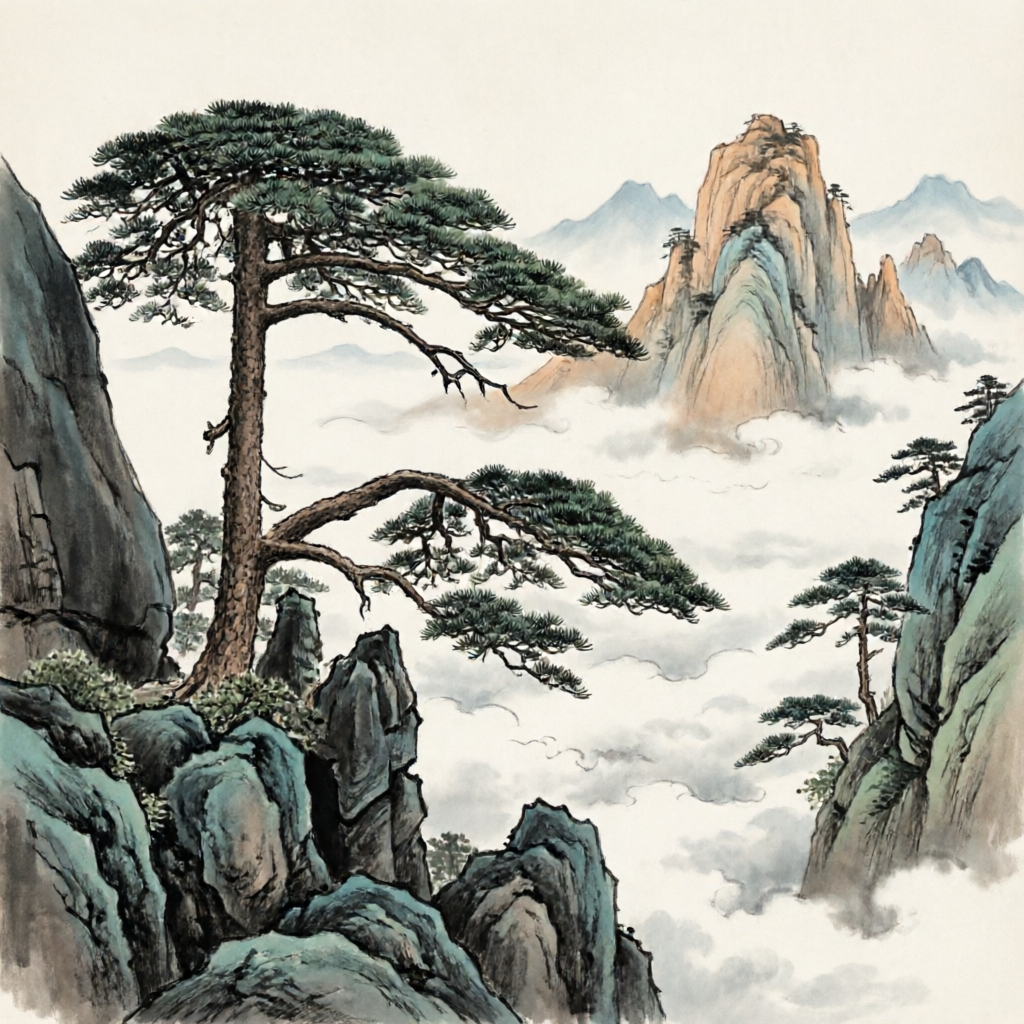
Mount Huangshan
Overview
Mount Huangshan, located in Huangshan City, Anhui Province, China, is one of the most famous mountains in the country and a UNESCO World Heritage Site. Known for its "five wonders"—unique pines, peculiar rock formations, seas of clouds, hot springs, and winter snow—Mount Huangshan has been a subject of Chinese art and literature for centuries. The mountain covers an area of approximately 1,200 square kilometers, with a scenic area spanning about 120 square kilometers. Its highest peak, Lotus Peak, rises to 1,864.8 meters above sea level.
History
Ancient Period (1.9 Billion Years Ago)
Approximately 1.9 billion years ago during the early Proterozoic era, the entire southern Anhui region, including what is now Mount Huangshan, existed under an oceanic environment. During the Meso-Proterozoic period, the South China Ocean crust subducted under the Yangtze Plate, causing the crust south of Huangshan to continue subsiding while submarine volcanic eruptions occurred. The water bodies in the Huangshan area gradually became shallower, with no sedimentary rock layers visible on the surface.
Qin and Han to Sui and Tang Dynasties
During the Qin and Han dynasties, historical records mention only Chen Ye, the governor of Kuaiji, who "maintained a pure conduct and lived as a hermit in this mountain." During the Song Yuanjia era of the Southern Dynasties, a monk from Goguryeo (modern-day Korea) built the Xinluo An (Hermitage) below the Boyun Peak, marking the beginning of Buddhism in the region.
During the Sui and Tang dynasties, Taoist temples began to be constructed in the southwestern part of Huangshan, including Fuqiu Temple and Jiulong Temple. In the 18th year of the Kaiyuan era (731 AD), Buddhist Master Zhiman built a temple near the White Dragon Pool, which was later named Xiangfu Temple during the Northern Song Dynasty. In the 6th year of the Tianbao era (747 AD), Buddhist Master Muren built Xuanmiao Temple below the Xuanyuan Peak, later renamed Fugu Temple during the Qing Dynasty.
Song and Yuan Dynasties
During the 8th year of the Jiayou era of the Northern Song Dynasty (1063 AD), Huangshan Guan (later Shengzhen Guan) was built near the Caishi Peak. During the Jiading era of the Southern Song Dynasty, Huangshan Tang (Chengshan Guan) was built below the Cuiwei Peak, and Xianan Palace was established in front of Lian Peak.
At the end of the Southern Song Dynasty, Zhang Yinpu, a Taoist master of the Quanzhen School, built Songgu Temple. During the Yuan Dynasty, Xiandu Temple was built below the Xiandu Peak, and Xuanyuan Temple was built below the Zishi Peak. The characters "Xuanyuan Imperial Palace" were carved on the cliff of the Hot Spring, and Xuanyuan Stele was placed in front of the Water Curtain Cave.
Ming and Qing Dynasties
During the Jiajing era of the Ming Dynasty, Zhusha An (later renamed Fahai Chan Yuan and Huguo Ciguang Temple) was built in Huangshan. In the 34th year of the Wanli era (1606 AD), Buddhist Master Pumen came to the mountain and created Fahai Chan Yuan, which was later expanded by imperial decree into "Huguo Ciguang Temple." He later built Wenshu Temple in front of Yuping Peak and Dabei Temple on Guangming Peak.
In the 38th year of the Wanli era (1610 AD), Buddhist Master Yu'an raised funds to build Zhibei Chan Yuan, later named Yugu Temple by imperial decree. At the end of the Ming Dynasty and the beginning of the Qing Dynasty, Taoism gradually declined, with some temples falling into disrepair and others being converted to Buddhist monasteries. Buddhism flourished during this period.
Republic of China Period
In 1932 (21st year of the Republic), Xu Shiying, Premier of the Nationalist Government, prepared to establish the Huangshan Construction Committee. In April 1934 (23rd year of the Republic), the Huangshan Construction Committee was formally established, with offices in Huangshan, Shanghai, and Tunxi, as well as inquiry offices in Nanjing, Wuhu, and Hangzhou. The road from Tangkou Town to Xiaoyao Pavilion was opened, and stone steps from Yugu Temple to Beihai were constructed.
In 1943 (32nd year of the Republic), the Huangshan Administration Bureau was formally established under the Anhui Provincial Government. In 1947 (36th year of the Republic), the Anhui Provincial Government reported to the Ministry of the Interior of the Executive Yuan to further clarify the jurisdiction of Huangshan.
After the Founding of New China
On April 27, 1949, Huangshan was liberated. In June of the same year, the Southern Anhui Administrative Office sent personnel to take over Huangshan. In July, the Huangshan People's Management Office was formally established as a department-level office. Taoist activities in the Huangshan area completely disappeared.
In 1954, leaders from the East China Military and Political Committee, the Anhui Provincial Committee of the Communist Party of China, and the Anhui Provincial Government climbed the mountain to plan its development. In 1956, the mountain climbing path was renovated, and the road from Xiaoyao Pavilion to Hot Spring was opened. Buildings such as Guanpu Building, Huangshan Hotel, Hot Spring Swimming Pool, and Haimeng Jingshe (now Yihai Building) were constructed.
In 1958, Beihai Hotel, New Hot Spring Building, Lanyu Pavilion, and Guanyu Pavilion were built in Huangshan. From 1966 to 1976, the Huangshan People's Management Office was paralyzed. In July 1979, Comrade Deng Xiaoping inspected Huangshan. In October 1979, the Anhui Provincial Huangshan Administration Bureau was established, and Huangshan was officially opened to the public.
In May 1980, the Anhui Provincial People's Government established the Huangshan Planning Leadership Group. In 1981, the Huangshan Planning Leadership Group commissioned the Department of Architecture at Tsinghua University to prepare the "Overall Plan for the Huangshan Scenic Area." In January 1982, the "Overall Plan for the Huangshan Scenic Area" was completed. In July 1988, the "Overall Plan for the Huangshan Scenic Area" was approved in principle by the State Council and implemented by the Ministry of Construction.
In October 2022, Huangshan Tourism announced that all its commercial businesses would launch a "pay-after-visit" credit tourism model. Tourists can book scenic area tickets and cable car tickets for free and stay in hotels without deposit through a dedicated page. This means that Huangshan in Anhui became the first scenic area in China where tourists can visit first and pay later.
On May 19, 2024, the Huangshan Scenic Area Management Committee announced that after comprehensive testing and evaluation, Tiandu Peak would end its closed rotation period and resume opening to the public on May 20.
Key Information
| Feature | Description |
|---|---|
| Location | Tangkou Town, Huangshan District, Huangshan City, Anhui Province |
| Climate | Subtropical monsoon climate with vertical changes due to altitude |
| Opening Hours | 06:00-22:00 |
| Scenic Area Level | AAAAA (highest rating in China) |
| Ticket Price | 190 yuan (peak season), 150 yuan (off season) |
| Area | Approximately 1,200 km² |
| Mountain Range | Part of the larger Huangshan mountain system |
| Park Type | National park, UNESCO World Heritage Site, World Geopark |
| Protection Level | National key scenic area, World Heritage Site |
| Approval Authority | State Council of China |
| Heritage Number | 531-018 (UNESCO) |
Cultural Significance
Mount Huangshan has profound cultural significance in Chinese history and art. For centuries, it has been a source of inspiration for poets, painters, and scholars. The mountain's "five wonders" have been depicted in countless works of art, particularly in traditional Chinese landscape painting (shan shui). The famous saying "Once you've seen the Five Great Mountains, you don't need to see any other mountains; once you've seen Huangshan, you don't need to see any other peaks" reflects its esteemed status in Chinese culture.
The mountain is also associated with numerous legends and myths. The most famous legend concerns the Yellow Emperor (Huangdi), who is said to have achieved immortality after bathing in the hot springs for 49 days. This connection has made Huangshan a site of spiritual importance in Taoism.
Modern Status
Today, Mount Huangshan is one of China's premier tourist destinations, attracting millions of visitors annually. The mountain has been developed with modern infrastructure while maintaining its natural beauty. In addition to its status as a UNESCO World Heritage Site, Huangshan is also recognized as a World Geopark and a National 5A-Level Tourist Attraction.
Recent developments include the implementation of sustainable tourism practices and the introduction of innovative services like the "pay-after-visit" credit tourism model launched in 2022. The mountain continues to be a site of scientific research, particularly in the fields of geology, botany, and ecology, due to its unique geological features and biodiversity.
References
- Li, W. (2015). The Cultural Landscape of Mount Huangshan. Cambridge University Press.
- Zhang, Y., & Wang, H. (2018). Geological Evolution and Biodiversity of Huangshan Mountain. Springer.
- UNESCO World Heritage Centre. (2020). Mount Huangshan. Retrieved from https://whc.unesco.org/en/list/531