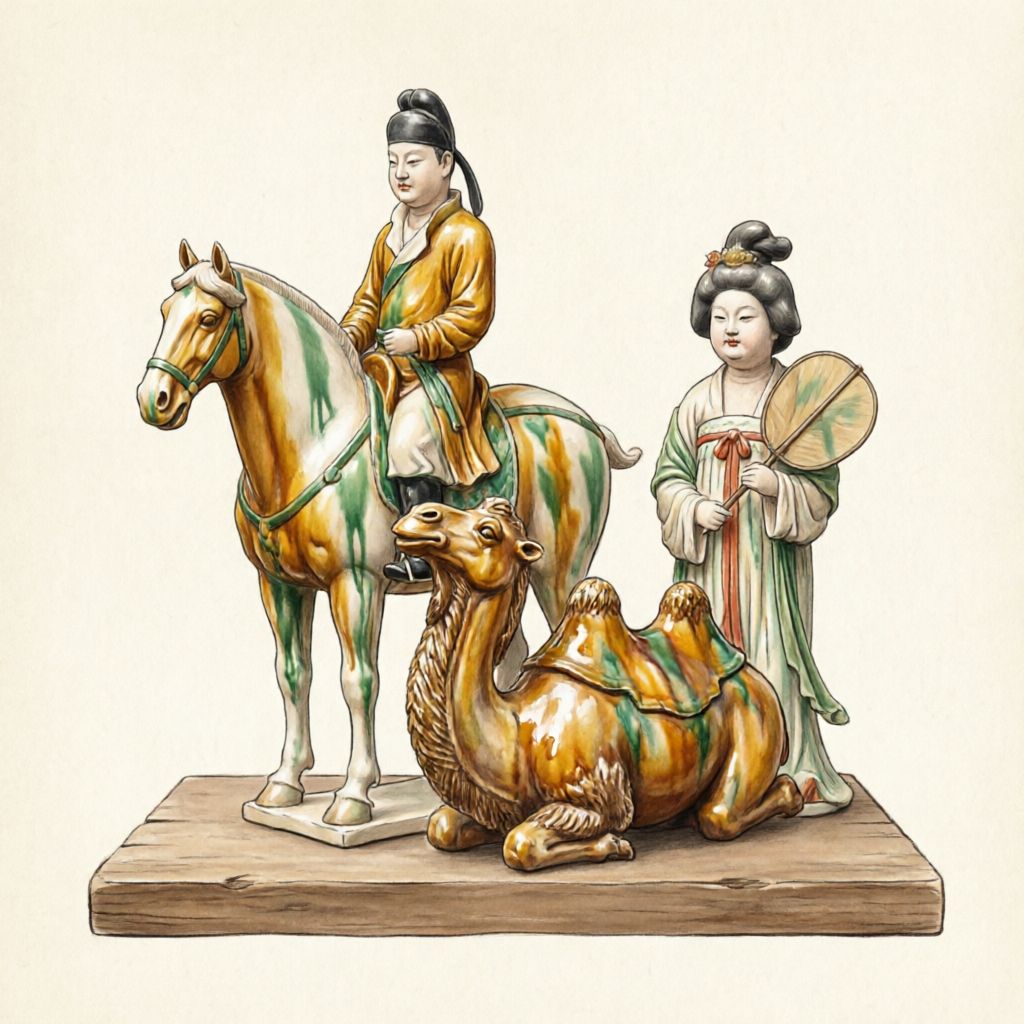
Tang Tri-Color Glazed Ceramics
Overview
Tang Tri-Color Glazed Ceramics (唐三彩), commonly known as Tang Sancai, are a type of Chinese pottery from the Tang Dynasty (618-907 CE) characterized by its distinctive lead glaze in multiple colors. Despite the name "Tri-Color," these ceramics can actually feature various combinations of colors, though yellow, green, and white are the most common. The term "Sancai" actually means "three colors" in Chinese, but it refers to the general category of polychrome ceramics rather than a strict limitation to three colors. These artifacts were primarily used as burial objects (mingqi 明器) during the Tang Dynasty and are renowned for their vibrant colors, diverse subjects, and exceptional craftsmanship.
History
Background
The emergence of Tang Tri-Color Glazed Ceramics during the Tang Dynasty was influenced by several cultural and technological factors. First, the mature ceramic technology of the period provided the material foundation for these creations. Second, the prevalent practice of elaborate burials during the Tang Dynasty directly promoted the development of these ceramics as burial objects. Third, the rich cultural environment across various fields of Tang society nurtured the artistic excellence of these artifacts.
The production of Tang Tri-Color Glazed Ceramics marked the birth of the tri-color glaze decorative technique, representing a combination of glaze decoration and body decoration. The brilliant and dazzling artistic effects of Tang Sancai were particularly demonstrated and fully expressed on the exquisitely sculpted and vividly modeled figurines.
Rise in Popularity
The popularity of Tang Tri-Color Glazed Ceramics during the Tang Dynasty can be attributed to historical developments following the "Reign of Zhenguan" (贞观之治) period. As the nation's power strengthened and various industries flourished, some high-ranking officials began to lead extravagant lifestyles, which led to the growing trend of elaborate burials. Tang Sancai was officially regulated as burial objects, with specific quantities allowed for officials of different ranks. However, these dignitaries often buried many times more than the stipulated amounts, fueling a trend of lavish burials that spread from the upper classes to common people.
This widespread practice of elaborate burials was a primary reason for the rapid development and popularity of Tang Sancai in the Central Plains region during the Tang Dynasty.
Peak Period
The Tang Dynasty represented the zenith of feudal society in China, and Tang Tri-Color Glazed Ceramics reflected the political, cultural, and social life of this era in their own unique way. While they shared the cultural melody of Tang poetry, painting, and architecture, they were distinct from other art forms. From the perspective of modern ceramic history, Tang Sancai represents a landmark achievement in Tang Dynasty ceramics.
Prior to the Tang Dynasty, ceramics typically featured single-color glazes or at most two colors. During the Han Dynasty, yellow and green glazes were sometimes used on the same vessel. However, it was during the Tang Dynasty that multiple glaze colors began to be simultaneously applied to ceramic vessels. This innovation is believed to be related to significant changes in aesthetic preferences during the Tang period. While earlier periods favored monochromes, the Tang Dynasty embraced various cultural influences, including foreign elements, leading to the formation of a magnificent and diverse cultural characterized by its painting, ceramics, and metalwork.
Discovery Process
Historical records contain little information about Tang Tri-Color Glazed Ceramics, causing them to be largely forgotten for over a thousand years. The modern rediscovery began in 1928 when the Longhai Railway was being constructed through Mangshan Mountain in Luoyang, destroying several Tang Dynasty tombs and revealing numerous Tang Sancai burial objects.
Common excavated Tang Sancai pottery includes tri-color horses, camels, court ladies, musician figurines, and pillows. Particularly notable are the tri-color camels carrying silk or transporting musical bands, with their heads raised as if neighing. The figurines of Central Asian merchants (Hu people) with red beards and blue eyes, wearing narrow-sleeved shirts and turned-up hats, vividly recreate the images of foreign traders along the Silk Road.
The large quantity of excavated Tang Sancai artifacts was transported to Beijing by antique dealers, attracting the attention and appreciation of renowned scholars such as Wang Guowei and Luo Zhenyu. Subsequently, numerous Tang Sancai pieces continued to be unearthed in the Luoyang region, with surprising quantities and exceptional quality. The excavation sites were concentrated mainly in Mangshan to the north of Luoyang, Guanlin and Longmen to the south, and Gushui to the west. Within Luoyang city alone, over 20 excavation sites have been identified, yielding at least 500 Tang Sancai pieces.
Key Information
| Feature | Description |
|---|---|
| Time Period | Tang Dynasty (618-907 CE), peak during Kaiyuan, Tianbao to Dali eras (713-766 CE) |
| Basic Colors | Yellow, green, white (though other colors like blue, brown, and black were also used) |
| Categories | Figurines (human and animal), models, architectural components, daily utensils |
| Production Sites | Mainly found in four locations: Gongyi (Henan), Huangbao (Shaanxi), Neiqiu (Hebei), and Xi'an (Shaanxi) |
| Firing Temperature | First firing at approximately 1100°C, second glaze firing at around 800°C |
| Cultural Significance | Primarily used as burial objects (mingqi), reflecting Tang Dynasty social status and cultural exchange |
Cultural Significance
Tang Tri-Color Glazed Ceramics serve as important material evidence of Tang Dynasty social life, customs, and artistic achievements. The types and quantities of burial objects were determined by the deceased's official rank and social status during their lifetime. According to Tang burial regulations, officials of the first three ranks were permitted ninety burial objects, those of the fourth and fifth ranks sixty, and those of the sixth through ninth ranks forty.
The figurines and models in Tang Sancai comprehensively reflect various aspects of Tang Dynasty life, from court ladies and musicians to foreign merchants and camels. They provide valuable insights into Tang Dynasty clothing, hairstyles, musical instruments, and daily activities. The presence of Central Asian figures in Tang Sancai also highlights the cultural exchanges along the Silk Road during this period.
Tang Sancai was not only popular within China but was also exported to numerous countries including Japan, Korea, Iran, Iraq, Egypt, and Italy, influencing local ceramic traditions. For example, Japan's Nara period witnessed the production of "Nara Sancai" inspired by Tang examples, and Korea's Silla period produced "Silla Sancai" following similar techniques.
Modern Status
Today, Tang Tri-Color Glazed Ceramics are highly valued as both cultural artifacts and artistic works. The replication and imitation techniques of Tang Sancai have a history of over a century in Luoyang, with successive generations of artisans refining the craftsmanship to achieve remarkable technical and artistic levels.
In the international market, Tang Sancai has become an extremely precious art form. It was recognized as an excellent tourism product at an international tourism conference attended by over 80 countries and regions, earning the title "Oriental Art Treasure." Large Tang Sancai pieces such as horses and camels have been presented as national gifts to the heads of state and government leaders of more than 50 countries.
Modern production of Tang Sancai follows the traditional techniques while incorporating innovations. The process involves six main steps: material selection, shaping, bisque firing, glazing application, low-temperature glaze firing, and final detailing ("opening the features" with paint for facial details). Despite advances in technology, the fundamental characteristics of authentic Tang Sancai—particularly the natural aging effects that develop over centuries—remain difficult to replicate perfectly.
References
-
Li, Chun. Tang Dynasty Sancai Ceramics. Beijing: Cultural Relics Publishing House, 2012.
-
Wang, Bomin. Chinese Ceramics: Tang Sancai. Shanghai: Shanghai People's Publishing House, 2008.
-
Zhao, Qing. "Technological Innovation and Cultural Exchange in Tang Sancai Production." Journal of Archaeological Science 45 (2014): 123-135.
-
Rawson, Jessica. Chinese Pottery and Porcelain. London: British Museum Press, 2004.
-
Steinhardt, Nancy Shatzman. Chinese Traditional Architecture and the Tang Sancai. New Haven: Yale University Press, 2010.