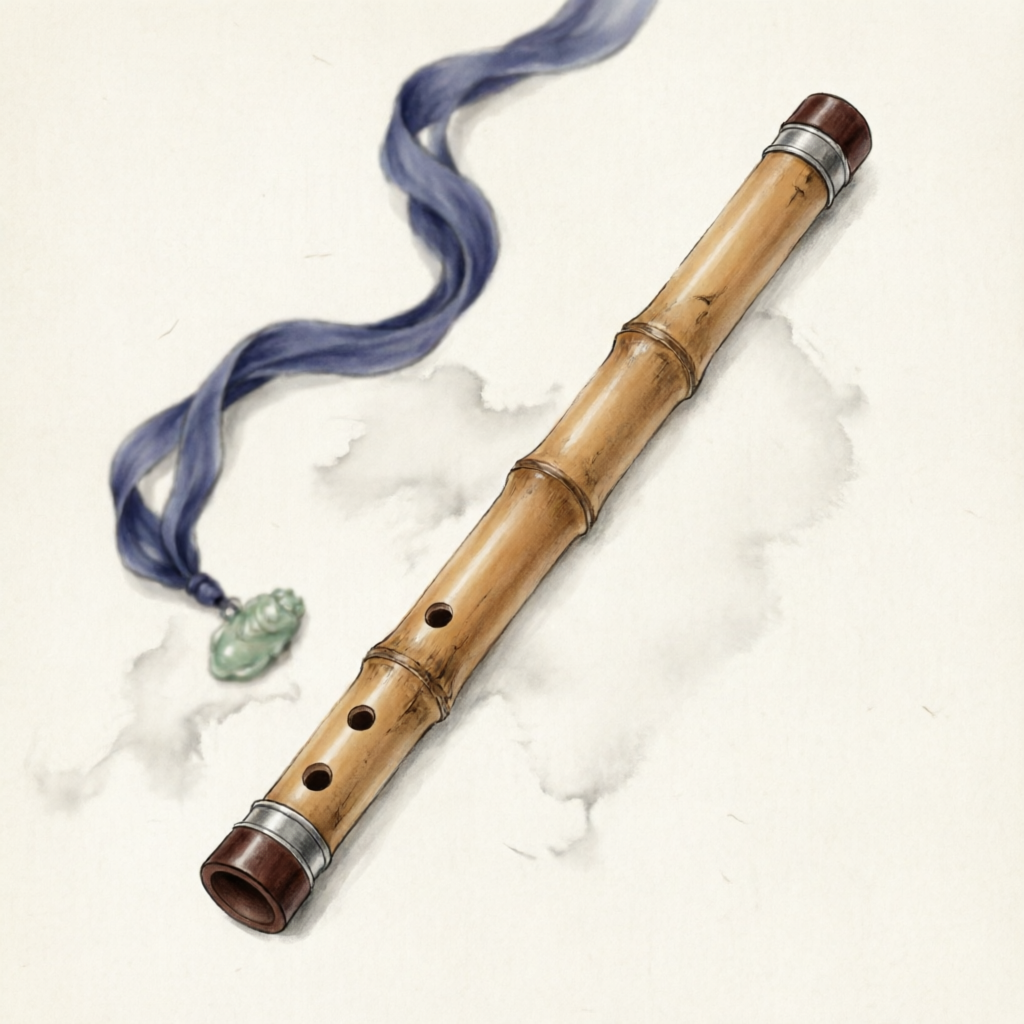
Dizi (Chinese Flute)
Overview
The dizi (笛子) is a traditional Chinese bamboo flute that has been an integral part of Chinese musical culture for millennia. As one of the oldest wind instruments in China, the dizi is characterized by its distinctive membrane-covered hole, which gives it a bright, clear timbre unlike other flutes worldwide. The instrument has evolved through numerous dynasties, developing various regional styles and playing techniques that continue to thrive in both traditional and contemporary Chinese music.
History
Ancient Era
The history of the Chinese flute can be traced back to the Neolithic period. Ancestral people would gather around campfires, celebrate their hunting successes with song and dance, and utilize bird leg bones with holes drilled into them to attract prey and communicate signals. This practice led to the creation of the bone flute, the oldest musical instrument unearthed in China.
In 1977, bone whistles and flutes dating back approximately 7,000 years were unearthed at Hemudu in Yuyao, Zhejiang Province. In May 1986, sixteen vertical bone flutes made from bird limbs were discovered at the early Neolithic site in Jiahu Village, Wuyang County, Henan Province, which were determined to be over 8,000 years old. These flutes featured five to eight sound holes, with seven-hole flutes being most common. Some even had additional small holes next to the main ones, matching the Chinese tonal system completely. The seven-hole Jiahu bone flute, unearthed in 1987 from the Jiahu site in Wuyang County, Henan Province (dating back about 9,000 years), is considered the world's oldest playable wind instrument.
During the Yellow Emperor period (approximately 4,000 years ago), bamboo began to grow abundantly in the Yellow River basin, leading to the selection of bamboo as material for flute construction. The Shiji (Records of the Grand Historian) records: "The Yellow Emperor ordered Linglun to cut bamboo from Kunqu and make flutes, which when blown sounded like phoenix calls." Using bamboo represented a significant advancement in flute construction, as bamboo has better vibration properties than bone and is easier to work with. By the Qin and Han dynasties, seven-hole bamboo flutes had been developed, and "double-headed flutes" were invented. Cai Yong, Xun Xu, and Emperor Wu of Liang all made twelve-law flutes, where each flute corresponded to a specific musical pitch.
In 1978, two bamboo chi (a type of ancient flute) were unearthed from the tomb of Marquis Yi of Zeng in Suixian, Hubei Province. Meanwhile, two flutes excavated from the No. 3 Han tomb at Mawangdui in Changsha, Hunan Province, featured a 90-degree angle between the blowing hole plane and the finger hole plane, which is remarkably similar to the flute (chi) position in the Zeng tomb. The time gap between these discoveries spans several hundred years, while the spatial distance between Changsha and Suixian is hundreds of miles, yet the blowing hole positions are nearly identical. This indicates the widespread form of horizontal flutes or chi from the pre-Qin period to the early Han Dynasty.
During the Warring States period, the chi was one of the main melodic instruments used in sacrificial ceremonies and banquets. The flute was also very popular, as evidenced by "Fu on the Flute" by Song Yu, a student of Qu Yuan, which described southern flutes of that time as very similar to modern flutes.
Han and Jin Dynasties
In ancient times, the flute was called "di" (篴). During the Han Dynasty, Xu Shen's Shuowen Jiezi stated: "The flute has seven holes and is made of bamboo tube."
After the Han Dynasty, the horizontal flute occupied a very important position in court and military guchiyue (wind and percussion music). This fact indicates that the development of the Chinese flute had moved beyond its early primitive form, becoming more rational and complete in terms of musical temperament and structure, and increasingly coordinating with other instruments in ensembles. On the portrait bricks from the Northern and Southern Dynasties unearthed in Deng County, Henan, we can clearly see historical images of wind and percussion bands performing in coordination. The holding direction, angle, and posture of the hands of the horizontal flute players are exactly the same as modern flute players.
Before the Han Dynasty, "di" mostly referred to vertical flutes. Since the Qin and Han dynasties, "di" has become the common name for both vertical xiao (flute) and horizontal flutes, a usage that continued for a long time. During the reign of Emperor Wu of Han, the horizontal flute, also called "hengchui" (横吹), was developed and occupied a rather important position in Han Dynasty guchiyue. The two bamboo flutes unearthed from the No. 3 Han tomb at Mawangdui in Changsha, Hunan Province, both belong to the category of horizontal flutes.
During the Jin Dynasty, vertical flutes existed, with a wooden addition to the blowing head that allowed air to pass through a gap and vibrate against the edges of two whistle holes to produce sound.
In the Northern Dynasties, flutes were not only extremely common but also developed, with significant variations in shape, length, and thickness. By the Northern Zhou and Sui dynasties, the name "hengdi" (horizontal flute) began to appear. In the late Sui Dynasty, a ten-hole flute capable of playing a chromatic scale emerged.
Tang and Song Dynasties
During the Sui and Tang dynasties, the "Da Hengchui Bu" (Great Horizontal Wind Section) and "Xiao Hengchui Bu" (Small Horizontal Wind Section) of guchiyue both used horizontal flutes. In the "Yanyue" (Banquet Music) genre for entertainment and appreciation during the Sui and Tang periods, the horizontal flute (then called "hengliu") was widely active in ensembles. In Dunhuang murals of the Sui Dynasty and Tang Dynasty musician figures, we can also see performances of horizontal flutes. In other historical paintings, we find flute playing in different directions.
During the Tang Dynasty, records of famous flute performers began to appear, such as Li Mo, Sun Chuxiu, You Cheng'en, and Yun Zhaoxia. Among them, Li Mo, who had studied with a Western Regions musician from Kucha, was renowned for his extraordinary flute skills and was acclaimed as "the best under heaven" for his flute playing abilities during the Kaiyuan era.
Chen Yang's Yue Shu (Book of Music), Volume 148, states: "The Tang seven-star tube is the ancient long flute. Its shape is like a chi but longer, with more than seven holes. It is blown horizontally, with an additional hole beside it where bamboo membrane is attached to assist resonance through vibration. It was made by Liu Xi..." This suggests that at least from the Tang Dynasty, flutes with the characteristic tone of Chinese membrane flutes appeared. The membrane on the flute is one of the most distinctive features of Chinese flutes.
From the Tang Dynasty, there was a distinction between large and small horizontal flutes. At the same time, the vertical chi was called xiao, while the horizontal one was called "di". In the Tang Dynasty, Lü Cai created the "chi ba" (尺八), a vertical flute that was later introduced to Japan. In the Shosoin Repository of the ancient capital Nara, Japan, four Tang Dynasty horizontal flutes are treasured. Among them are one ivory and one carved stone horizontal flute, and two bamboo ones. They vary in length but all have seven oval sound holes. Liu Xi created the seven-star tube flute with a membrane to assist resonance, making him the first person to add a membrane to a flute.
From the 7th century, flutes underwent further improvements with the addition of a membrane hole, greatly enhancing their expressive capabilities, and performance techniques reached a considerably high level.
During the Song Dynasty, there was a variety of flutes, including "chashou di" (cross-handed flute), "longjing di" (dragon-neck flute), small horizontal flute with eleven holes, large horizontal flute with nine holes, and jade flute with seven holes. With the rise of Song poetry and Yuan opera, dramatic arts flourished, and the flute became an accompanying instrument for many opera genres, divided into two categories based on the operas they accompanied: "bangdi" and "qudi". In the folk opera ensembles, the flute was also an indispensable instrument.
Modern Era
In the 1960s, Zhao Songting invented the "pai di" (排笛), which consists of 2 to 4 flutes of different pitches tied together, expanding the range by more than three octaves and providing richer musical variations that are easier to play.
From the "kou di" (口笛, mouth flute) that emerged in 1971 (also called Yu's flute) to the "bone whistle" and "bone flute" unearthed at Hemudu in Zhejiang in 1977, people were surprised to find such similarities between them, a similarity that had spanned more than 7,000 years. The evolution and development of the flute over these 7,000 years is astonishing to the world: Chinese bamboo flute art is so magnificent and diverse.
Key Information
| Feature | Description |
|---|---|
| Chinese Name | 笛子 (dizi) |
| Other Names | Bamboo flute, Chinese transverse flute |
| Origin | China, dating back to 7,000-9,000 years ago |
| Materials | Bamboo, with some modern versions made of other materials like wood, jade, or synthetic materials |
| Key Components | Blow hole, membrane hole, six finger holes, two base holes, two auxiliary holes |
| Distinctive Feature | Membrane-covered hole that creates the characteristic bright tone |
| Regional Types | Qu di (Southern), Bang di (Northern), Kou di (mouth flute), Tibetan flute, Dong flute, Yuping flute |
| Playing Techniques | Tremolo, flutter-tongue, sliding note, trill, circular breathing, etc. |
| Cultural Significance | Integral to Chinese folk music, opera, and chamber music |
Cultural Significance
The dizi holds a special place in Chinese culture, symbolizing both scholarly refinement and folk traditions. In ancient China, the flute was associated with scholars and literati, often depicted in paintings and poems as an instrument for expressing refined emotions and philosophical contemplation. The famous Tang Dynasty poet Li Bai wrote several poems praising the flute, including "Listening to a Flute on the Night of Spring", which helped cement the instrument's cultural importance.
In folk traditions, the dizi became essential to various regional music forms and opera genres. In northern China, it accompanied lively opera styles like bangzi (clapper opera), while in southern regions, it accompanied the more elegant kunqu opera. The instrument's versatility allowed it to express a wide range of emotions, from the heroic and martial to the gentle and melancholic.
The dizi also plays important roles in Chinese rituals and ceremonies. It has been used in religious ceremonies, imperial court music, and local festivals throughout Chinese history. Its bright, penetrating sound was believed to ward off evil spirits and bring good fortune, making it particularly popular during festivals and celebrations.
Modern Status
Today, the dizi continues to thrive in both traditional and contemporary contexts. In traditional Chinese music, it remains an essential instrument in folk ensembles, opera accompaniment, and chamber music. The instrument has also been adapted for modern orchestral use, with composers incorporating it into symphonic works that blend Western and Chinese musical elements.
Contemporary dizi makers have experimented with new materials and designs while preserving traditional construction methods. Modern innovations include the development of keyed flutes for extended chromatic capabilities, adjustable membrane tension systems, and flutes with metal joints to prevent pitch changes due to temperature fluctuations during performance.
The dizi has gained international recognition through the efforts of virtuoso performers like Zhao Songting, Yu Xunfa, and more recently, Jiang Yan. These musicians have expanded the technical possibilities of the instrument and introduced it to global audiences through recordings, international performances, and master classes.
Educational institutions in China and abroad now offer formal training in dizi performance, ensuring the transmission of traditional techniques to new generations. The instrument has also found its way into music therapy practices, with its penetrating tone and expressive capabilities being utilized for therapeutic purposes.
References
-
Jones, Andrew F. "Yellow Bell, Bamboo Flute, and the Ideology of Musical Tone in Modern China." Ethnomusicology, vol. 43, no. 2, 1999, pp. 210-230.
-
Pian, Rulan. Song and Music in the Yuan Drama: Studies on the Yuan Musical Tradition. Harvard University Press, 1967.
-
Stockmann, Doris. Die chinesische Musik. Bärenreiter, 1963.
-
Yang, Yinliu. Zhongguo Yinyue Shigao (A History of Chinese Music). People's Music Publishing House, 1985.
-
Zhang, Boyu. "The Dizi: Its History, Construction, and Performance Practice." Asian Music, vol. 25, no. 1, 1993, pp. 1-32.
-
Zhao, Songting. Dizi Jifa (Dizi Playing Techniques). People's Music Publishing House, 1996.