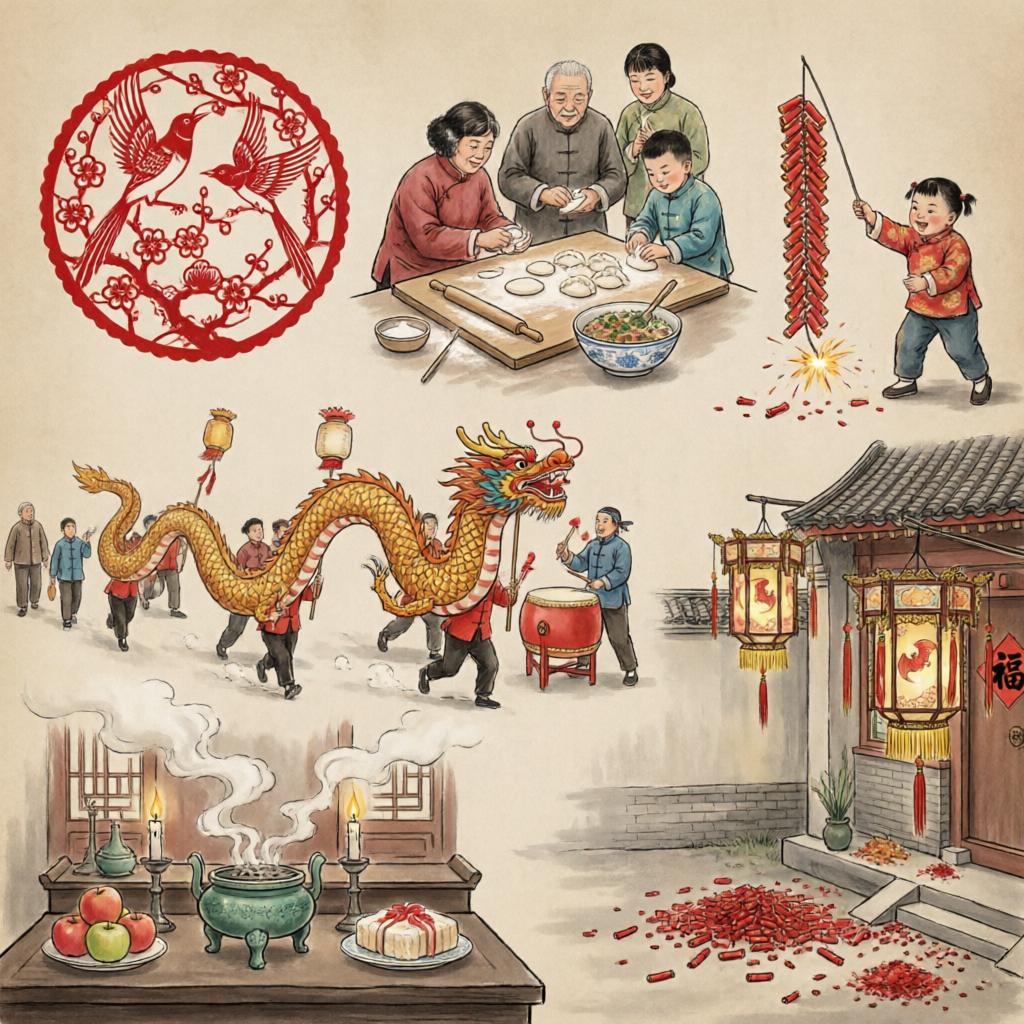
Spring Festival Customs
Overview
The Spring Festival, also known as Chinese New Year, represents the most important traditional holiday in Chinese culture. The customs associated with this celebration have evolved over thousands of years, incorporating elements from ancient agricultural rituals, religious practices, and folk traditions. These customs vary across different regions of China but generally revolve around themes of renewal, family reunion, and auspicious beginnings for the coming year.
History
Origins
The customs of the Spring Festival originated in ancient times and were closely related to agricultural production and natural cycles. During the pre-Qin period, recorded Spring Festival customs began to emerge, featuring strong religious elements and practical purposes. These early customs included activities like the Nuo ceremony (傩祭), setting up peach wood figures (立桃梗), and peach wood people (桃人), reflecting people's reverence for nature and deities.
Evolution Through Dynasties
During the pre-Qin period, Spring Festival customs gradually took shape, with people performing sacrificial rites to pray for harvests and ward off evil spirits. The worship of heaven, earth, and ancestors was an important component of these customs. People would hold the Nuo ceremony in the twelfth lunar month to drive away evil spirits and prevent disasters.
By the Han and Wei dynasties, Spring Festival customs became more established as an important traditional Chinese festival. During this period, the festival was called "Zhengdan" (正旦) or "Yuanri" (元日), with its date fixed as the first day of the first lunar month. Emperor Wu of Han established the Taichu calendar, providing a fixed calendrical basis for the Spring Festival. The imperial court would hold court meetings during the festival, where the emperor received congratulations from officials, demonstrating the feudal dynasty's emphasis on the occasion.
During the Tang and Song dynasties, Spring Festival customs reached a stage of prosperity, characterized by innovation and development. The economic prosperity and cultural flourishing during this period provided a favorable social environment for the evolution of Spring Festival customs. The festival atmosphere became more intense, with people focusing on entertainment and celebratory activities. The Lantern Festival became an important part of the Spring Festival period, with activities like lantern viewing and solving riddles gaining popularity.
Key Information
| Aspect | Description |
|---|---|
| Traditional Name | 春节习俗 (Chūnjié xísú) |
| Classification | Pre-festival customs, Festival period customs |
| Timing | Pre-festival customs begin from the 23rd day of the 12th lunar month |
| Key Activities | House cleaning, ancestor worship, family reunion dinner, giving red envelopes, setting off firecrackers |
| Cultural Significance | Symbolizes renewal, family unity, and good fortune for the coming year |
Cultural Significance
Spring Festival customs are deeply rooted in Chinese cultural values and philosophical beliefs. The emphasis on family reunion during the New Year's Eve dinner reflects the Confucian value of familial harmony and filial piety. The practice of giving red envelopes (压岁钱, yāsuìqián) symbolizes the transmission of blessings and good wishes from elders to the younger generation.
The various customs also demonstrate Chinese people's cosmological worldview and relationship with nature. The orientation of activities around the lunar calendar, agricultural cycles, and natural phenomena shows the integration of human life with natural rhythms. The worship of deities and ancestors reflects the Chinese concept of a hierarchical universe where humans exist in relationship with both visible and invisible powers.
Modern Status
While many traditional Spring Festival customs continue to be observed, contemporary celebrations have evolved to reflect modern lifestyles. Urbanization has led to changes in how families celebrate, with many people traveling to their hometowns during the Spring Festival travel rush (春运, chūnyùn), the largest annual human migration in the world.
Some traditional practices have been adapted or simplified in modern contexts. For example, the custom of setting off firecrackers has been restricted in many cities due to concerns about air quality and safety. Digital red envelopes have become popular, allowing family members to send money electronically using mobile payment platforms.
Despite these changes, the core values of family reunion, respect for elders, and hope for prosperity remain central to Spring Festival celebrations. The festival has been recognized as an intangible cultural heritage of China, and efforts are being made to preserve and transmit traditional customs to younger generations.
References
-
Jiao, T. (2019). Chinese Festivals and Customs. Cambridge University Press.
-
Liu, L. (2020). The Evolution of Spring Festival Customs in Chinese History. Journal of Chinese Cultural Studies, 37(2), 145-162.
-
Wang, H. (2018). Food Symbolism in Chinese New Year Celebrations. Food and Foodways: Cross-Cultural Food Research, 26(3), 211-227.
-
Zhang, Y. (2021). Rituals and Symbolism: Understanding Traditional Chinese New Year Customs. Routledge.
-
Chen, X. (2017). Family and Community in Chinese New Year Celebrations. Modern China, 43(4), 387-412.