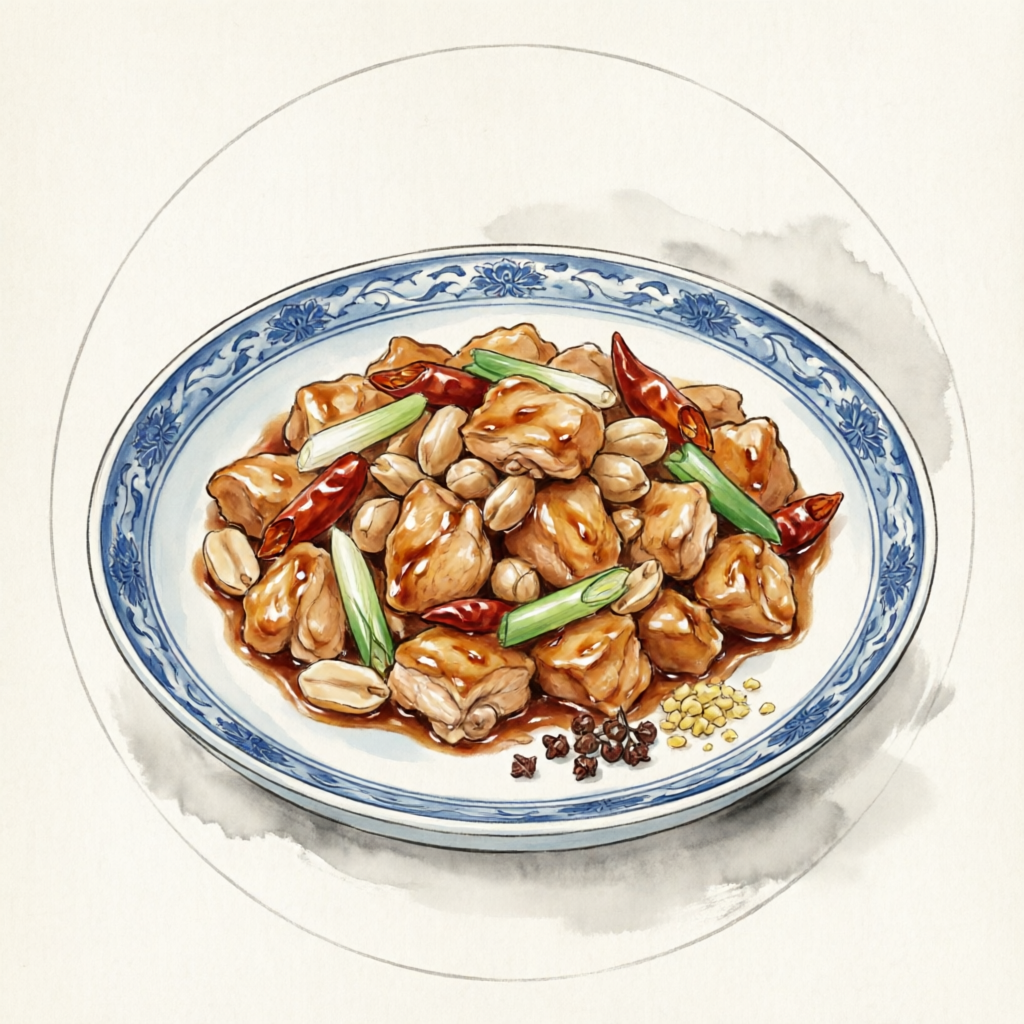
Kung Pao Chicken
Overview
Kung Pao Chicken (宫保鸡丁, Gōng Bǎo Jī Dīng) is a classic Chinese dish that has gained international recognition as one of China's most famous culinary exports. The dish features diced chicken stir-fried with peanuts, vegetables, and chili peppers in a sauce that balances sweet, sour, savory, and spicy elements. Named after Ding Baozhen, a late Qing Dynasty official with the honorary title "Gongbao," this dish exemplifies the complexity and balance characteristic of Chinese cuisine.
History
Kung Pao Chicken has a rich history dating back to the Qing Dynasty. The dish was created by Ding Baozhen (丁宝桢), who served as both Governor of Shandong and Viceroy of Sichuan. Ding was an avid food enthusiast who particularly enjoyed chicken and peanuts with a preference for spicy flavors. While serving in Shandong, he instructed his chefs to modify the local "Jiao Bao Ji Ding" (酱爆鸡丁) by adding chili peppers, creating a spicier version. Later, during his tenure as Governor-General of Sichuan, he further developed this dish, which became known as "Ding's Family Chicken." The name "Gongbao" derives from Ding's honorary title "Taizi Taibao" (太子太保), often abbreviated as "Gongbao" (宫保), which was posthumously bestowed upon him by the imperial court in recognition of his contributions.
According to historical accounts, Ding once encountered a farmer preparing a stir-fried chicken dish during an incognito visit to Daming Lake in Jinan. Impressed by the flavor and technique, he hired the farmer as his personal chef. When Ding was transferred to Sichuan, the chef accompanied him and adapted the recipe by replacing Sichuan peppercorns with local chili peppers, creating the Sichuan-style version of the dish. After Ding's death, the dish was introduced to the imperial court as a tribute dish, eventually becoming one of China's most celebrated culinary creations.
Key Information
| Aspect | Details |
|---|---|
| Origin | Created by Ding Baozhen in Qing Dynasty China |
| Primary Ingredients | Chicken, peanuts, chili peppers, vegetables |
| Key Seasonings | Sichuan peppercorns, soy sauce, vinegar, sugar, garlic |
| Regional Variations | Sichuan, Shandong, Guizhou, and Western adaptations |
| Cooking Method | Stir-frying (爆炒) |
| Flavor Profile | Sweet, sour, spicy, savory with numbing sensation |
Cultural Significance
Kung Pao Chicken holds significant cultural importance as a representative dish of Chinese cuisine, particularly associated with Sichuan cooking. It exemplifies the Chinese culinary principle of balancing multiple flavors and textures. The dish has transcended regional boundaries to become a symbol of Chinese food culture globally.
In China, Kung Pao Chicken has evolved beyond its original form to inspire numerous variations, including "Gongbao Tendon," "Gongbao Squash," "Gongbao Tofu," and "Gongbao Rabbit," demonstrating its culinary influence. The dish has also been adapted internationally, with Western versions often modifying the spice levels and ingredients to suit local tastes.
The dish's name has been subject to various interpretations and regional adaptations. During China's Cultural Revolution, "Gongbao" was temporarily changed to "Gongbao" (公爆) or "Hongbao" (烘爆) to remove references to the imperial honorific. In regions outside Sichuan, the dish is sometimes mistakenly written as "Gongbao," "Gongbao," or other variations, reflecting misunderstandings of its historical origins.
Modern Status
Today, Kung Pao Chicken enjoys widespread popularity both in China and internationally. It has become a staple in Chinese restaurants worldwide and is frequently featured in international media as a representative Chinese dish. In 2014, German Chancellor Angela Merkel visited Chengdu and personally purchased ingredients to observe the preparation of Kung Pao Chicken, highlighting its global recognition.
The dish has been adapted in numerous ways to suit different palates and dietary preferences. Vegetarian versions replace chicken with tofu or vegetables, while gluten-free adaptations modify the sauce ingredients. The dish has also influenced fusion cuisine, appearing in various creative forms in contemporary culinary settings.
In China, Kung Pao Chicken continues to be celebrated as a cultural icon. In 2018, it was recognized as one of China's top ten classic dishes in both Guizhou and Sichuan provinces. The dish has also been nominated for inclusion in Sichuan's "Tianfu Tourism Cuisine" program, further cementing its status as a culinary treasure.
References
- Dunlop, F. (2008). Land of Plenty: A Treasury of Sichuan Food. W.W. Norton & Company.
- Lin, H. C. (2016). Chinese Cuisine: Regional and Traditional Foods. Cambridge University Press.
- Zhang, F. (2020). The Cultural History of Chinese Cuisine. Routledge.
Nutritional Information
Kung Pao Chicken is nutritionally balanced, providing approximately 129 kcal per 100g serving. It contains 9.8g of protein, 7g of fat, and 6.9g of carbohydrates. The dish is a good source of vitamins and minerals, including vitamin A (65μg), vitamin C (7.1mg), and iron (0.8mg). The combination of protein from chicken and healthy fats from peanuts makes it a satisfying dish that can be part of a balanced diet.