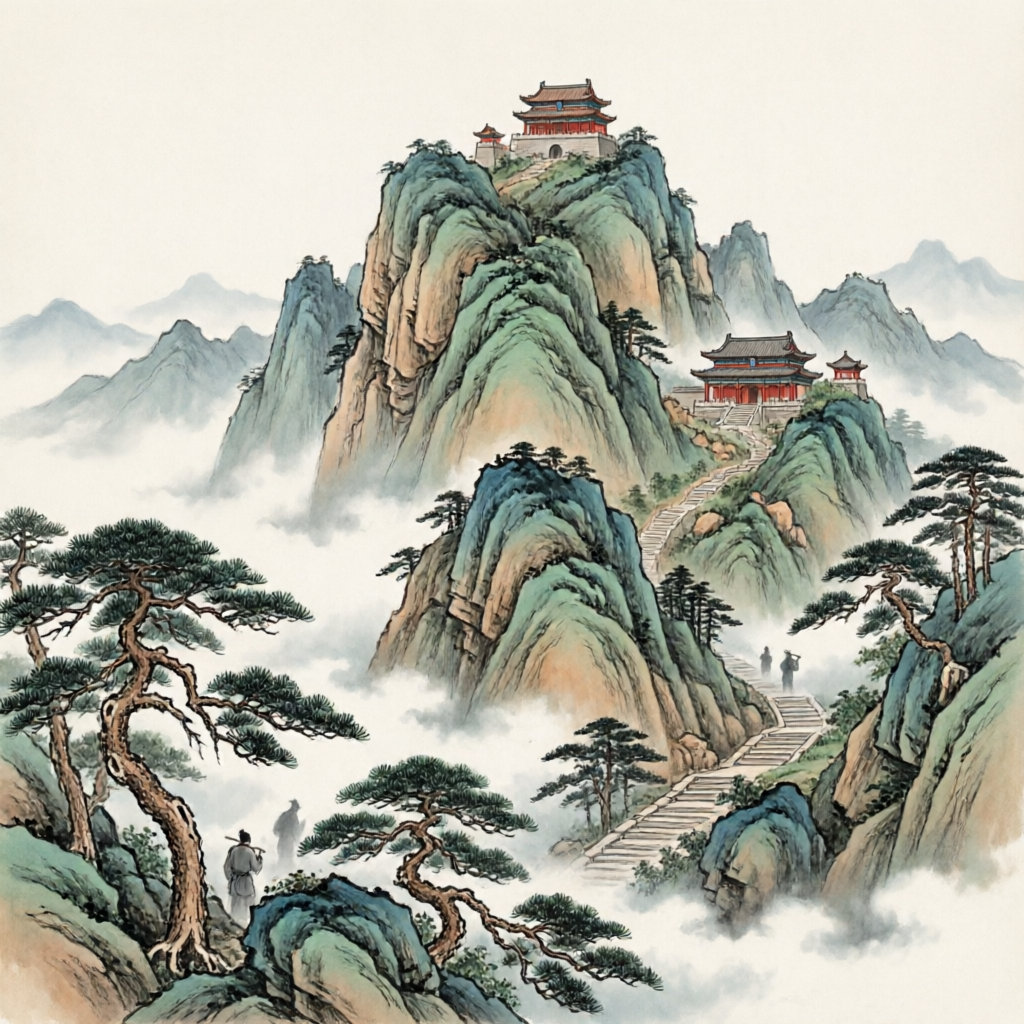
Overview
Mount Tai, located in central Shandong Province, spans the cities of Tai'an, Jinan, and Zibo. Historically known as "Daishan" and "Daizong," it was renamed "Mount Tai" during the Spring and Autumn Period. The mountain stands majestically east of the North China Plain, overlooking the Qilu Plain, with the Yellow River to the west and the sea to the east. Mount Tai's main peak, Yuhuangding, reaches an elevation of approximately 1,532.7 meters, covering an area of 426 square kilometers. The mountain's proximity to Confucius's hometown of Qufu to the south and Jinan, the "Spring City," to the north adds to its cultural significance.
History
Mount Tai's history spans billions of years, evolving through complex geological processes. The mountain's formation can be divided into three main stages: the ancient Mount Tai formation, the marine-terrestrial evolution, and the current Mount Tai formation.
During the Archean era, Mount Tai was part of a large depression or trough in western Shandong, where thick mud-sandy and basic volcanic materials accumulated. Later, through the "Taishan Movement," these materials folded and uplifted into a massive mountain system, accompanied by fractures, magmatic activities, and metamorphism, forming the "Taishan Complex" of various metamorphic and igneous rocks.
In the early Paleozoic era, the North China region experienced significant subsidence, causing ancient Mount Tai to submerge below sea level. On the eroded surface of the ancient metamorphic complex, a nearly 2,000-meter-thick Cambrian-Ordovician limestone was deposited. By the end of the Middle Ordovician, influenced by the Caledonian movement, the North China region rose as land, experiencing a long sedimentary hiatus.
During the Mesozoic era, a NEE-taishan fault developed at the southern foot of the mountain. The northern block of this fault, the original ancient Mount Tai, continuously uplifted and experienced weathering and erosion. In the Cenozoic era, Mount Tai continued to experience significant tilting and uplift, completely stripping away the sedimentary cover that had once overlain the ancient metamorphic complex, allowing the 2-billion-year-old metamorphic rocks to re-expose at the surface.
Key Information
| Feature | Description |
|---|---|
| Location | Central Shandong Province, spanning Tai'an, Jinan, and Zibo cities |
| Altitude | Main peak (Yuhuangding): 1,532.7 meters |
| Area | 426 square kilometers |
| Geological Age | Parts of the rock formations are approximately 2.5 billion years old |
| Climate | Vertical climate variation: mountain foot January average -3°C, summit -9°C; mountain foot July average 26°C, summit 18°C |
| Water Resources | Total storage: 30.43 billion cubic meters (groundwater: 14.97 billion, surface water: 15.46 billion) |
| Vegetation | Over 1,412 species of higher plants, 80% forest coverage |
| Wildlife | 25 species of mammals, 154 species of birds, 12 species of reptiles, 6 species of amphibians, 45 species of fish |
Geological Features
Mount Tai's geological structure is extremely complex, dominated by fractures with characteristics of fault block tilting and uplift. It contains both Precambrian and Mesozoic-Cenozoic structures. The Precambrian geological features mainly include multiple periods of folding, fracturing, and ductile shear zones, which constitute an extremely complex structural landscape.
From a regional tectonic perspective, the strong subduction of the Pacific Plate in an east-west direction against the Eurasian Plate has caused the Taishan region to experience nearly north-south extension. This has led to intense tilting activity along the Taishan fault, causing significant uplift of Mount Tai. The neotectonic movement is widespread and intense, playing a dominant role in the formation and geomorphological pattern of Mount Tai.
The mountain's terrain can be divided into four main types: alluvial-proluvial terraces, denudation-accumulation hills, structural denudation low mountains, and erosion-structural medium-low mountains. These create a magnificent landscape of overlapping peaks and towering mountains.
Erosion Landscapes
Under the influence of neotectonic movement, Mount Tai exhibits intense erosion and cutting, developing various types of erosion landscapes. Due to the significantly greater uplift of the southern slope compared to the northern slope, erosion is stronger and erosion landscapes are more developed on the south side.
The erosion landscapes can be classified into five types based on morphology and origin:
1. Erosion-structural medium mountains: Distributed around the main peak Yuhuangding and other areas, with elevations of 1,000-1,500 meters.
2. Erosion-structural low mountains: Found in areas like Aolai Peak, Zhongtianmen, and Jianding Mountain, with elevations of 700-1,000 meters.
3. Karst erosion-structural low mountains: Mainly distributed in the area from Jiguan Mountain to Qingshan northeast of the main peak, with elevations of 500-700 meters.
4. Karst erosion hills: Mostly found in the Cambrian limestone areas on the northern edge of Mount Tai, with elevations of 300-500 meters.
5. Denudation hills: Primarily distributed along the southern edge of the low mountains, with elevations around 200 meters.
Micro-landscapes
Mount Tai also features numerous small and micro-landscapes, including:
- Three-level planation surfaces: At different elevations (50-200m, 600-800m, and 1,000-1,500m)
- Three-fold valley slopes: Showing three turns in the valley slopes
- Three-level caves: Distributed at different elevations (510-515m, 540-545m, and 560m)
- Three-level terraces: Along rivers surrounding Mount Tai
- Three-tiered waterfalls: Including the "Three Pools Moon" waterfall
Climate and Hydrology
Mount Tai exhibits significant vertical climate variation. The mountain foot has an average January temperature of -3°C, while the summit averages -9°C. In July, the mountain foot averages 26°C, while the summit averages 18°C. Annual precipitation increases with elevation, with the summit receiving 1,132 mm compared to 722.6 mm at the foot.
The mountain is rich in water resources, with a total storage of 30.43 billion cubic meters. Rivers and streams are distributed with Yuhuangding as the watershed. The northern rivers flow into the Yellow River, while eastern, southern, and western rivers flow into the Dawen River. Due to the steep terrain, rivers are short, rapid, and erosive, creating numerous waterfalls and pools. Notable waterfalls include Heilongtan Waterfall, Three Pools Iterative Waterfall, and Yunbuqiao Waterfall.
Mount Tai is also known for its numerous springs, with dozens of famous springs such as Wangmu Spring, Moon Spring, and Yuye Spring. The spring water is colorless, transparent, and contains various trace elements beneficial to human health, making it high-quality mineral water and one of the "Three Beauties of Mount Tai" (cabbage, tofu, and water).
Natural Resources
Flora
Mount Tai belongs to the North China flora region and is a transitional zone between dry and humid climates due to the influence of the Yellow Sea and Bohai Sea. The mountain supports abundant vegetation with 1,412 species of higher plants in 174 families and 645 genera, and 446 species of lower plants. There are 1,136 species of vascular plants in 133 families and 550 genera, including 814 wild species and 322 cultivated species. The forest coverage exceeds 80%.
Mount Tai is home to numerous ancient and famous trees, with over 10,000 trees of 34 species. These ancient trees are closely connected to the historical and cultural development of Mount Tai and are symbols of ancient civilization. Notable examples include the Han Cypress in the Cold, the Official Seal Hanging Tree, the Tang Scholar Tree Embracing Its Young, the Thousand-Year-old Blue Tan, and the Five Officials Pine.
Fauna
The animal life of Mount Tai represents the fauna of the central and southern Shandong hills and is mostly composed of species found in North China. The mountain is home to 25 species of mammals in 11 families and 20 genera, 154 species of birds in 34 families and 88 genera, 12 species of reptiles in 7 families and 5 genera, 6 species of amphibians in 3 families and 3 genera, and 45 species of fish in 12 families.
Invertebrates are numerous and widely distributed, with approximately 900 identified insect species. In recent years, new species have been discovered, including the Pointed Gray Butterfly in November 2022 and the Taishan Great钻瘤蛾 (Eurasia dilatifemur) in December 2025, a new record species for China.
Cultural Significance
Mount Tai holds immense cultural importance in Chinese history and tradition. As one of the Five Great Mountains of China, it has been a site of religious worship for over 3,000 years. The mountain has been venerated by both Taoists and Buddhists and has served as a natural laboratory for scientific research and artistic inspiration.
The mountain features numerous temples, stone inscriptions, and cultural relics that reflect its long history of veneration. The "Four Wonders" of Mount Tai—sunrise, sea of clouds, sunset glow, and the golden ribbon of the Yellow River—are celebrated natural phenomena that attract visitors from around the world.
Mount Tai has inspired countless poets, painters, and scholars throughout Chinese history. Its imposing presence and dramatic landscapes have been depicted in countless works of art and literature, solidifying its place as a symbol of Chinese cultural identity and natural beauty.
Modern Status
Today, Mount Tai is a UNESCO World Heritage Site and one of China's most popular tourist destinations. It receives millions of visitors annually who come to experience its natural beauty, cultural heritage, and spiritual atmosphere. The mountain is divided into six main scenic areas:幽区 (Secluded Area), 旷区 (Vast Area), 奥区 (Mysterious Area), 妙区 (Wonderful Area), 秀区 (Beautiful Area), and 丽区 (Picturesque Area).
Modern conservation efforts focus on protecting the mountain's delicate ecosystem while allowing sustainable tourism. The local government has implemented measures to control pollution, limit commercial development, and preserve the natural and cultural heritage of the area.
Mount Tai continues to be a site of scientific research, particularly in the fields of geology, botany, and climatology. Its complex geological features and well-preserved ecological succession provide valuable insights into Earth's history and processes.
References
- Li, S., & Wang, H. (2018). Geological Evolution and Landscape Features of Mount Tai. Shandong Science Press.
- Zhang, Y., & Liu, Q. (2020). Biodiversity and Conservation of Mount Tai. China Environmental Science Press.
- Chen, W., & Zhao, R. (2019). Cultural Significance of Mount Tai in Chinese History. Cultural Relics Publishing House.
- Wang, J., et al. (2021). Climatic Characteristics and Hydrological Features of Mount Tai. Journal of Mountain Science, 18(3), 567-582.
- UNESCO World Heritage Centre. (2002). Mount Tai. World Heritage Nomination Documentation.