Overview
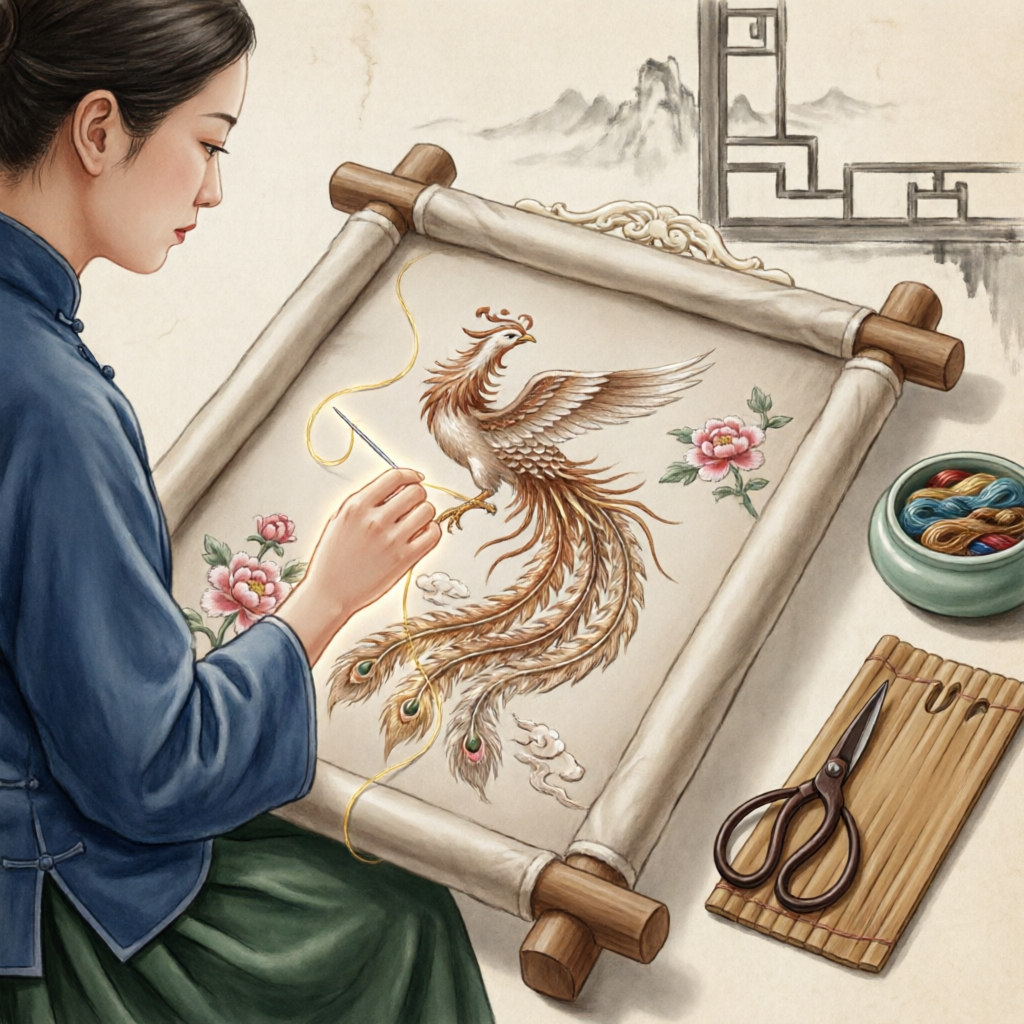
Xiang Embroidery (湘绣) is a traditional embroidery style centered in Changsha, Hunan Province. It represents one of China's Four Great Embroideries, alongside Suzhou, Yue, and Shu embroideries. Modern Xiang Embroidery developed on the foundation of Hunan folk embroidery techniques, incorporating elements from ancient court embroidery, literati embroidery, and techniques from other embroidery styles like Suzhou and Yue embroideries. This fusion created a unique artistic form characterized by its lifelike imagery, vibrant colors, and remarkable attention to detail.
Xiang Embroidery primarily uses silk threads, pure silk, hard satin, soft satin, transparent gauze, and various colored silk and wool threads for creation. Its compositions are meticulously structured with vivid colors, and various stitching techniques are employed to create special artistic effects. The embroidery can depict figures, animals, landscapes, flowers, and birds with remarkable realism, utilizing techniques such as flat embroidery, woven embroidery, mesh embroidery, knot embroidery, seed embroidery, cut velvet embroidery, and random stitch embroidery.
History
The history of Xiang Embroidery dates back over 2,000 years to the Spring and Autumn and Warring States periods. Archaeological discoveries from the Chu tombs in Changsha and the Western Han Dynasty Mawangdui tomb reveal that Hunan's local embroidery techniques had already reached an impressive level during that time. In 1958, dragon and phoenix pattern embroidery unearthed from a Chu tomb in Changsha amazed the world with its exquisite patterns and delicate needlework.
In 1972, approximately forty embroidered garments were discovered in the Western Han Mawangdui tomb, demonstrating that Hunan embroidery (Xiang Embroidery) had developed to a high level as early as 2,100 years ago. Professor Tian Zibian noted in his "History of Chinese Dyeing and Weaving": "The splendid Chu embroidery and Han embroidery from Mawangdui are not only a proud chapter in Chinese embroidery history but also the natural origin of Xiang Embroidery."
During the Qing Dynasty, Xiang Embroidery emerged as a rising star in the embroidery arts, building upon Hunan folk embroidery while incorporating techniques from other embroidery schools. In 1898, Wu Hanchen, son of embroiderer Hu Lianxian, opened the first "Wu Caixia Embroidery Shop" in Changsha, which sold its own embroidered works and helped make Xiang Embroidery famous nationwide. In the late Guangxu period, Hunan folk embroidery evolved into a unique embroidery system with an independent style and strong local characteristics.
In the 1930s, Xiang Embroidery reached its peak production value of 800,000 silver yuan, with one-third of its products exported. After the founding of New China, Xiang Embroidery experienced three development stages: the "golden age" of the 1950s, an industrial adjustment period in the early 1970s, and a period of "hundred flowers blooming" in the early 1990s. In the 21st century, Xiang Embroidery was listed in the first batch of China's intangible cultural heritage protection projects.
Key Information
| Feature | Description |
|---|---|
| Chinese Name | 湘绣 (Xiāng Xiù) |
| Origin | Changsha, Hunan Province, China |
| Recognition | One of China's Four Great Embroideries |
| UNESCO Status | National Intangible Cultural Heritage (since 2006) |
| Key Materials | Silk threads, hard satin, soft satin, transparent gauze |
| Distinctive Feature | Vivid imagery, vibrant colors, realistic textures |
| Major Techniques | 72 traditional stitches including flat stitch, scattered stitch, random stitch |
| Notable Works | "Winter Snow in Northern Country" (collected in the Great Hall of the People) |
| Geographical Indication | Approved by AQSIQ on March 28, 2011 |
Cultural Significance
Xiang Embroidery holds profound cultural significance as both an art form and a cultural symbol of Hunan Province. It has been described as "magical art" and "the most precious embroidery," serving as a cultural ambassador for China. The embroidery style integrates traditional Chinese painting, calligraphy, poetry, and seal carving techniques, creating a unique artistic expression that transcends mere craft.
The embroidery is often presented as national gifts to foreign leaders and dignitaries, earning praise as "marvelous hands, exquisite works." Xiang Embroidery products are widely used for gifts, decoration, collection, and in fashion accessories, with exports to over twenty countries and regions across Europe, America, Asia, Africa, and Hong Kong, Macao, and Taiwan.
Modern Status
Today, Xiang Embroidery continues to evolve while preserving its traditional techniques. In 2008, the annual output value of Xiang Embroidery exceeded 500 million RMB, with exports of over 1.2 million pieces (sets) annually, providing employment for nearly 6,000 rural workers. By 2012, the Xiang Embroidery industry included over 100 related enterprises, with 8 Chinese Arts and Crafts Masters and 12 Hunan Provincial Arts and Crafts Masters among its practitioners.
The industry has faced challenges over the years, including shifts in market demand and competition from machine-made products. However, efforts to preserve and promote Xiang Embroidery have strengthened its position as a cultural treasure. The Shaping area in Changsha has been designated as the "Hometown of Chinese Xiang Embroidery," and specialized industrial parks have been established to support the industry's development.
In recent years, Xiang Embroidery has embraced modern design concepts while maintaining its traditional essence, appealing to contemporary tastes and expanding its market presence. The embroidery continues to be recognized for its cultural value, with ongoing efforts to document techniques, train new artisans, and promote awareness of this important cultural heritage.
References
-
Tian, Z. (1984). History of Chinese Dyeing and Weaving. China Light Industry Press.
-
Gao, C. (2009). Traditional Chinese Embroidery: Art and Techniques. Yale University Press.
-
Liu, Y. (2015). Intangible Cultural Heritage of China: Xiang Embroidery. Hunan Fine Arts Publishing House.