Overview
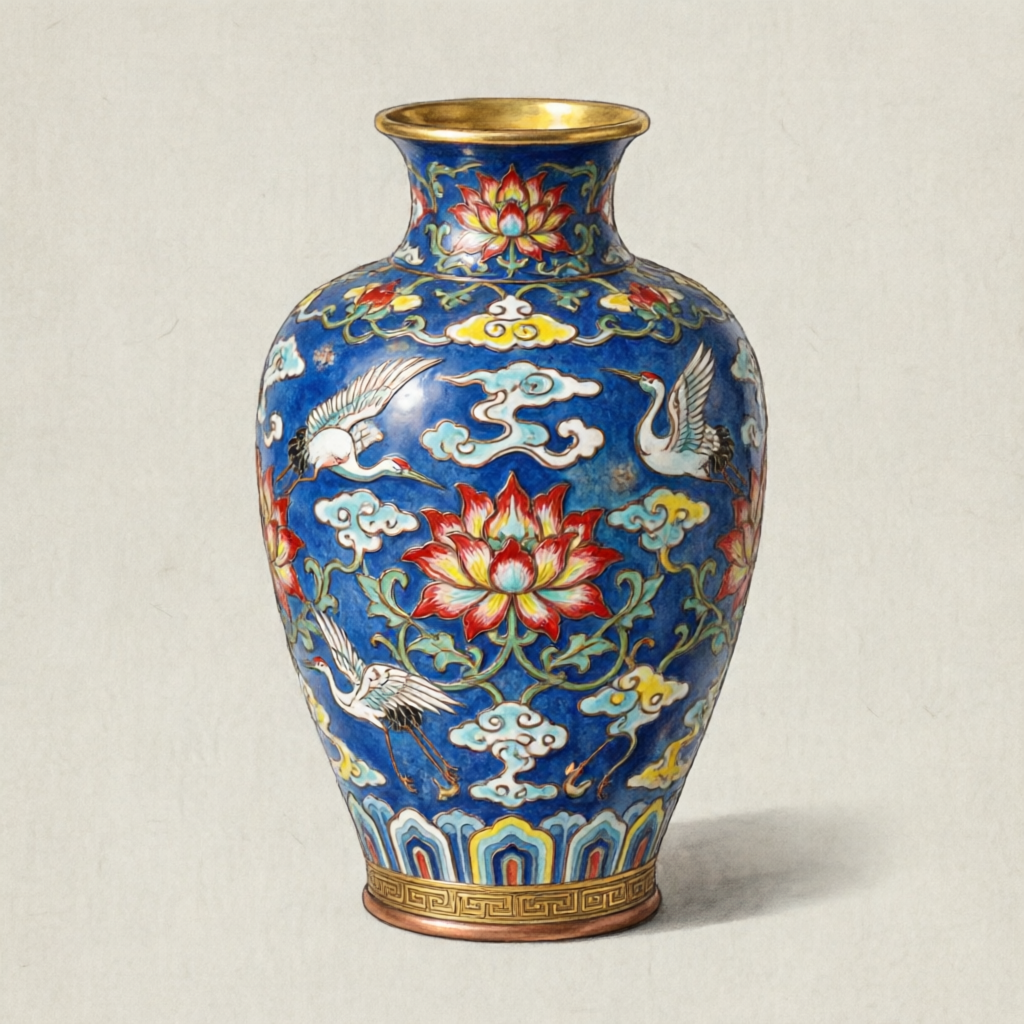
Cloisonné, also known as Jingtai Lan (景泰蓝) in Chinese, is a traditional decorative art form that involves creating intricate designs on metal objects by filling recessed areas with colored enamel paste. The art form is characterized by its elegant shapes, elaborate patterns, and rich colors, making it one of the three great treasures of Chinese craftsmanship alongside carved lacquer and gold lacquer inlay. Cloisonné pieces are renowned for their crystalline texture and brilliant appearance, representing a perfect fusion of Chinese artistic traditions with foreign influences.
History
The origins of cloisonné in China remain a subject of scholarly debate. Archaeological evidence suggests that cloisonné objects may have appeared during the Yuan Dynasty (1271-1368), with the Palace Museum in Beijing preserving several pieces believed to be from this period, including animal-ear three-ring vessels and lotus-shaped incense burners. According to historical records in the "History of Song - Foreign Chronicles," "Dashi" (大食) was an ancient Chinese term for Arab regions in West Asia. Experts analyzing historical materials suggest that "copper-body cloisonné enamelware" was introduced to China from Arab countries around the late 13th century.
Initially called "Dashi kiln ware," "Guiguo kiln ware," or "Fulang qian" (佛郎嵌), this craft was brought to China by Arab artisans who possessed the technical skills and raw materials for producing metal-body enamelware. The Mongol army's campaigns across Eurasia during the late 13th century resulted in the capture of numerous skilled craftsmen who were transported to serve Mongol nobility, bringing with them the technology for producing luxurious metal-body enamelware.
The term "Jingtai Lan" first appeared in the archives of the Qing Dynasty's Imperial Workshop (Zao Ban Chu). In the "Records of Completed Work" from the sixth year of Yongzheng's reign (1728), there is a reference to "imitating Jingtai Lan enamelware," marking the earliest known written record of this term. The name became popular because the craft reached its zenith of development during the Jingtai era (1450-1457) of the Ming Dynasty.
Key Information
| Aspect | Details |
|---|---|
| Chinese Name | 景泰蓝 (Jingtai Lan) |
| Alternate Names | 法浪 (Falong), 发蓝 (Fa Lan), 珐郎 (Fa Lang) |
| Origin Period | Late Yuan Dynasty (13th century) |
| Place of Origin | China (Beijing as primary center) |
| Key Materials | Copper body, colored enamel paste, gold/silver/copper wire |
| Production Process | Body making, wire laying (cloisonné), enamel filling, firing, polishing, gilding |
| Cultural Status | One of China's Three Great Craft Treasures |
| Protection Level | National Intangible Cultural Heritage |
Cultural Significance
Cloisonné holds a significant position in Chinese cultural and artistic heritage. As a court art form, it was an essential component of imperial decorations and treasures in palaces such as the Forbidden City's Hall of Supreme Harmony, the Guozijian's Biyong Palace, and the Summer Palace's Hall of Dispelling Clouds. The craft embodies the philosophical Chinese saying "stones from other mountains can polish jade," illustrating how this imported art form was assimilated and transformed within China's rich artistic soil.
The artistic characteristics of Beijing cloisonné can be summarized by four elements: form, pattern, color, and light. A fine cloisonné piece requires excellent craftsmanship in each stage: the form depends on body making, the decoration on wire laying, the color on enamel preparation, and the brilliance on polishing and gilding. This integration of artistry, craftsmanship, carving, inlay, glass smelting, and metallurgy creates works with distinctive ethnic style and profound cultural meaning.
During the Ming Dynasty, particularly during the Xuande (1426-1435) and Jingtai (1450-1457) periods, cloisonné developed distinctive artistic features. The Xuande period saw the formation of a mature artistic style with pieces featuring lotus leaves, taotie (mythical beast), lion playing ball, and Xifan lotus patterns. The color palette primarily included light blue, sapphire blue, light green, deep green, red, white, and yellow. The Jingtai period witnessed further development with more diverse shapes, practical applications, and new colors such as grape purple, kingfisher blue, and purplish-red.
Modern Status
After the founding of the People's Republic of China in 1949, cloisonné craftsmanship experienced significant revival and development. Artists' cultural and artistic levels improved substantially, especially after the 1960s with the continuous addition of professional technical personnel. The industry successfully preserved traditional strengths while developing new varieties.
In 1959, to celebrate the tenth anniversary of the PRC, artists created the "Golden Fish and Lotus Large Fish Bowl" for the Great Hall of the People. In the 1970s, historically significant large pieces like the "Lion Stove," "Pavilion Stove," "Lion Rolling Embroidered Ball Plate," and "Peacock Vase" were produced. The craft has since expanded to include practical items such as smoking accessories, stationery, lamps, tea sets, furniture, and decorative screens.
Technological innovations have transformed production processes. In 1958, workers at Beijing Cloisonné Factory developed specialized rolling machines for body making, significantly improving productivity and product quality. The introduction of electric grinders in the 1950s and subsequent improvements led to superior finishing quality. Modern production also utilizes electric ball mills for enamel grinding and natural gas for firing, replacing traditional coal furnaces.
Cloisonné continues to play an important role in international relations. In 1997, the "Universal Celebration" pair of vases (1.8 meters high each) was gifted by Beijing to Hong Kong upon its return to China. In 1998, a pair of large cloisonné vases was presented to Moscow to celebrate its 850th anniversary. More recently, in 2014, the "Four Seas Rising in Peace" cloisonne vase was created as a gift for APEC leaders, combining three traditional enamel techniques.
The craft has also seen innovation in scale and form. In 2016, the "Dingli Jingang Furnace" was completed in Hebei Province, standing 5.99 meters high with a diameter of 3.39 meters, becoming the largest cloisonne furnace ever created. In 2005, cast-body cloisonné techniques were revived to create the "Buddhist Treasure Dragon Kings" series, featuring eight pieces with over fifty figures.
References
-
Gyllensvärd, B. (1979). Chinese Cloisonné: The Pierre Uldry Collection. Smithsonian Institution Press.
-
Rawson, J. (1995). Chinese Jade from the Neolithic to the Qing. British Museum Press.
-
Wang, S. (2000). Traditional Crafts of China. Beijing: Foreign Languages Press.
-
Clarke, J. C. Y. (2000). Chinese Cloisonné: History, Technique, and Examples. Philip Wilson Publishers.
-
Li, J. (2012). Chinese Enamel Art: From the Yuan Dynasty to the Present. Beijing: Cultural Relics Publishing House.