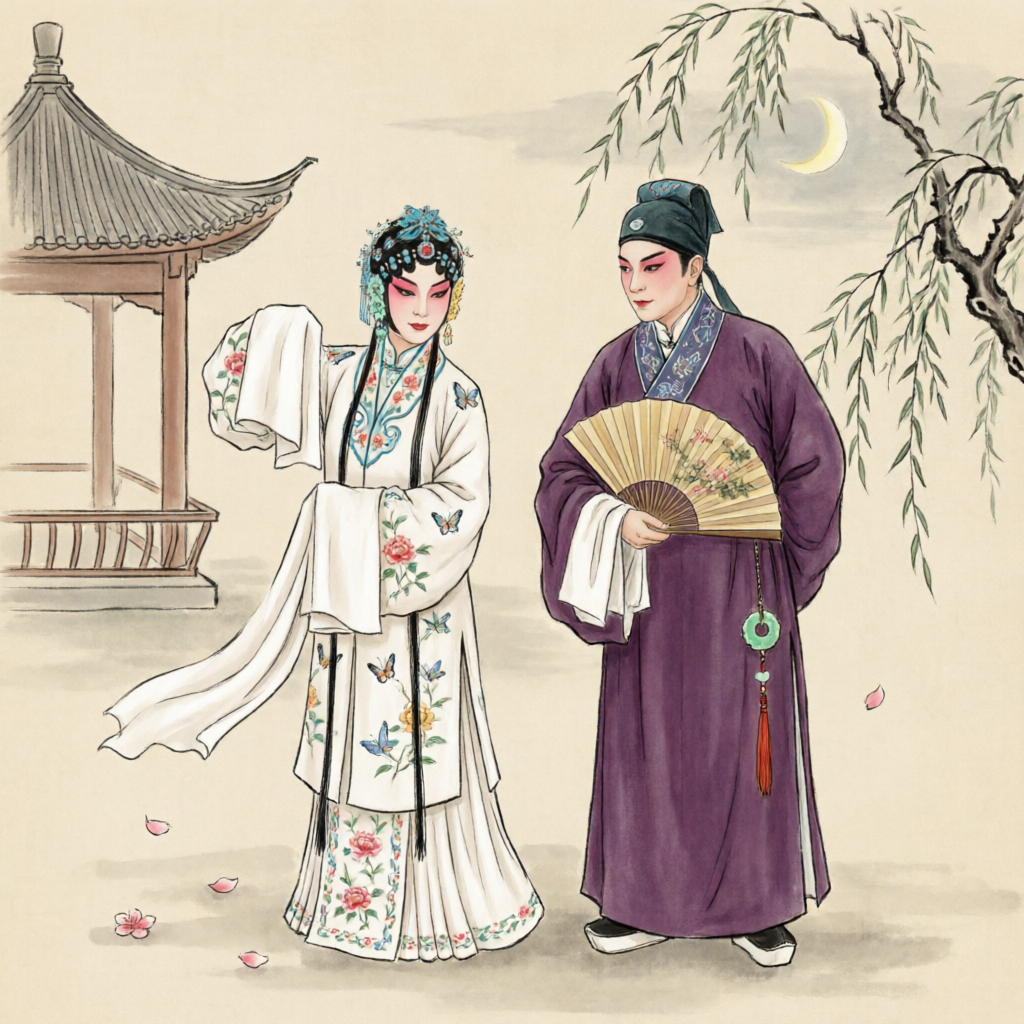
Kunqu Opera
Overview
Kunqu Opera, formerly known as "Kunshan腔" (Kunshan tune) or simply "Kun腔" (Kun tune), is one of the oldest forms of traditional Chinese opera and performing art. With a history spanning over 600 years, Kunqu is renowned for its elegant melodies, poetic lyrics, and highly stylized performance techniques. Often referred to as the "ancestor of a hundred operas" (百戏之祖), Kunqu has profoundly influenced the development of numerous regional opera forms throughout China and beyond.
History
Kunqu Opera originated in the Kunshan area of Jiangsu province during the Yuan Dynasty (1271-1368), with folk musician Gu Jian (顾坚) credited as its early developer. However, it was during the Jiajing era (1522-1566) of the Ming Dynasty that Kunqu underwent a significant transformation through the efforts of Wei Liangfu (魏良辅), a pioneering musician and reformer. Wei refined the Kunshan tune by incorporating elements from other popular opera styles of the time, such as the Yaoqiang, Yiyangqiang, and Haiyanqiang. The resulting style was characterized by its soft, delicate, and flowing quality, earning it the nickname "shuimodiao" (水磨调), or "water-ground tune," comparing its refinement to the meticulous process of grinding rice flour.
By the Wanli era (1573-1620), Kunqu experienced explosive growth, producing a wealth of outstanding plays and flourishing performances. Historical records indicate that in Suzhou alone, there were several thousand professional Kunqu performers during this period. Performances took place in diverse venues, including private homes, villas, countryside stages, and even on boats in the water towns of the Jiangnan region. This era also saw innovations in audience accessibility, with special "female viewing platforms" (女台) constructed to allow women to attend performances without violating social proprieties.
The 18th century marked a turning point in Kunqu's history. As local opera forms (collectively known as "huabu" or "flower troupe") gained popularity with the rising merchant class and urban audiences, Kunqu gradually lost its dominant position on the stage. Its refined, literate style became increasingly disconnected from the tastes of the general public. The rise of Beijing Opera in the mid-19th century further accelerated Kunqu's decline, with many Kunqu performers switching to the more popular new form.
Following the establishment of the People's Republic of China in 1949, efforts were made to revive traditional performing arts, including Kunqu. A significant turning point came in 1956 with the adaptation and performance of "The Fifteen Strings of Coins" (十五贯) by the Zhejiang Kunqu Troupe. This production achieved nationwide acclaim, leading to Premier Zhou Enlai's famous remark: "One play saved one art form." This success prompted the reestablishment of Kunqu troupes across China.
In 2001, Kunqu Opera was among the first 19 works to be proclaimed by UNESCO as a Masterpiece of the Oral and Intangible Heritage of Humanity, recognizing its outstanding universal value and the need for its preservation.
Key Information
| Aspect | Description |
|---|---|
| Chinese Name | 昆曲 (Kunqu) / 昆剧 (Kunju) |
| Geographical Origin | Kunshan, Jiangsu Province, China |
| Time Period | Originated: Yuan Dynasty (14th century) Golden Age: Ming Dynasty (16th-17th centuries) |
| Recognition | UNESCO Masterpiece of the Oral and Intangible Heritage of Humanity (2001) |
| Main Performance Centers | Jiangsu, Shanghai, Zhejiang, Beijing, Hunan, Jiangxi |
| Major Troupes | Northern Kunqu Theatre (Beijing) Jiangsu Kunqu Theatre Shanghai Kunqu Troupe Zhejiang Kunqu Troupe Hunan Kunqu Troupe Yongjia Kunqu Troupe (Zhejiang) |
| Notable Plays | "The Peony Pavilion" (牡丹亭) "The Palace of Eternal Youth" (长生殿) "The Peach Blossom Fan" (桃花扇) "The Fifteen Strings of Coins" (十五贯) |
Cultural Significance
Kunqu Opera occupies a privileged position in Chinese cultural history as a comprehensive art form that integrates poetry, music, dance, theater, and fine arts. Its literary works, many of which are masterpieces of classical Chinese literature, continue to be studied and performed today. The form's influence extends far beyond its own repertoire, having nurtured the development of numerous regional opera forms across China, including Peking Opera, which incorporated many elements from Kunqu performance traditions.
Kunqu's aesthetic principles reflect the cultural values and artistic sensibilities of the literati class in traditional China. Its emphasis on poetic expression, emotional subtlety, and refined performance techniques represents the pinnacle of classical Chinese artistic achievement. The form's slow, deliberate pace and emphasis on linguistic beauty create a contemplative theatrical experience that stands in contrast to the more dynamic and popular forms of entertainment.
The preservation of Kunqu has become a cultural imperative in modern China. As one of the most complete and systematic traditional performing arts forms, Kunqu serves as a "living fossil" of Chinese theatrical tradition, preserving performance techniques, musical structures, and literary conventions that might otherwise be lost.
Modern Status
Today, Kunqu Opera faces significant challenges in maintaining its relevance in contemporary society. The form's highly stylized nature, slow pace, and literary content create barriers for modern audiences accustomed to faster-paced and more accessible entertainment forms. As of recent estimates, there are only about 600 professional Kunqu practitioners in China, compared to the thousands during its heyday.
Despite these challenges, Kunqu has experienced a modest revival in recent decades. The establishment of dedicated Kunqu troupes, educational programs, and annual festivals such as the China Kunqu Festival has helped preserve and promote the art form. Contemporary adaptations of traditional Kunqu plays, such as condensed versions of "The Peony Pavilion," have introduced the form to new audiences while maintaining its essential artistic qualities.
Innovative approaches to Kunqu performance have also emerged, including experimental productions that incorporate contemporary elements while respecting traditional aesthetics. The 2006 production of "The Duke of Sun" (公孙子都) by the Zhejiang Kunqu Troupe, for example, revitalized Kunqu's tradition of martial arts performance while exploring contemporary psychological themes.
International interest in Kunqu has grown following its UNESCO recognition, with performances and educational exchanges occurring worldwide. The form's unique aesthetic qualities and historical significance continue to attract scholars, artists, and audiences from diverse cultural backgrounds.
References
- Chang, S. C. The Rise and Fall of the Kunqu Theater. University of Hawaii Press, 2010.
- Mackerras, C. "The Chinese Theatre in the 20th Century." In The Cambridge Guide to Theatre, edited by Martin Banham, 1998.
- Wu, Z. "Kunqu Opera: Preservation and Innovation in the 21st Century." Asian Theatre Journal, vol. 28, no. 1, 2011, pp. 127-145.
- Li, Y. The Kunqu Art: History, Theory, and Practice. Shanghai People's Publishing House, 2008.
- Gerstle, C. Theater as Knowledge: The Catastrophic Decline of Kunqu, China's Old Opera. University of Hawaii Press, 2013.