Tai Chi
Overview
Tai Chi (太极) is a significant concept in Chinese cultural history representing the primordial state of the universe before heaven and earth were divided. The term embodies the philosophical understanding of the cosmos as an undifferentiated whole from which all things emerge through the interplay of opposing yet complementary forces known as yin and yang. This concept forms the foundation of many traditional Chinese practices including martial arts, medicine, and cosmology.
History
The term "Tai Chi" first appears in classical Chinese texts, most notably in the I Ching (Book of Changes), where it states: "The I Ching has Tai Chi, which produced the two primary forces (Liang Yi). The two primary forces produced the four symbols (Si Xiang). The four symbols produced the eight trigrams (Ba Gua)." This passage establishes Tai Chi as the origin point from which the entire cosmological system of Chinese philosophy emerges.
In the Zhuangzi ("Great Master" chapter), Tai Chi is mentioned as being above the highest point and below the deepest point, indicating its transcendental nature. However, the precise meaning of "Tai Chi" remained somewhat ambiguous in early texts, leading to diverse interpretations throughout Chinese intellectual history.
During the Song Dynasty (960-1279), Neo-Confucian scholars further developed the philosophical implications of Tai Chi, making it a focal point of I Ching studies. According to the Jingyi Kao (Examination of Classical Meanings) compiled by Zhu Yizun of the Qing Dynasty, over sixty specialized works on Tai Chi were written during the Song Dynasty alone.
Key Information
| Aspect | Description |
|---|---|
| Chinese Name | 太极 (Tàijí) |
| Romanization | Tai Chi, T'ai Chi, or Taiji |
| Core Concept | The undifferentiated primordial state of the universe |
| Philosophical Origin | Emerges from the interaction of yin and yang |
| Earliest Textual Reference | I Ching (Book of Changes), Zhou Dynasty (1046-256 BCE) |
| Development | Systematized during Song Dynasty Neo-Confucianism |
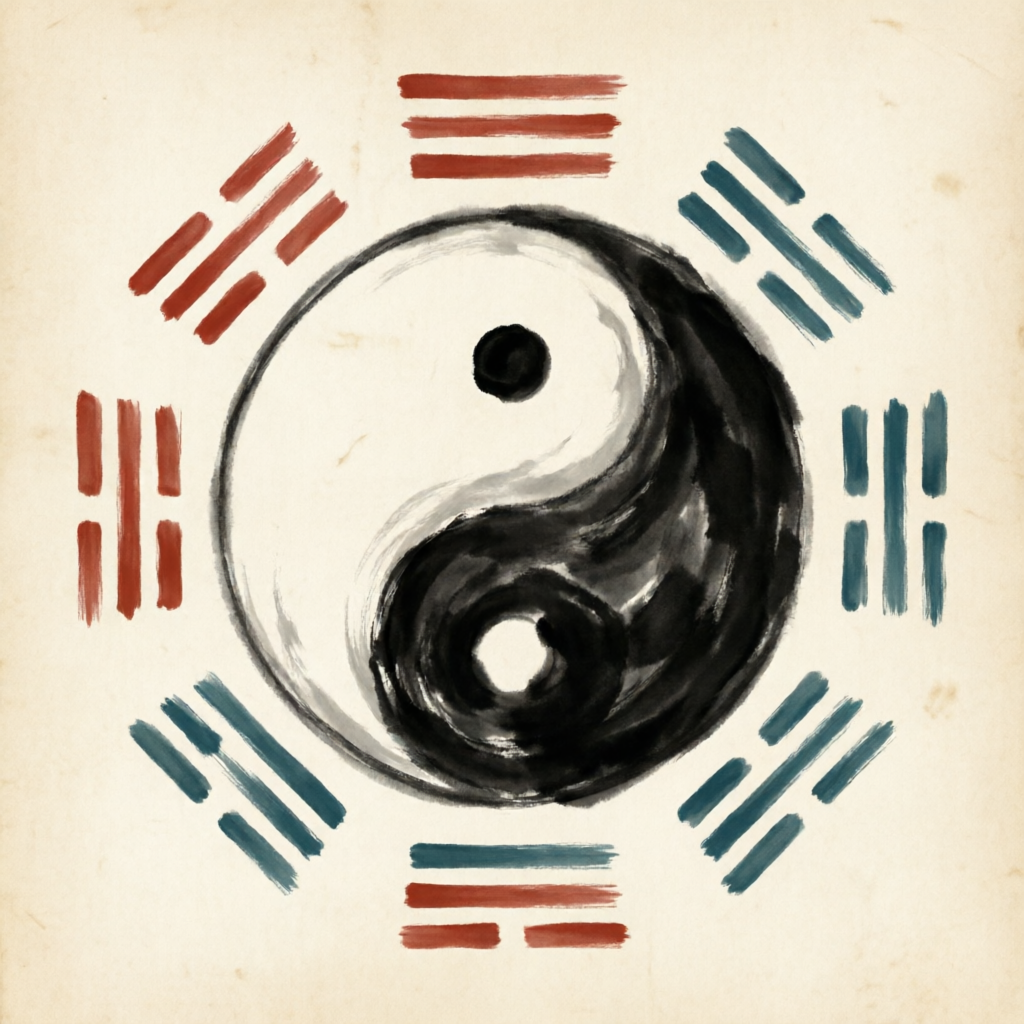
| Symbolic Representation | Often depicted as the Taijitu (阴阳太极图), showing yin and yang in dynamic balance |
| Cultural Impact | Influenced Chinese philosophy, medicine, martial arts, and art |
Cultural Significance
The Tai Chi concept has profound cultural significance in China and throughout East Asia. It represents the philosophical understanding of reality as a dynamic balance of opposing forces that are complementary rather than contradictory. This principle has been applied to numerous aspects of Chinese culture:
In traditional Chinese medicine, Tai Chi theory informs the understanding of health as a balance of yin and yang energies within the body. The practice of Tai Chi Chuan (the martial art) embodies these principles through slow, flowing movements that cultivate internal energy (qi) and promote harmony between mind and body.
The Taijitu (太极图), commonly known as the "yin-yang diagram," is perhaps the most recognizable visual representation of this concept. This symbol, featuring two fish-like forms of contrasting colors that curve around each other, has become ubiquitous in Chinese culture, appearing in temples, on flags, in martial arts schools, and even in modern contexts like the South Korean flag and Singaporean air force insignia.
Modern Status
In contemporary contexts, Tai Chi has transcended its philosophical origins to become widely practiced as a martial art and health exercise. Millions of people worldwide practice Tai Chi Chuan for its physical, mental, and spiritual benefits. The practice has been adapted into various forms, from traditional styles emphasizing martial applications to modern therapeutic approaches focused on stress reduction and health maintenance.
Academically, the concept of Tai Chi continues to be studied in philosophy, cultural studies, and comparative religion. Scholars examine its historical development, its relationship to other philosophical systems, and its contemporary relevance in an increasingly globalized world.
The origins of the Taijitu diagram remain a subject of scholarly debate. While some theories suggest connections to Neolithic symbols depicting paired animals or natural phenomena, others trace its development to Song Dynasty scholars like Zhang Xingcheng, who is credited with creating one of the earliest known versions of the diagram in his 12th-century work Yi Xuan.
References
-
Needham, Joseph. (1956). Science and Civilisation in China, Volume 2: History of Scientific Thought. Cambridge University Press.
-
Little, Stephen. (1990). Taoism and the Arts of China. University of Chicago Press.
-
Robinet, Isabelle. (1997). Taoism: Growth of a Religion. Translated by Phyllis Brooks. Stanford University Press.
-
Zhang, Dainian. (1983). Key Concepts in Chinese Philosophy. Foreign Languages Press.
-
Kalton, Michael S. (1988). The Neo-Confucian Vision of Reality: A Study of the Historical Development of the Neo-Confucian World-View. University of Michigan Press.