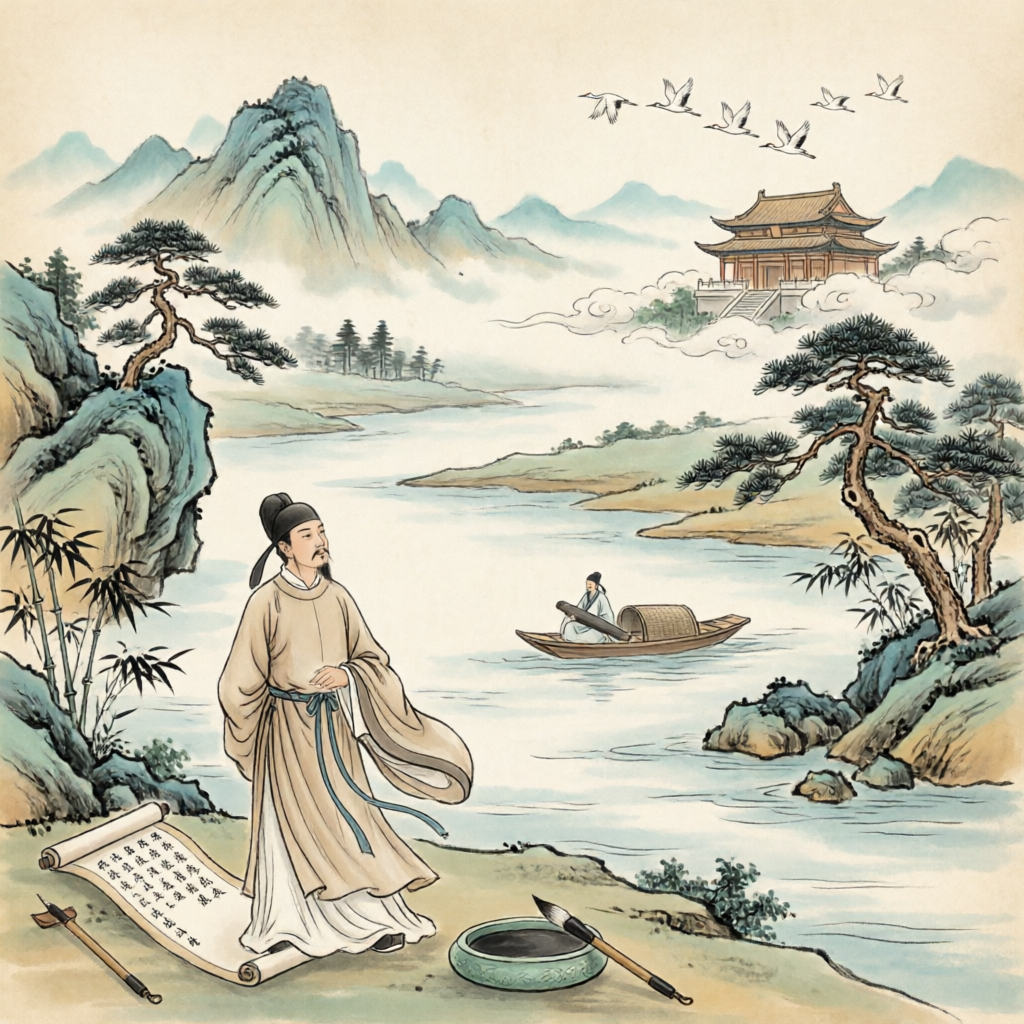
Tang Poetry
Overview
Tang poetry (唐诗) refers to poetry created during the Tang Dynasty (618-907 CE), widely regarded as the pinnacle of Chinese poetic achievement. This period produced an extraordinary body of work that continues to influence Chinese literature and culture. Tang poetry encompasses various forms including ancient-style poetry (古体诗) and regulated verse (近体诗), with distinct characteristics that evolved across different periods of the dynasty.
History
Early Tang Period
The Early Tang period (618-712) marked the preparation phase for Tang poetry's flourishing. This era featured the "Four Paragons of the Early Tang" (初唐四杰) - Wang Bo, Yang Jiong, Lu Zhaolin, and Luo Binwang - who began to transform the ornate and delicate court poetry of the preceding dynasties. Their works introduced more vigorous emotions and broader themes.
Chen Zi'ang emerged as a pivotal figure who theoretically criticized the weak poetic style of the Southern Dynasties, advocating for a return to the "Han-Wei style" (汉魏风骨). His thirty-eight "Ganyu" poems embodied this approach, significantly influencing Tang poetry's development. Shen Quanqi and Song Zhiwen made substantial contributions to poetic meter, helping to finalize the "regulated verse" (近体诗) form.
High Tang Period
The High Tang period (712-766) represents the zenith of Tang poetry, coinciding with the "Kaiyuan Prosperity" (开元盛世) when the Tang Empire reached its peak of power and cultural achievement. This era produced the most celebrated poets in Chinese literary history, including Li Bai and Du Fu, alongside prominent representatives of the pastoral poetry school (Wang Wei, Meng Haoran) and the frontier poetry school (Gao Shi, Cen Shen).
Mid Tang Period
The Mid Tang period (766-835) initially experienced a decline before reviving later. The latter half saw the emergence of the "New Yuefu Poetry" (新乐府诗) led by Bai Juyi and Yuan Zhen, who advocated for poetry that addressed contemporary social issues. Bai Juyi's principle that "articles should be written for the times and poems for specific events" (文章合为时而著,歌诗合为事而作) guided much of this period's poetry.
Late Tang Period
The Late Tang period (835-907) is characterized by a "sunset radiance" (夕阳返照) aesthetic. Notable poets included Wen Tingyun, Li Shangyin, Du Mu, and Wei Zhuang. Li Shangyin and Du Mu are collectively known as the "Little Li and Du" (小李杜) to distinguish them from the earlier masters.
Key Information
| Characteristic | Description |
|---|---|
| Time Period | Tang Dynasty (618-907 CE) |
| Major Forms | Ancient-style poetry (古体诗), Regulated verse (近体诗) |
| Sub-forms | Five-character ancient, Seven-character ancient, Five-character quatrain, Seven-character quatrain, Five-character regulated verse, Seven-character regulated verse |
| Major Schools | Pastoral poetry, Frontier poetry, Romantic poetry, Realist poetry |
| Notable Poets | Li Bai, Du Fu, Wang Wei, Meng Haoran, Bai Juyi, Li Shangyin |
Cultural Significance
Tang poetry holds profound cultural significance in Chinese literary tradition. It not only inherited and developed earlier poetic forms but created new ones, particularly the regulated verse system. The Tang poetic tradition established aesthetic standards that influenced subsequent Chinese literature for centuries.
The various poetic schools reflected the era's diverse intellectual and cultural currents. The pastoral poetry of Wang Wei and Meng Haoran, for instance, embodied the integration of Buddhism, Taoism, and nature appreciation, while the frontier poetry of Gao Shi and Cen Shen captured the era's military expansion and cultural exchanges.
Tang poetry also developed a sophisticated system of poetic titles and nicknames that reflected each poet's distinctive style and contribution to the literary tradition. These titles, such as "Poet Immortal" (诗仙) for Li Bai and "Poet Sage" (诗圣) for Du Fu, became enduring cultural references.
Modern Status
Today, Tang poetry remains a vital part of Chinese cultural identity and education. Classical poetry, particularly Tang works, continues to be memorized and studied in Chinese schools, forming an essential component of literary education.
Internationally, Tang poetry has been widely translated and studied, contributing to global appreciation of Chinese literature. Poets like Li Bai and Du Fu have achieved recognition beyond Chinese-speaking contexts, with translations available in numerous languages.
Contemporary Chinese poets and writers continue to draw inspiration from Tang poetry's formal achievements and thematic depth. The regulated verse system, in particular, influences modern Chinese poetic experiments that balance tradition with innovation.
References
-
Owen, Stephen. "The Great Age of Chinese Poetry: The High Tang." Yale University Press, 1981.
-
Burton, Richard. "The Poetry of the T'ang Dynasty." Penguin Classics, 1973.
-
Cooper, J.H. "The Art of Chinese Poetry: An Anthology of Verse from the Tang Dynasty." Everyman's Library, 1998.
-
Mair, Victor H. "The Columbia Anthology of Traditional Chinese Literature." Columbia University Press, 1994.