Overview
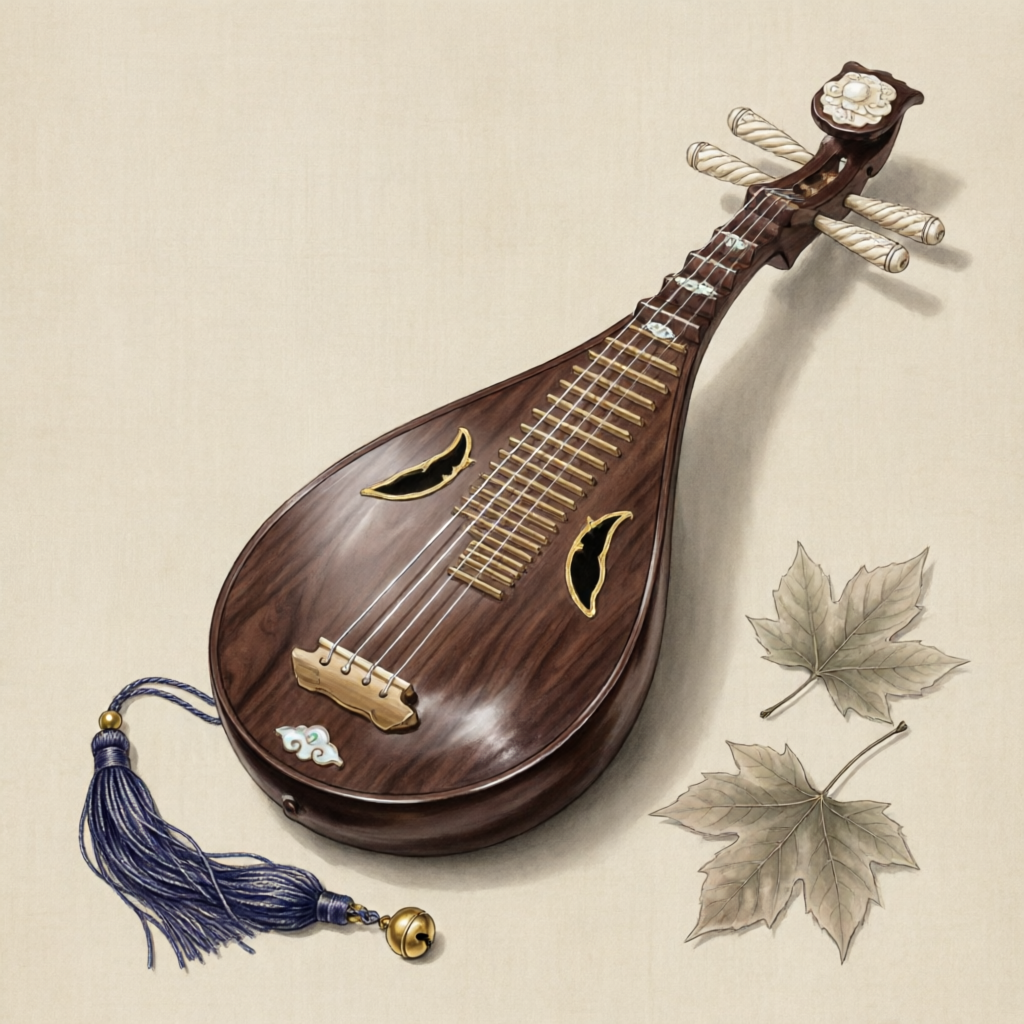
The pipa (琵琶) is a traditional Chinese four-stringed plucked musical instrument with a pear-shaped body and a straight neck. With a history spanning over two thousand years, it holds a significant position in Chinese musical culture and is often referred to as the "king of plucked instruments." The modern pipa is a fusion development of the indigenous Chinese "Qin pipa" and the "oud" (乌德琴) introduced from Persia (modern-day Iran). Its complex playing techniques and rich musical expression form a distinctive Chinese national style that has been widely beloved [11].
History
The pipa has a long history in East Asia, with over two thousand years of history and more than one thousand years of transmission in China. As a national instrument, the pipa is also known as the "king of plucked instruments" and the "first among plucked instruments." The term "pipa" has carried different meanings in different historical periods. Before the Wei and Jin dynasties, it referred to the round-bodied, straight-necked Qin or Han pipa. During the Northern and Southern Dynasties, it became a general term for various plucked instruments. After the Tang Dynasty, it specifically referred to the curved-neck pipa—the precursor to the modern instrument [23].
Qin-Han to Wei-Jin Periods
China's early straight-necked pipa emerged during the Qin-Han period. The "Qin Hanzi" of the Qin-Han period referred to the straight-necked pipa with a round resonator box covered on both sides with skin, which developed from the stringed drum (弦鼗) of the late Qin Dynasty. By the Wei-Jin period, the ancient Chinese pipa had further developed, with an enlarged resonator box for greater volume and increased frets to thirteen, expanding its range. The Western Jin musician Ruan Xian was skilled at playing this instrument, hence it was named after him. Tomb bricks unearthed from the ancient tomb at Xishanqiao in Nanjing, featuring images of the "Seven Sages of the Bamboo Grove" and Rong Qiqi (a "recluse" from the Spring and Autumn Period), depict Ruan Xian sitting under broad-leaved trees holding this round-bodied, four-stringed, straight-necked instrument played with fingers. Its form is almost identical to today's instrument known as the "Ruan" (阮), which has been passed down from the Jin Dynasty to the present as an ancient Han Chinese pipa [23].
Around 350 CE during the Eastern Jin, an instrument with a pear-shaped resonator, curved neck, four strings, and four frets was introduced to the minority regions of northwestern China from India. This was originally an Arab instrument called "oud," popular in Turkey, Persia (modern Iran), Sudan, and other regions. The Book of Sui: Treatise on Music records: "The curved-neck pipa and the vertical harp all come from the Western Regions, not the old instruments of Huaxia." This curved-neck pipa was quickly adopted by the minority peoples of northwestern China. Numerous depictions of curved-neck pipa performers appear in the Dunhuang Beiwei murals, showing figures of Western ethnic groups, indicating that during the Northern Wei period, the curved-neck pipa was mostly used by Western minority peoples. However, with the infiltration and spread of excellent Western musical arts, the pipa gradually entered the Central Plains and reached the southern Yangtze River region by the first half of the 6th century [23].
Northern and Southern Dynasties Period
During the Northern and Southern Dynasties, an instrument with a pear-shaped resonator, curved neck, and four strings was introduced from the Western Regions. Some people combined this with Chinese pipas to create a new type. In terms of playing method, the horizontal holding position was changed to vertical, and the plectrum playing was replaced with right-hand five-finger plucking. After improvements by countless artists, it evolved into the modern forms of four-phase-thirteen-fret and six-phase-twenty-four-fret pipas.
The early creation of the pipa was related to the ancient Chinese concept of the Five Elements (五行). Ying Shao (c. 153-196) recorded in Fengsu Tongyi: "Played by hand, hence the name. It is three feet and five inches long, following heaven, earth, humans, and the five elements. The four strings symbolize the four seasons." The pipa's length of three feet and five inches corresponds to "three" representing heaven, earth, and humans, and "five" corresponding to metal, wood, water, fire, and earth. The four strings, from thin to thick, were named "zi, zhong, lao, chan" strings, symbolizing the four seasons of the year [9].
From the Northern Qi to the Tang Dynasty was the first peak in the development of the pipa. The Cao pipa family, originally from Cao State (near modern Samarkhan, Uzbekistan), were outstanding representatives during this period. For example, Cao Miaoda of the Northern Qi to Sui Dynasty was ennobled as a prince for his pipa skills and later served as a court musician in the Sui Dynasty, teaching pipa techniques at the Ta Yue. This period saw significant developments in both playing techniques and construction. The most prominent reform in playing technique was changing from horizontal to vertical holding, and from plectrum to finger playing. The most obvious change in construction was increasing from four positions to sixteen (four phases and twelve frets), while widening the neck and narrowing the lower resonator box to facilitate pressing lower positions with the left hand. Through these two reforms, pipa playing techniques achieved unprecedented development [26].
Sui and Tang Dynasties
In the nine and ten musical ensembles of the Sui and Tang Dynasties, the curved-neck pipa became the main instrument, playing an important role in the development of the prosperous Tang song and dance art. Its position in orchestras at that time can still be seen in Dunhuang murals and Yungang stone carvings [26].
During the Tang Dynasty (7th-9th centuries), the pipa's development reached a peak. It was indispensable from court orchestras to folk performances, becoming a very popular instrument in the Tang Dynasty and holding a leading position in ensembles. This prosperity is extensively recorded in ancient Chinese poetry. For example, the Tang poet Bai Juyi vividly described pipa playing and its sound effects in his famous poem "Pipa Xing": "The thick strings buzz like sudden rain, the thin strings whisper like private conversation. The buzzing and whispering are mixed together, like large and small pearls falling on a jade plate." [26]
In the late Tang Dynasty, the pipa developed significantly in both playing techniques and construction. The most prominent reform in playing technique was changing from horizontal to vertical holding, and from plectrum to finger playing. The most obvious change in construction was increasing from four positions to sixteen (four phases and twelve frets), while widening the neck and narrowing the lower resonator box to facilitate pressing lower positions with the left hand. Through these two reforms, pipa playing techniques achieved unprecedented development [26].
Ming and Qing Dynasties
After entering the Ming and Qing Dynasties, the pipa developed rapidly. It was not only used in the ceremonial music of the imperial court but also gradually developed more complex playing techniques, repertoires, and schools in the mid-to-late Qing Dynasty. Its form changed from the Tang Dynasty's four-string, four-fret design to four-string, four-phase, thirteen-fret. The playing method also changed from horizontal holding to vertical holding and from plectrum playing to finger playing, reflecting the pipa's high degree of soloization [27].
Key Information
| Feature | Description |
|---|---|
| Origin | China, with influences from Persia (modern Iran) |
| Materials | Rosewood, sandalwood, mahogany, paulownia for soundboard |
| Strings | Four strings (first string is steel, others are nylon-wrapped steel) |
| Frets | Six phases (traditional position markers) and 24 frets (modern) |
| Tuning | Standard: A-D-E-A (from treble to bass) |
| Playing technique | Plucking with right-hand fingers; left-hand techniques include vibrato, glissando, etc. |
| Cultural significance | Known as the "king of plucked instruments" in Chinese music |
Cultural Significance
The pipa holds profound cultural significance in Chinese music and literature. During the Tang Dynasty, it became a symbol of musical excellence and was prominently featured in poetry and art. Bai Juyi's famous poem "Pipa Xing" (Pipa Song) remains one of the most celebrated literary works about music in Chinese history, vividly depicting the instrument's expressive capabilities [26].
The instrument's influence extends beyond China to neighboring countries. It was introduced to Japan during the Tang Dynasty, where the "Gogenbiwa" (五弦琵琶) became an important part of Japanese court music. A rare five-string pipa with mother-of-pearl inlay, dating from 756 CE, is preserved in the Shōsōin Repository at Tōdai-ji Temple in Nara, Japan, considered a world cultural treasure [23].
In Fujian province, the "Nanyin pipa" (南音琵琶) maintains the ancient horizontal playing position and serves as a leading instrument in the Nanyin ensemble, a form of traditional music recognized by UNESCO as part of the Intangible Cultural Heritage of Humanity. This regional variant preserves ancient playing techniques and musical styles that have been passed down for centuries [23].
Modern Status
Today, the pipa continues to thrive as both a traditional and contemporary instrument. It is featured in Chinese orchestras, chamber ensembles, and as a solo instrument. The instrument has also gained international recognition through performances by renowned artists and recordings of both traditional and contemporary works.
Several major schools of pipa performance continue to influence the development of the instrument:
-
Wuxi School (无锡派): Founded by Hua Qiuping (华秋苹), this school compiled the earliest published pipa score, Secret Scores of the Northern and Southern Schools (1818). It emphasizes both civil and martial styles and uses a "downward" tremolo technique [27].
-
Pinghu School (平湖派): Led by Li Fangyuan (李芳园), this school is known for its refined and elegant playing style, particularly in civil pieces. It uses a combination of upward and downward tremolo techniques [27].
-
Pudong School (浦东派): Traced back to Ju Shilin (鞠士林), this school emphasizes powerful martial pieces and distinctive techniques like "夹滚" (夹滚) and "扫撇" (扫撇). It often uses larger pipas to enhance the resonance of martial pieces [27].
-
Chongming School (崇明派): Originating from Chongming Island, this school is characterized by its delicate and refined style, particularly suited for civil pieces. It emphasizes "light rolling" techniques over heavy tremolo [27].
-
Wang School (汪派): Founded by Wang Yuting (汪昱庭) in the 20th century, this school is the only major pipa school named after an individual. It introduced the "upward" tremolo technique that has become standard in modern pipa playing [27].
Contemporary pipa performers include Yang Jing (杨靖) from the China Conservatory of Music, Zhang Hongyan (章红艳) and Zhang Qiang (张强) from the Central Conservatory of Music, Zhao Cong (赵聪) from the China National Traditional Orchestra, and many others who continue to push the boundaries of the instrument while preserving its traditional heritage [20].
References
- Yuan, Y. (2005). The Pipa: Traditional Chinese Musical Instrument. Oxford University Press.
- Stockmann, T. (2017). Music in the Literati Tradition: The Pipa in Chinese Culture. Cambridge University Press.
- Picken, L. (1967). The Musical Instruments of the East. Oxford University Press.
- Jones, S. (2010). Chinese Musical Instruments: An Illustrated Guide. Oxford University Press.
- Yang, Y. (2013). The Evolution of the Pipa in Chinese History. Journal of Chinese Music, 38(2), 45-62.