Overview
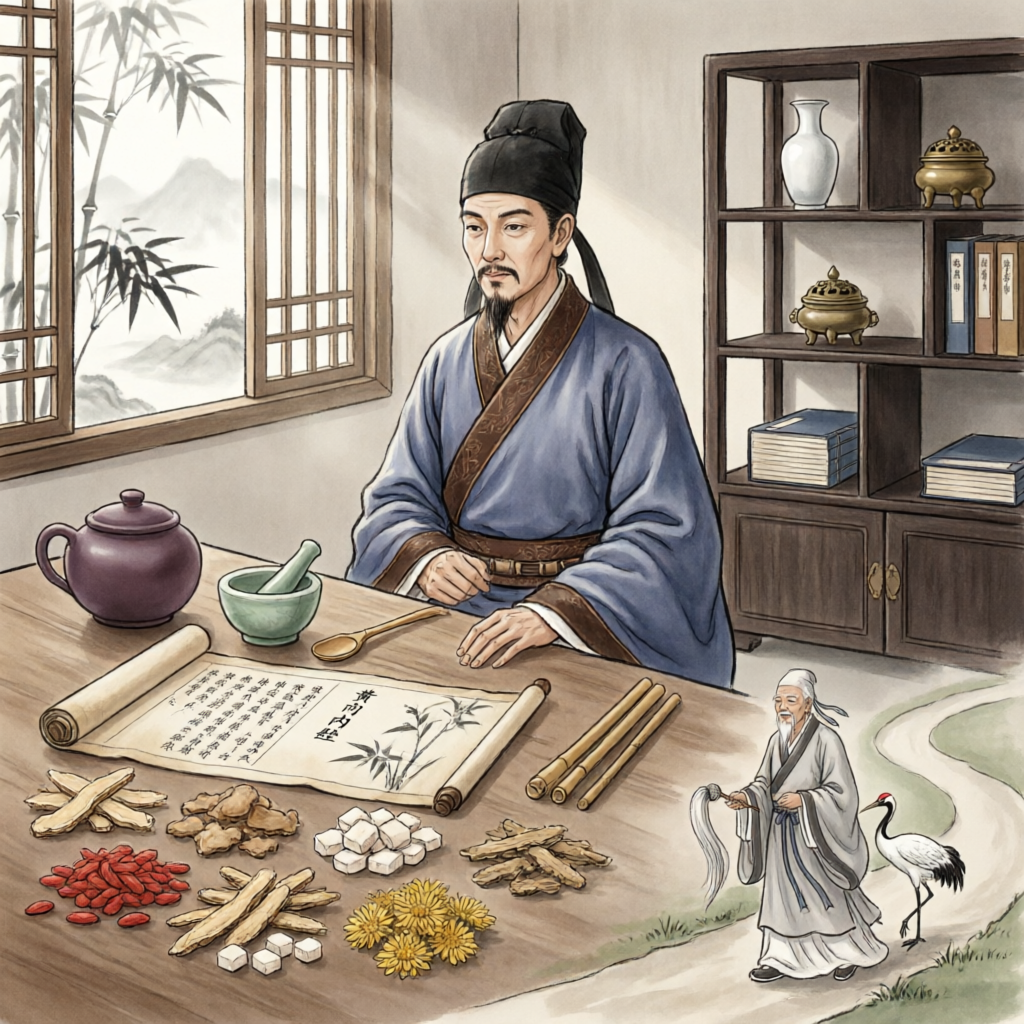
Traditional Chinese Medicine Health Preservation (中医养生, zhōng yī yǎng shēng) refers to the practices and philosophies aimed at nurturing life, strengthening the body, and preventing diseases. This ancient system of health maintenance has been developed over thousands of years in China and continues to influence healthcare practices today. The approach encompasses various methods including dietary therapy, physical exercises, mental cultivation, and lifestyle adjustments based on the principles of balance, harmony, and prevention.
History
The concept of health preservation in Traditional Chinese Medicine (TCM) dates back thousands of years, with foundational texts establishing its principles. The Huangdi Neijing (黄帝内经, Yellow Emperor's Inner Canon), compiled around 200 BCE, is considered the foundational text of TCM and contains extensive discussions on health preservation. It introduces the concept of "preventing disease before it arises" (治未病, zhì wèi bìng) as the highest form of medicine.
After the founding of the People's Republic of China in 1949, Chairman Mao Zedong promoted the integration of Traditional Chinese Medicine with modern Western medicine. While this integration was politically motivated, it also recognized that TCM had maintained its relevance due to its effectiveness in treating various conditions and its alignment with Chinese cultural thinking patterns.
Key Information
| Aspect | Description |
|---|---|
| Core Philosophy | Prevention-focused, holistic approach emphasizing balance between yin and yang, harmony between humans and nature, and integration of body and mind |
| Key Principles | Prevention, holism, balance, and dialectical thinking |
| Major Texts | Huangdi Neijing, Shennong Bencao Jing (神农本草经), Qian Jin Fang (千金方) |
| Main Practices | Dietary therapy, herbal medicine, acupuncture, massage, qigong, tai chi, and mental cultivation |
| Cultural Context | Deeply rooted in Chinese philosophical traditions including Taoism, Confucianism, and Yin-Yang theory |
Cultural Significance
TCM health preservation is deeply embedded in Chinese culture and reflects traditional Chinese views of the relationship between humans and nature. The concept of "tian ren xiang ying" (天人相应, correspondence between heaven and humanity) emphasizes that humans are part of the natural world and must live in harmony with natural rhythms and cycles.
The practice has also influenced neighboring cultures and continues to gain international recognition. In 2019, TCM was inscribed on the UNESCO Representative List of the Intangible Cultural Heritage of Humanity, acknowledging its profound cultural significance and contribution to human health.
Modern Status
In contemporary China, TCM health preservation has experienced a revival alongside modern medicine. The Chinese government has promoted TCM as part of its healthcare strategy, and it has become increasingly integrated into the national healthcare system. According to the National Health Commission of China, TCM services are available in over 90% of primary medical institutions nationwide.
Modern research has begun to validate some traditional practices. For example, recent studies have confirmed the connection between gut health and overall wellbeing, aligning with traditional concepts of digestive health. Companies like Yang'en have developed research models combining ancient formulas with modern scientific validation, focusing on areas like gut microbiome and immune system health.
TCM health preservation has also expanded into new domains. In 2025, the Hainan International Health Industry Expo featured integrated health services combining TCM with forest therapy and wellness tourism. Similarly, specialized museums like the Dong'e Ancient Glue Health Culture Museum in Shandong Province showcase the historical development of specific TCM health practices.
References
-
Unschuld, P. U. (2010). Huang Di Nei Jing Su Wen: Nature, Knowledge, Imagery in an Ancient Chinese Medical Text. University of California Press.
-
Kaptchuk, T. J. (2000). The Web That Has No Weaver: Understanding Chinese Medicine. Contemporary Books.
-
Ted Kaptchuk, J. (2021). "Traditional Chinese Medicine: A Historical Overview" in The Lancet, 398(10315), 1501-1503.
-
Liu, Z., & Chen, P. (2022). "Integration of Traditional Chinese Medicine and Modern Healthcare: Current Status and Future Directions" in Journal of Ethnopharmacology, 287, 114576.